 Everett
 What LP SmartSide Actually Is
LP SmartSide is an engineered wood siding product — strands of wood fiber bonded with resin under heat and pressure, then treated with a zinc borate solution for insect and moisture resistance, and finished with a factory primer or pre-finished coating. It comes in lap boards, panels, trim, and soffit, and it installs a lot like traditional wood siding: nail it up, caulk the joints, paint or top-coat it, and maintain the finish over time.
It's a legitimate product with a real place in the market. It's lighter than fiber cement, easier on saw blades and installer backs, and it holds a fastener similarly to real wood. Homeowners on a tighter budget, or contractors who want a wood look without milling actual cedar, often land on LP SmartSide for good reason. We're not here to tell you it's junk — it isn't. We're here to explain why, as a company that installs siding for a living in Snohomish County, we don't put our name behind it.
Where LP SmartSide Performs Reasonably Well
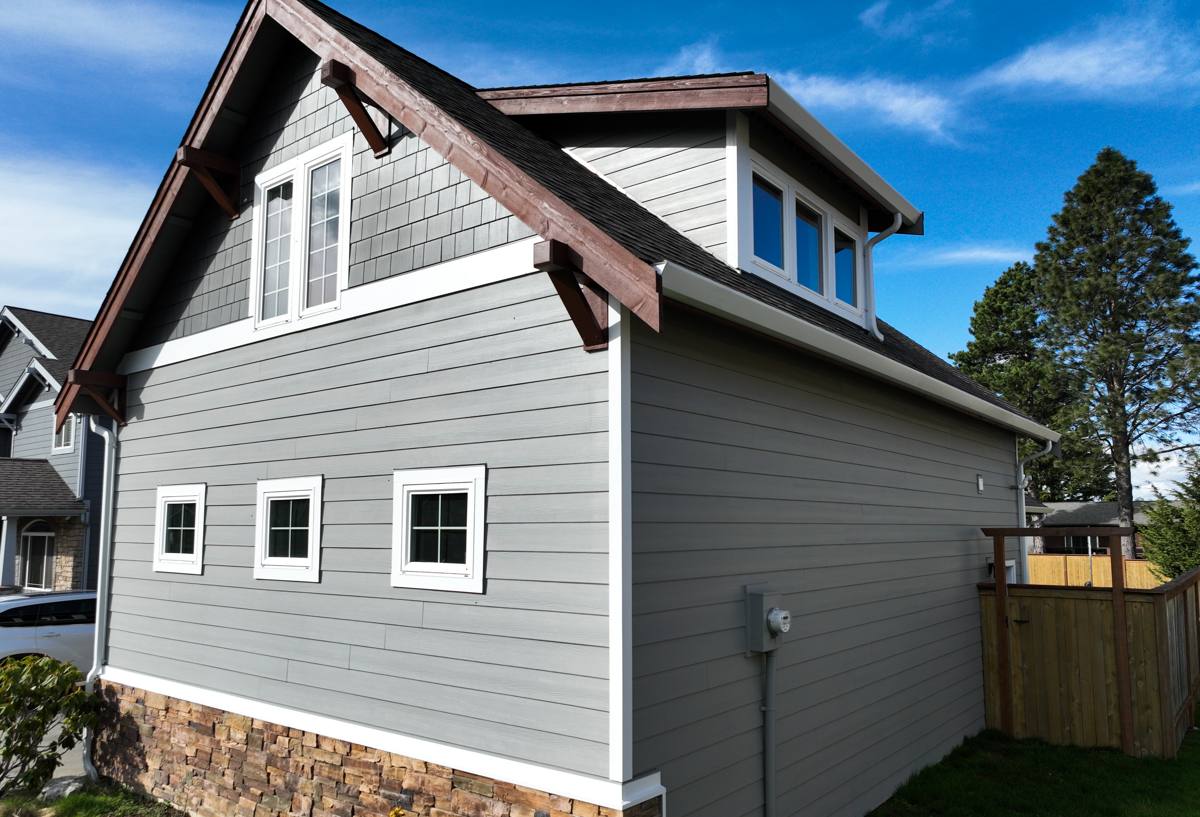
Give credit where it's due. LP SmartSide holds paint well when the finish is intact, it's more impact-resistant than vinyl, and it gives a traditional lap-siding look at a lower material cost than fiber cement. In drier climates, or on homes where the finish gets inspected and refreshed on schedule, it can hold up for a long service life. The engineering that goes into the strand-and-resin substrate and the zinc borate treatment is genuinely an improvement over the older generation of wood composite siding products from decades past.
What it gets right
- Lighter weight — easier to handle on tall walls and gables
- Good fastener holding power, similar to solid wood
- Accepts paint and stain-matched finishes well when intact
- Lower upfront material cost than fiber cement in most markets
- Insect and fungal resistance built into the substrate treatment
Where the Trade-Offs Show Up
Every siding product is a wood-based, cement-based, or plastic-based system, and every system has a weak point. For LP SmartSide, the weak point is the same one that faces any engineered-wood product: the substrate is still wood fiber, and wood fiber swells, checks, and eventually breaks down if water gets past the finish and stays there.
The factory finish and field caulking aren't decoration — they're the entire moisture defense. As long as that seal is intact, the product performs as designed. The problem is that seals don't stay perfect forever. Cut ends at corners, butt joints, and penetrations for hose bibs, vents, and light fixtures all need field-applied sealant and touch-up coating done correctly and re-inspected on a schedule. Miss a spot, let a caulk joint crack and go unnoticed for a season or two, and that's where moisture gets a foothold in a wood-fiber panel.
What this means for a homeowner day to day
- Cut edges must be field-sealed at install — a step that's easy to shortcut and hard to inspect afterward
- Caulk joints need periodic re-inspection and renewal, not a one-time install-and-forget
- Warranty coverage is typically tied to documented maintenance — skip it and coverage can be reduced or voided
- Once moisture gets behind the finish, the strand substrate doesn't dry out and recover the way solid dimensional lumber sometimes can
None of that makes LP SmartSide a bad product when installed and maintained exactly to spec. It does make it a product whose long-term performance depends heavily on ongoing homeowner maintenance and installer discipline — two variables we don't want standing between a customer and a 30-year siding job.
Why This Matters More in Everett Than It Would Inland
Snohomish County isn't a gentle climate for exterior wood products. Everett sits close enough to Puget Sound that salt-laden air reaches exterior surfaces on a lot of homes, especially anything with a water view or west-facing exposure. Salt air accelerates finish breakdown and corrodes fasteners faster than it would fifty miles inland. Layer on our driving winter rain — often blowing sideways off the Sound for days at a stretch — and any gap in a caulk joint or finish coat gets tested constantly, not occasionally.
Then there's moss. Everett's long, mild, wet stretch from October through May is exactly the environment moss and algae favor, and they'll colonize any siding surface that stays damp and shaded — north walls, areas under tree cover, spots that don't get afternoon sun. Moss holds moisture against the surface it's growing on. On a fiber-cement product that's a cosmetic issue you wash off. On a wood-fiber substrate, prolonged damp contact next to a compromised finish is exactly the failure mode the product is most vulnerable to.
We're not saying LP SmartSide can't be installed correctly here. It can. We're saying that in a marine climate with this much rain volume and this long a moss season, the margin for maintenance lapses gets thinner, and the consequences of a missed caulk joint show up faster than they would in Spokane or Boise.
LP SmartSide vs. James Hardie Fiber Cement
| Factor | LP SmartSide | James Hardie Fiber Cement |
|---|---|---|
| Base material | Wood strand/resin composite | Cement, sand, and cellulose fiber |
| Combustibility | Combustible (wood-based) | Non-combustible |
| Moisture behavior | Performance depends on intact finish/caulk | Doesn't rot or support fungal growth |
| Factory finish | Primed or coated; field paint/caulk maintenance expected | ColorPlus baked-on finish, separately warranted |
| Climate engineering | Standard product line | Regional HZ formulations for wind/moisture exposure |
| Insect resistance | Zinc borate treated | Naturally resistant (cement-based) |
| Weight/handling | Lighter, easier to cut and handle | Heavier, requires fiber-cement blades and tools |
| Typical warranty structure | Maintenance-dependent, often prorated | Long-term transferable warranty |
Why We Standardized on James Hardie
We stopped installing wood-based and composite siding products, including LP SmartSide, because we wanted one system where the long-term outcome doesn't hinge on how well a homeowner keeps up with caulk and paint touch-ups five, ten, and twenty years down the road. Fiber cement is our answer to that.
Hardie's board is non-combustible, which matters to us and to insurers. It doesn't have a wood substrate that can swell or support rot if a seal fails. The ColorPlus factory finish is baked on and covered by its own warranty separate from the substrate, so the color and the material aren't relying on a single field-applied coat to do all the work. Hardie also engineers specific HZ product formulations for different climate zones — including the wet, moderate-humidity Pacific Northwest — rather than shipping one formulation everywhere. And the warranty on the product itself is a strong, transferable one that isn't built around a homeowner maintenance checklist the way engineered wood products often are.
That's the trade we make for our customers: a material cost that's higher than LP SmartSide, in exchange for a siding system whose performance in an Everett winter doesn't depend on catching every hairline caulk crack before the rain finds it.
What Correct Installation Looks Like, Whatever You Choose
If you're getting bids and some of them include LP SmartSide or another engineered wood product, installation quality matters more than usual. Ask specifically how cut ends will be field-sealed, what caulk product is being used and its expected service life, and whether the crew is following the manufacturer's documented installation instructions to the letter — because warranty claims on these products are frequently denied over installation details, not material defects.
Questions worth asking any contractor bidding wood or composite siding
- Will every cut end be sealed on-site, and with what product?
- What's the manufacturer's minimum clearance from grade, decks, and roof lines?
- Who is responsible for warranty registration, and what maintenance keeps it valid?
- What happens to trim, fascia, and soffit — are they the same product or something else?
- Is the crew factory-trained or certified on this specific product line?
Our Bottom Line
LP SmartSide isn't a scam or a product we think should be avoided everywhere. It's a reasonable choice for some homes in some climates, installed by a crew that treats the sealing details as seriously as the manufacturer's instructions require. We just don't think it's the right long-term bet for homes exposed to Everett's combination of salt air, sustained driving rain, and a moss season that runs most of the year — and we'd rather not sell a product whose 30-year performance depends on maintenance we can't control after we leave the job site.
If you're weighing siding options for a home in Everett or anywhere else in Snohomish County, we're happy to walk your specific house, point out the exposures that matter most, and give you a straight answer on what we'd install and why. Reach out for a free, no-pressure estimate — no obligation, just a clear look at your options.