 Everett
 Siding in West Everett: Built for the Real Conditions Here
West Everett sits close enough to Port Gardner Bay and the broader Puget Sound shoreline that homes in the area deal with a specific combination of weather stress that inland Snohomish County neighborhoods don't see nearly as much: salt-tinged air rolling off the water, wind-driven rain that hits siding at an angle instead of straight down, and long stretches of gray, damp months that keep exterior surfaces wet for days at a time. None of that is exotic or unusual for western Washington, but it does mean the siding on a West Everett home is working harder than siding on a similar house forty miles east of the Cascades foothills.
We install and repair siding, roofing, windows, and decks throughout Everett and the surrounding Snohomish County area, and West Everett is a neighborhood we're in regularly. This page walks through what that climate actually does to exterior materials, how we approach siding work for homes here, and why we've standardized on one siding product instead of offering the usual lineup of options.
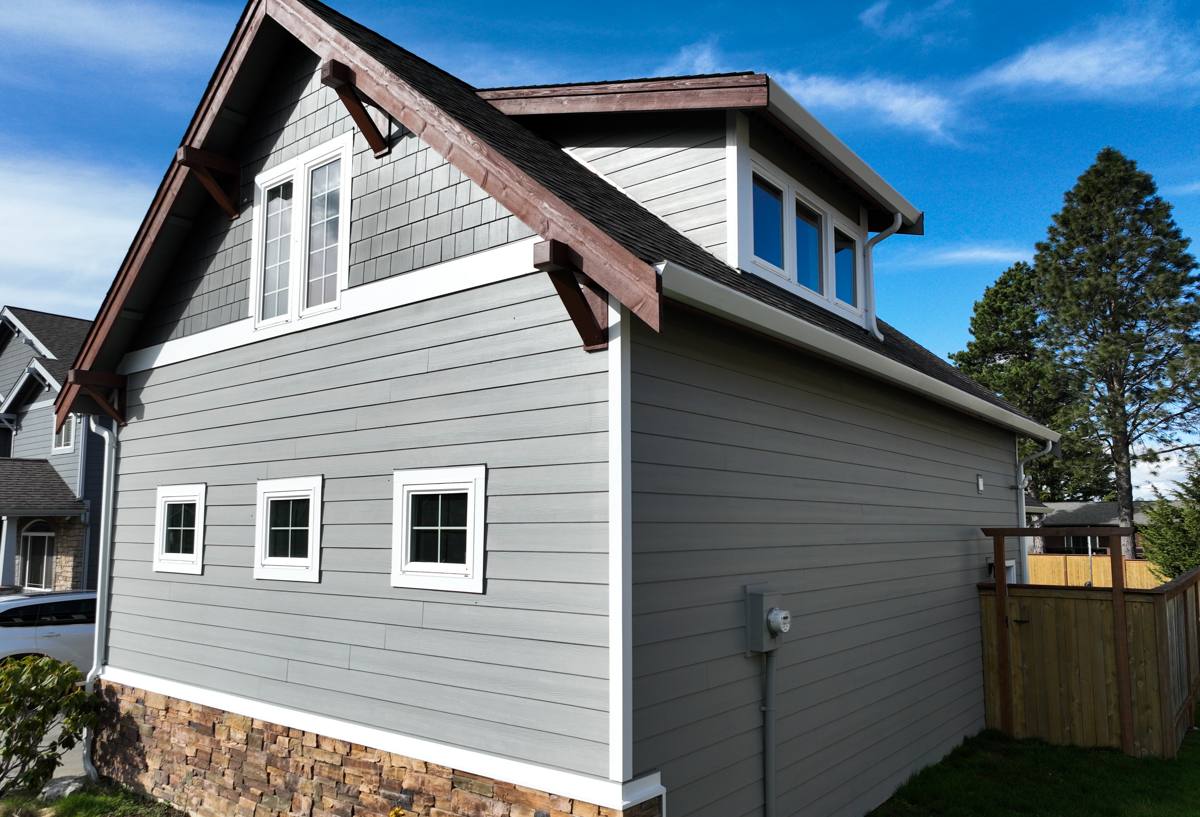
What Salt Air, Driving Rain, and Moss Actually Do to a House
Salt Air and Metal Fasteners
Proximity to saltwater doesn't just mean occasional corrosion on a bike rack or a car's undercarriage. Airborne salt accelerates the breakdown of unprotected or poorly coated metal fasteners, flashing, and trim. Over years, that can mean streaking, staining, and eventually fastener failure at the exact points where siding is supposed to be securely held to the wall. It's a slow process, which is part of why it's easy to overlook until it shows up as a real problem.
Driving Rain and Wall Assemblies
Wind off the Sound doesn't just add volume to a rainstorm — it changes the angle at which water hits a house. Rain that would otherwise run down a flat wall and drip off gets pushed sideways and upward into seams, laps, and trim joints. If a siding product or its installation isn't detailed to handle that kind of intrusion, water finds its way behind the cladding, and that's where rot, mold, and hidden structural damage start. This is a installation-quality issue as much as a material issue — the same siding product performs very differently depending on how carefully it was flashed, lapped, and sealed.
Moss, Mildew, and the Long Wet Season
Snohomish County's wet season runs long, and West Everett's tree cover and marine-influenced humidity give moss and mildew a lot of opportunity. Moss doesn't just look bad — it holds moisture directly against a wall surface for extended periods, which is exactly the condition that causes organic materials to swell, rot, or delaminate. Siding that can shrug off constant moisture contact without warping or absorbing water is a real practical advantage here, not a marketing point.
Why We Install Only James Hardie Fiber Cement Siding
We made a deliberate decision to stop offering the full menu of siding materials — no vinyl, no LP SmartSide, no Cemplank, no Allura, no primed spruce or cedar — and install James Hardie fiber cement exclusively. That's not a marketing gimmick; it's a standard we set after weighing how each of those products actually holds up against the kind of weather West Everett homes face, versus the trade-offs each one carries.
Fiber Cement vs. the Alternatives
| Material | How It Handles Sustained Moisture | Where It Falls Short Here |
|---|---|---|
| Vinyl siding | Doesn't absorb water, but seams and laps can let wind-driven rain behind panels | Can warp or crack in temperature swings; fades and becomes brittle over time; limited fire resistance |
| LP SmartSide (engineered wood) | Resists moisture better than raw wood, but is still wood-based | Edges and cut ends are vulnerable if not sealed and maintained meticulously |
| Primed spruce / cedar | Natural wood absorbs moisture readily | High maintenance burden — repainting, caulking, and moisture monitoring are ongoing, not one-time |
| Cemplank / Allura (other fiber cement) | Similar base material to Hardie | We standardized on one manufacturer, one warranty structure, and one factory-finish system so every job we do meets the same spec |
| James Hardie fiber cement | Engineered specifically for moisture, doesn't rot, resists moss and mildew growth on the surface | Requires correct installation (fastener pattern, clearances, flashing) to perform to spec — which is why installation quality matters as much as the product |
To be fair to the alternatives: vinyl is inexpensive and low-maintenance in mild climates, engineered wood products have improved significantly over older wood siding, and cedar has genuine aesthetic appeal that some homeowners specifically want. Those aren't bad products in every context. But for the specific combination of salt exposure, driving rain, and a long moss season that West Everett homes face, we found the maintenance burden, moisture vulnerability, or installation sensitivity of those alternatives added up to more risk and more long-term homeowner cost than we were willing to sign our name to.
What James Hardie Gets Right
James Hardie fiber cement is non-combustible, which matters given wildfire smoke and ember exposure has become a more regular late-summer concern even west of the mountains. It's engineered from cement, sand, and cellulose fibers, so it doesn't rot, and it resists pest damage that affects wood-based products. Hardie's ColorPlus factory-applied finish is baked on in a controlled environment rather than field-painted, which gives more consistent coverage and a longer service life before repainting is needed — a real advantage in a climate where wet weather limits the number of good painting days each year anyway.
Hardie Product Lines for Marine and Wet-Climate Regions
James Hardie makes climate-engineered product lines, and for a coastal-influenced area like West Everett, the HZ5 line is formulated for exactly this kind of wetter, cooler climate zone. It's manufactured with the moisture behavior of the Pacific Northwest in mind rather than being a generic national product. We select the specific Hardie product — lap siding, board and batten, shingle-style panels, or trim — based on the home's architecture and exposure, but the underlying material spec stays consistent with what this region's weather actually demands.
Warranty Considerations
James Hardie backs its ColorPlus finished products with a manufacturer's finish warranty and a separate product warranty, both of which are transferable to a subsequent homeowner within the specified terms — something worth knowing if you're planning to sell in the coming years. We install to the manufacturer's specifications specifically because doing so is what keeps that warranty coverage intact; installation errors are one of the most common reasons a warranty claim gets denied industry-wide, regardless of which siding product is involved.
How a Siding Project Works for a West Everett Home
Assessment and Planning
We start with an on-site look at the existing siding, the condition of the sheathing and moisture barrier underneath where accessible, and the specific exposure your home faces — a wall that takes the brunt of southwest storms needs different attention at seams and flashing than a more sheltered elevation.
Installation Details That Matter in This Climate
- Proper rain-screen or drainage plane behind the siding so any incidental moisture has somewhere to go
- Correct fastener type, spacing, and depth per Hardie's installation instructions — corrosion-resistant fasteners matter more here given salt air exposure
- Flashing at every window, door, and roofline intersection, since these are the highest-risk points for wind-driven rain intrusion
- Proper clearance between siding and grade, decks, and roof lines to prevent standing moisture contact
- Caulking and sealant only where the manufacturer specifies it — over-caulking can trap moisture just as easily as under-caulking lets it in
Timeline and What to Expect
Most single-family siding replacements take one to two weeks depending on home size, weather windows, and whether trim, window flashing, or sheathing repair is needed underneath. Snohomish County's wet season can extend timelines, which is part of why we plan installation windows around realistic weather rather than optimistic ones.
Roofing, Windows, and Decks: The Rest of the Building Envelope
Siding doesn't work in isolation. A roof with failing flashing, windows with degraded seals, or a deck ledger board that's trapping moisture against the house will undermine even a perfect siding installation. Because we handle roofing, windows, and decks in addition to siding, we look at a West Everett home's exterior as one connected system rather than four separate trades. That matters most at the transition points — where a roofline meets a wall, where a window opening interrupts a siding course, or where a deck attaches to the house — since those junctions are where the majority of real-world water intrusion problems actually originate.
Signs a West Everett Home May Need Siding Attention
- Visible moss or persistent green staining on north-facing or shaded walls
- Soft spots, bubbling, or visible warping in existing siding panels
- Rust streaking below fasteners or trim pieces
- Paint that's failing faster than expected, especially on wood or engineered wood siding
- Gaps or separation at seams, corners, or window trim
- Higher-than-expected heating bills, which can indicate moisture-compromised insulation behind siding
Why a Local Crew Matters
Siding installation isn't one-size-fits-all across the country, and it isn't even one-size-fits-all across Snohomish County. A crew that works regularly in Everett and West Everett specifically understands how the marine layer, the rain patterns off the Sound, and the local moss growth season actually behave on real houses — not just what a manufacturer's spec sheet says in general terms. That local repetition is what lets a crew catch the details that matter before they become five-year problems instead of just following instructions generically.
Get a Free, No-Pressure Estimate
If you're noticing wear on your West Everett home's siding, or you're planning ahead for a project, we're glad to come take a look and walk you through what we're seeing and what your options are — no pressure, no obligation. Use the form below to request a free estimate.