 Everett
 A Neighborhood That Takes Real Weather
Delta sits inside Everett, Washington, in the part of Snohomish County where the Snohomish River, Port Gardner Bay, and Puget Sound all shape what the air is doing to a house year-round. That's not a small detail. Homes in and around this part of Everett deal with a combination most inland Washington neighborhoods don't: salt-tinged air moving off the water, driving rain that comes in sideways during the fall and winter storm months, and a moss season that, for a lot of properties here, barely takes a break. Any exterior contractor can tell you this part of the state gets a lot of rain. Fewer will tell you what that rain actually does to different siding materials over ten or twenty years, or why the answer changes depending on how close a house sits to the water, how much tree canopy shades it, and which direction its walls face.
We work on homes throughout Delta and the surrounding Everett area, and the exterior problems we get called out for tend to repeat themselves: siding that's held moisture at the bottom courses and started to swell or delaminate, moss creeping up north-facing walls and staying there most of the year, caulking and trim that's failed faster than it should have, and roofs and windows that are past due for attention but keep getting pushed off. None of that is a surprise once you understand what this specific stretch of Snohomish County puts a house through. It's also exactly why we standardized on one siding product instead of offering a menu of options with different price points and different long-term outcomes.
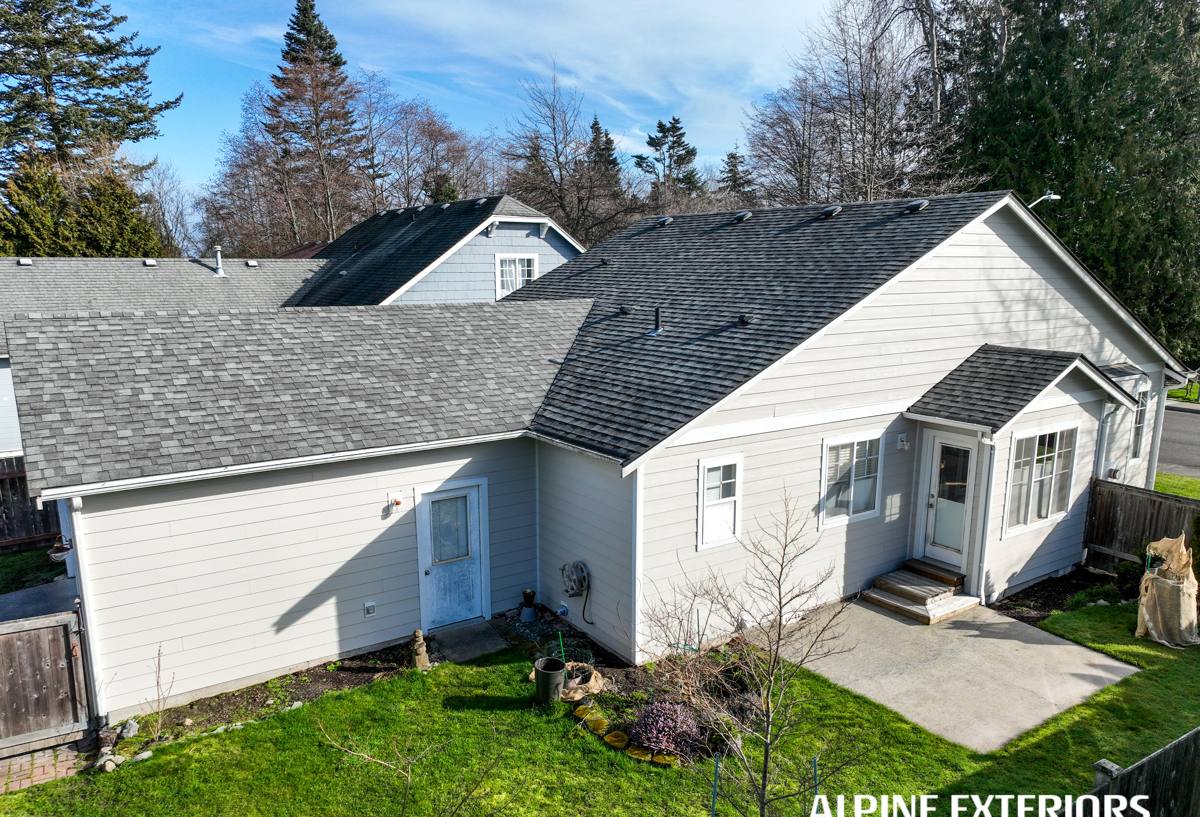
What Salt Air, Rain, and Moss Actually Do to a House
Salt-Laden Air
Proximity to Port Gardner Bay and the Snohomish River means the air moving across Delta carries more salt than it would twenty or thirty miles inland. Salt exposure accelerates corrosion on exposed metal fasteners and flashing, and it speeds up fading and chalking on lower-quality paints and coatings. It's a slow process — nobody notices it happening week to week — but over a decade it's the difference between an exterior that still looks sharp and one that looks tired and dated well before it's actually worn out structurally.
Driving, Wind-Driven Rain
Everett doesn't just get a lot of rain — a good share of it arrives sideways during fall and winter storms, which pushes water into seams, laps, and trim joints that would stay dry in a straight-down rain. That makes flashing detail, caulking quality, and the water-shedding design of the siding itself matter more here than they would in a drier or calmer climate. Materials that depend on a perfect, unbroken paint film to stay watertight are working against a tougher opponent in this neighborhood than the manufacturer's marketing usually accounts for.
A Moss Season That Doesn't Really End
Shaded walls, north-facing exposures, and lots with mature evergreen canopy — common throughout Delta and the rest of Everett — stay damp longer after every rain event, which is exactly what moss and algae need to take hold. Moss on siding isn't just a cosmetic nuisance; it holds moisture against the surface longer than bare siding would, which speeds up whatever degradation process is already happening underneath.
Why We Install James Hardie Fiber Cement — and Nothing Else
We install James Hardie fiber cement siding exclusively. We don't offer vinyl, LP SmartSide, Cemplank, Allura, or primed wood siding as alternatives, and that's a deliberate standard, not a lack of options. Every one of those products has legitimate strengths and a place in the market — this isn't about calling them bad products. It's about what happens to each of them, specifically, in a climate like Delta's over the fifteen-to-thirty-year window a homeowner actually cares about.
- Vinyl can warp and become brittle with UV and temperature cycling, and its seams and J-channels give wind-driven rain more opportunities to work behind the material over time.
- LP SmartSide is an engineered wood product, which means its long-term performance depends heavily on caulking, flashing, and paint maintenance staying ahead of moisture — a maintenance burden that's harder to keep up with in a climate this wet.
- Primed wood or cedar requires the most ongoing maintenance of any option and is the most vulnerable to the moisture and moss conditions this neighborhood produces.
- Cemplank and Allura are also fiber cement products, and reasonable alternatives in the category — we simply standardized on one manufacturer's system, finish process, and warranty structure rather than mixing suppliers.
James Hardie fiber cement is non-combustible, dimensionally stable in wet-dry cycling, and — critically for this region — available in the HZ5 formulation engineered specifically for colder, wetter climate zones like the Pacific Northwest. Its ColorPlus finish is baked on at the factory under controlled conditions, which holds color and resists the fading, chalking, and cracking that field-applied paint struggles with once salt air and constant moisture get involved. It also carries a strong transferable warranty, which matters to homeowners in Delta who may sell within the coverage window and want that protection to carry forward.
What Correct Installation Looks Like Here
Fiber cement siding performs the way it's supposed to only when it's installed to spec, and in a climate like this the installation details matter as much as the product choice. Cut edges need to be sealed. Flashing at windows, doors, and roof lines needs to actually shed water downward and outward, not just look correct from the ground. Starter strips, laps, and clearances from grade and roof lines all have to follow the manufacturer's specifications, because those clearances exist specifically to keep wind-driven rain from wicking up into the bottom of the siding.
What We Check on Every Delta Project
- Existing sheathing and framing condition once old siding comes off — moisture damage doesn't announce itself until the wall is open
- Weather-resistive barrier and flashing integration at every penetration, not just the obvious ones
- Proper fastener type and pattern for HZ5 fiber cement, matched to local wind exposure
- Clearance from grade, roofing, and decks per manufacturer spec — a common shortcut that causes early moisture problems when skipped
- Caulking and sealant only where Hardie's install guide actually calls for it, not as a substitute for correct flashing
More Than Siding: Roofing, Windows, and Decks
Siding rarely fails in isolation. A roof that's shedding water poorly, windows with failed seals, or a deck ledger that's letting moisture into the wall assembly all put extra load on the siding around them — and in Delta's climate, that compounding effect shows up faster than it would somewhere drier. We handle roofing, window replacement, and deck construction alongside siding, which means we can look at a home's whole exterior envelope instead of treating each surface as a separate problem with a separate contractor and a separate set of assumptions about what the others are doing.
That matters most at the transitions — where a roof meets a wall, where a deck ledger attaches to the house, where a window is flashed into new siding. Those intersections are where water intrusion problems actually start, and they're easiest to get right when one crew is responsible for how all the pieces tie together.
Comparing Siding Materials for a Delta Home
| Material | How It Handles Salt Air & Rain | Maintenance Over Time | Typical Lifespan Here |
|---|---|---|---|
| James Hardie fiber cement (HZ5) | Engineered for wet climate zones; factory finish resists fading and chalking | Occasional washing; no repainting for years with ColorPlus | Multiple decades with correct install |
| Vinyl | Seams and channels give wind-driven rain more entry points; can warp with temperature swings | Low, but limited repair options once damaged | Moderate; shorter in exposed coastal-air locations |
| LP SmartSide (engineered wood) | Performance depends on staying ahead of moisture with caulk and paint upkeep | Higher — regular caulk and paint inspection needed | Shorter without consistent maintenance |
| Primed wood / cedar | Most vulnerable to moss, rot, and moisture in this climate | Highest — regular repainting and moisture checks | Shortest without diligent, ongoing upkeep |
Why a Local Crew Matters in Delta
A crew that works throughout Everett and Snohomish County day to day knows which walls in this part of town stay shaded and damp longer, which lots see the most direct salt exposure off the water, and which older homes are more likely to have moisture already trapped behind the siding before a tear-off even starts. That local pattern recognition doesn't come from a training manual — it comes from seeing the same climate do the same things to houses, project after project, in this specific area. It also means a crew that can actually show up for warranty callbacks, follow-up questions, or a future roofing or window project without starting the relationship over from scratch.
What to Expect From the Process
A Straightforward Path
- An on-site assessment of your current siding, trim, and any moisture or rot concerns
- A written estimate covering material, labor, and any repair work uncovered during tear-off
- Removal of old siding and inspection of sheathing and framing before anything new goes up
- Installation of weather-resistive barrier, flashing, and James Hardie fiber cement to manufacturer spec
- A final walkthrough so you understand what was done and how to care for the finished exterior
Questions Worth Asking Any Contractor Before You Sign
- Are you licensed and insured to work in Washington, and can you provide proof?
- Who is actually on the crew doing the install — subcontractors or your own employees?
- What does your written estimate include, and what could add to the cost once the wall is open?
- What warranty covers the material, and what separate warranty (if any) covers your labor?
- How do you handle moisture or rot found once old siding comes off?
Caring for Hardie Siding in This Climate
Once James Hardie fiber cement is installed correctly, upkeep is genuinely low compared to the alternatives, but it isn't zero. An occasional gentle wash — a garden hose and soft brush, not a pressure washer aimed directly at seams — keeps salt residue and organic buildup from settling in on shaded or water-facing walls. Keeping gutters clear and vegetation trimmed back from the siding helps limit the damp, shaded conditions that encourage moss. Beyond that, a periodic visual check of caulking and trim, especially after a hard winter storm season, catches small issues before they become bigger ones.
If you're in Delta and thinking about siding, roofing, windows, or a deck, we're happy to take a look and give you a straight, no-pressure estimate — what your home actually needs, what it would cost, and why, with no obligation attached.