 Everett
 Siding in Eastmont: A Different Climate Than It Looks Like on Paper
Eastmont sits inside Everett, in Snohomish County, close enough to Puget Sound and the surrounding waterways that homes here deal with a specific mix of weather stress most siding products were never really engineered for. It's not dramatic weather — no hailstorms, no wildfire embers — but it's relentless. Salt-laden air moving off the water, long stretches of driving rain pushed sideways by wind, and a moss and mildew season that can run eight or nine months out of the year. Individually, none of that sounds severe. Stacked together, year after year, it's exactly the kind of slow, cumulative punishment that separates siding that lasts thirty years from siding that starts failing at twelve.
We're a local exterior contractor working siding, roofing, windows, and decks across Everett and the surrounding Snohomish County communities, and Eastmont is squarely in our service area. This page is about what we actually see on homes here, how our process is built around this specific climate, and why we've standardized on one siding product instead of offering the usual lineup of options.
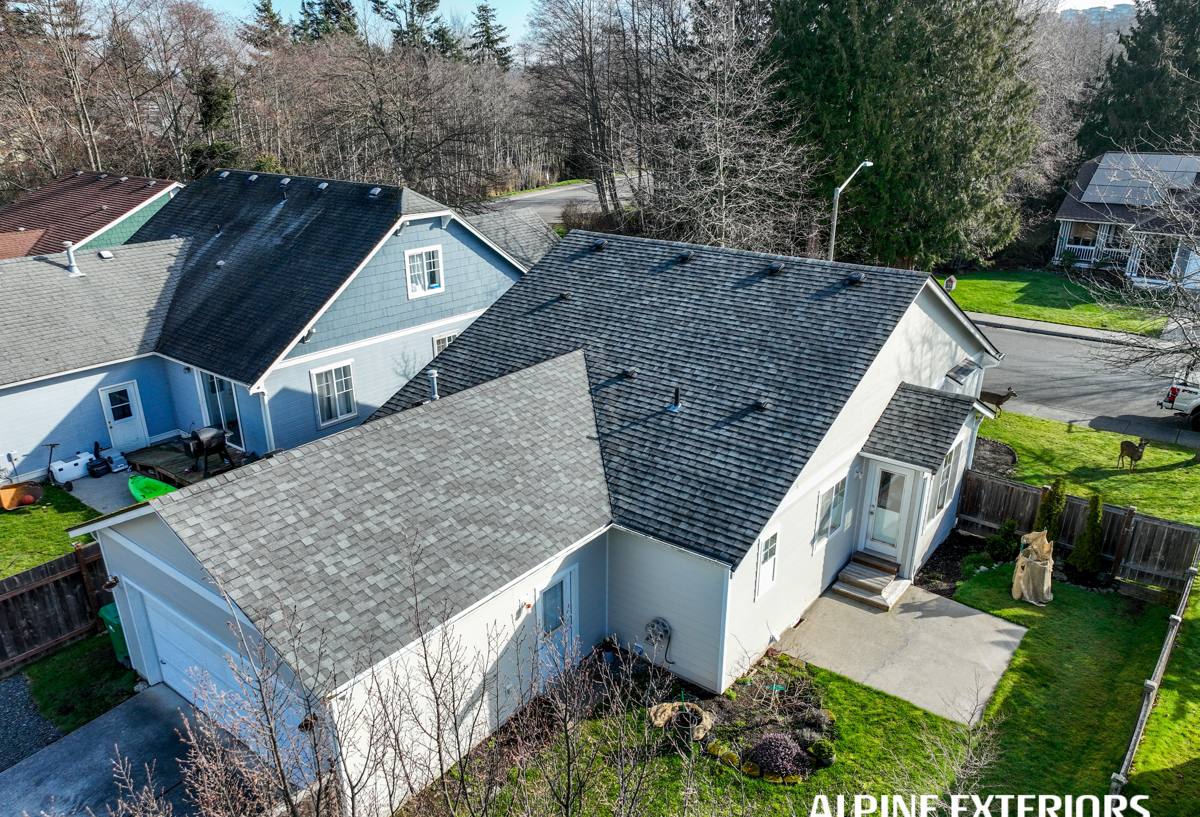
What Salt Air, Rain, and Moss Actually Do to a House
Salt Air and Metal Fatigue
Proximity to Puget Sound means airborne salt is a real factor here, even a few miles inland. Salt accelerates corrosion on anything metal — fasteners, flashing, trim screws, gutter hardware — and it degrades certain paint and coating systems faster than manufacturers' published lifespans suggest. A siding product's resistance to moisture is only half the story; what holds it to the wall matters just as much, and that's an installation detail as much as a product choice.
Driving Rain and Wind-Driven Moisture
Everett doesn't get the heaviest rainfall totals in the state, but it gets a lot of horizontal rain — wind off the water pushing moisture sideways into wall assemblies rather than letting it run straight down and off. That matters enormously for siding. A product that performs fine under vertical rain in a lab test can behave very differently when water is being forced into laps, seams, and butt joints for days at a stretch. Everett's own building history includes a well-documented wave of moisture-related siding failures in the 1990s and 2000s tied to products and installation methods that couldn't handle exactly this kind of exposure — it's part of why local contractors and homeowners here are more cautious about siding choices than in drier parts of the country.
The Long Moss Season
Cool, damp, shaded conditions for most of the year mean moss, algae, and mildew get a long runway on north-facing walls, under eaves, and anywhere sun doesn't reach consistently. This isn't just cosmetic. Sustained organic growth holds moisture against a wall surface, and moisture held against the wrong substrate for months at a time is how rot starts. Siding that can shrug off surface growth — or at least resist the moisture retention that comes with it — has a real durability advantage in a neighborhood like Eastmont.
Why We Install Only James Hardie Fiber Cement
We don't offer a menu of siding brands and let homeowners pick based on price alone, and we get asked about that fairly often. The short answer is that after years of doing this work in exactly the conditions described above, James Hardie fiber cement is the only product we're willing to put our name behind and back with our own installation warranty.
Fiber cement is a mix of cement, sand, and cellulose fiber, engineered specifically to resist moisture absorption, hold paint far longer than wood-based products, and stay dimensionally stable through wet-dry cycles. James Hardie takes that a step further with its HZ5 product line, engineered specifically for the freeze-thaw and moisture patterns of the Pacific Northwest, and its ColorPlus factory-finish system, which bakes a baked-on finish onto the board before it ever reaches a job site rather than relying entirely on field-applied paint. It's also non-combustible, which matters more every year as wildfire smoke and ember exposure become a bigger part of the conversation even west of the Cascades.
None of that makes fiber cement maintenance-free, and we won't tell you it is. It still needs proper caulking maintenance, periodic inspection, and correct installation to hit its expected lifespan. But it starts from a materially stronger position against the exact stresses Eastmont homes face than the alternatives.
What We Don't Install, and Why That's an Honest Trade-Off Conversation
We get asked about LP SmartSide, vinyl, Cemplank, Allura, and primed wood or cedar fairly regularly, usually because a homeowner is comparing quotes and wants to understand the gap. Here's the honest version, product by product.
| Product | What it gets right | Why we don't install it here |
|---|---|---|
| Vinyl siding | Lowest upfront cost, no painting required | Warps and gaps under heat/cold cycling and wind, seams open up over time, gives water a path in during driving rain |
| LP SmartSide | Engineered wood, lower cost than fiber cement | Wood-based core is more vulnerable to sustained moisture exposure than cement-based products, edge sealing is critical and easy to get wrong |
| Cemplank / Allura | Also fiber cement, similar core material to Hardie | Different manufacturing process and factory finish system; we standardized on one product line so our crews are deeply trained on one install spec rather than several |
| Primed spruce / cedar | Traditional look, natural material | Highest ongoing maintenance burden — repainting, moisture monitoring — in a climate that doesn't forgive gaps in that maintenance |
This isn't a claim that these products are junk — plenty of them perform reasonably well in the right climate with disciplined maintenance. It's that we made a standard, and that standard is built around what actually survives this specific corner of Snohomish County over decades, not just what looks good on install day.
How Siding, Roofing, Windows, and Decks Work Together on an Eastmont Home
Siding doesn't fail in isolation, and we don't treat it that way. The most common failure points we find on older homes in this area are at the transitions — where siding meets roofline, where it meets window and door trim, where it meets a deck ledger board. Water finds the seams between trades, not the middle of a wall.
Because we handle siding, roofing, windows, and decks under one crew, we look at those transitions as a system during an estimate, not as four separate contractors hoping their work lines up. A few examples of what that means in practice:
- Roof-to-wall flashing gets checked and corrected as part of a siding job, not left for a future roofing contractor to discover
- Window flashing and integration with the water-resistive barrier is verified before new siding closes it up — this is one of the most common places we find prior mistakes
- Deck ledger connections are inspected where a deck meets the house, since that's a documented weak point for hidden rot
- Kickout flashing at roof-to-wall intersections is confirmed present and functional, a detail that gets missed constantly on older Everett homes
Installation Details That Actually Determine How Long Hardie Lasts
The product is only part of the equation. We see fiber cement fail prematurely on other jobs almost exclusively because of installation shortcuts, not the material itself. A few specifics that matter more in a climate like this one:
- Proper clearance between siding bottom edge and grade, decks, roofing, and hardscape — too tight, and wicking moisture has nowhere to dry out
- Correct fastener pattern and depth — over-driven or under-driven nails compromise both the water seal and the board's ability to move slightly with temperature changes
- Rain screen or drainage gap behind the siding, giving incidental moisture a path to drain and the wall assembly a chance to dry
- Caulking at butt joints and penetrations using a product rated for the movement and moisture cycling this climate produces, applied to manufacturer spec rather than "close enough"
- Correct panel gaps to accommodate expansion, especially important given how much temperature and moisture swing Everett sees seasonally
Every one of these is invisible once the job is finished and the wall looks good. They're also exactly what determines whether that wall still looks good in fifteen years.
Signs an Eastmont Home May Need New Siding
Homeowners in this area often live with early warning signs for years before calling anyone, partly because siding damage tends to be gradual and partly because it hides behind trim, gutters, and shrubs. Worth checking for:
- Soft or spongy spots when you press on siding, especially near the bottom courses or below windows
- Persistent moss or algae staining that returns quickly after cleaning
- Paint that's bubbling, peeling, or failing faster than the rest of the house
- Visible gaps, warping, or buckling at seams and panel joints
- Rust streaking from fasteners or metal trim
- A musty smell in adjacent interior rooms, which can indicate moisture intrusion behind the wall
- Cracking at panel edges or corners, common on aging wood-based or vinyl products
Any one of these on its own isn't necessarily an emergency. Several together, or any sign paired with interior symptoms, is worth a professional look before it becomes a rot repair instead of a siding replacement.
What Drives Cost on a Siding Project
| Factor | Why it matters |
|---|---|
| Home size and wall complexity | More corners, dormers, and roof-wall intersections mean more flashing detail and labor time |
| Extent of hidden damage | Rot discovered once old siding is removed adds sheathing and framing repair before new siding can go on |
| Siding profile and ColorPlus selection | Lap width, texture, and factory-finish color options carry different material costs |
| Trim and accessory scope | Full trim replacement versus reusing existing trim changes both cost and how well the new siding integrates |
| Access and site conditions | Steep grades, mature landscaping, and multi-story sections affect labor and equipment needs |
We don't quote broad numbers without seeing the house — anyone who does is guessing. What we can say is that an accurate estimate requires a real walk-around, not a drive-by, precisely because hidden damage and access conditions vary so much house to house even within the same neighborhood.
Why a Local Everett Crew Is Worth Something Here
Siding installation isn't identical everywhere, and a crew that primarily works drier inland climates brings different habits than one that works Puget Sound weather every day. Details like drainage gap sizing, caulking product selection, and flashing sequencing get treated as more or less optional depending on how much a crew has personally seen those shortcuts fail. Working Everett and Snohomish County homes consistently means we're not guessing about how this climate treats an exterior — we're responding to what we actually see on tear-offs, on older homes, and on our own completed work years later.
If you're in Eastmont and thinking about siding, roofing, windows, or a deck, we're glad to come take an honest look and walk you through what we find — no pressure, no inflated quote to negotiate down from. A free estimate is the easiest way to find out what your home actually needs.