 Everett
 Why Marysville Siding Takes More Punishment Than People Expect
Marysville sits close enough to Puget Sound and the Snohomish River delta that homes here deal with a specific combination of weather stress: salt-tinged air moving in off the water, long stretches of driving rain through fall and winter, and a moss and algae season that can run most of the year on shaded north- and west-facing walls. None of these on their own is unusual for Western Washington. Together, over years, they're hard on siding that wasn't built or installed with that combination in mind.
Salt air accelerates corrosion on fasteners and metal trim, and it works into any exposed or poorly sealed wood fiber, keeping moisture where it doesn't belong. Driving rain — rain pushed sideways by wind rather than falling straight down — finds every weak lap, seam, and butt joint that a calmer climate would never test. And moss doesn't just look bad; a mat of moss or algae holds water against the siding surface for days at a time, which is exactly the condition that rots wood-based products and stains or degrades lower-grade siding finishes.
A siding job that would hold up fine in a drier inland climate can fail years early in Marysville if the product or the installation wasn't matched to these conditions. That's the starting point for every siding conversation we have with homeowners in this area.
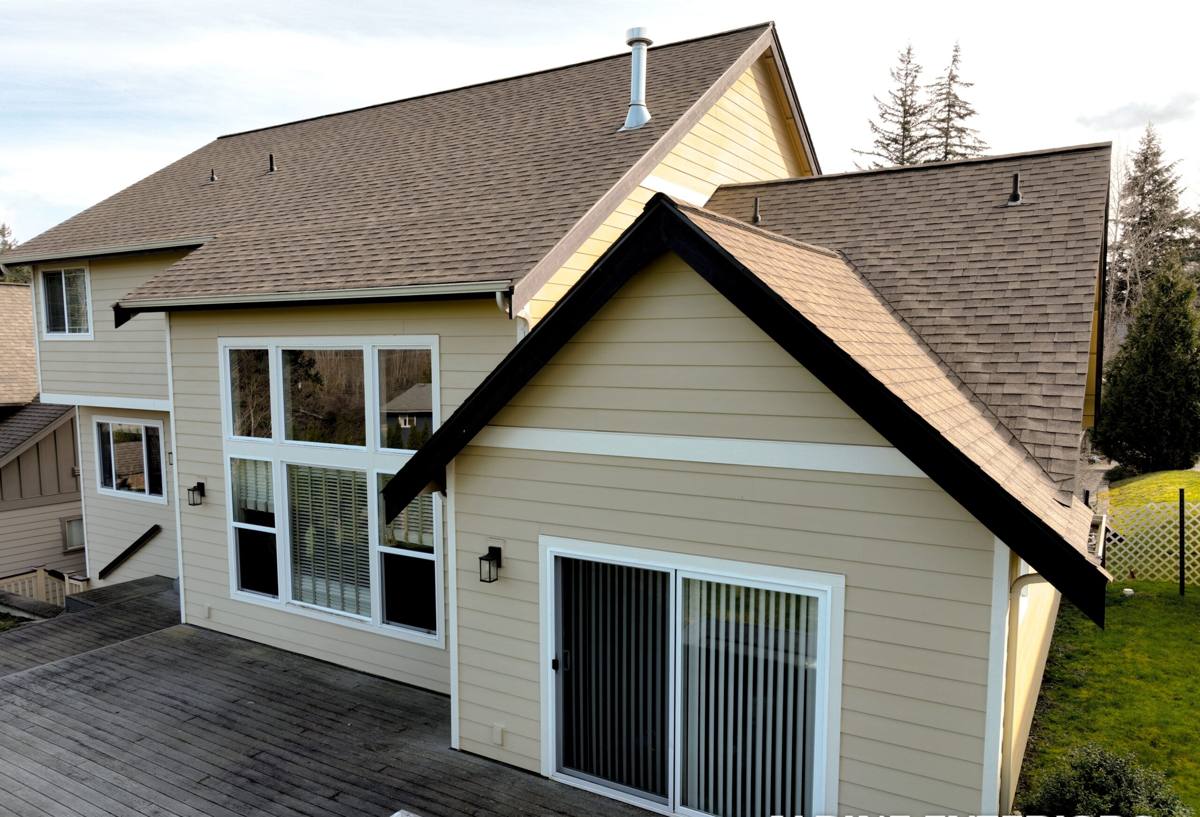
Signs Your Marysville Home's Siding Is Falling Behind
Most siding failure in this area doesn't show up as a single dramatic event — it shows up as a slow accumulation of small problems. Homeowners often notice one or two of these and assume it's cosmetic, when it's actually a sign the siding system itself is losing the fight against the climate.
- Soft, spongy, or crumbling spots when you press on the siding near the bottom courses or around window trim
- Persistent moss or dark green-black staining that comes back within weeks of cleaning
- Paint that's peeling, bubbling, or chalking faster than the repaint cycle you'd expect
- Visible gaps or separation at lap joints, corners, or where siding meets trim
- A musty smell in an interior room that backs onto an exterior wall
- Fastener heads showing rust streaks bleeding down the face of the siding
Any one of these is worth a look. Several together usually mean the underlying moisture management — not just the paint or surface layer — has broken down, and patch repairs won't hold for long.
What James Hardie Siding Solves in This Climate
We install James Hardie fiber cement siding exclusively — not as one option among several, but as the only product we put on homes. That's a deliberate standard, not a sales preference, and it's worth explaining why in the context of Marysville specifically.
Fiber cement is non-combustible and dimensionally stable, meaning it doesn't swell, warp, or cup the way wood-based and some engineered wood siding products can when they take on repeated moisture. In a climate with a long wet season and salt-laden air, that stability matters more than it does in drier regions. James Hardie's HZ5 product line is engineered specifically for climates like ours — cold, wet, humid — with a formulation built to resist moisture-related damage better than the company's warmer-climate HZ10 line.
The factory-applied ColorPlus finish is also relevant here. Because the color coat is baked on in a controlled factory environment rather than field-applied, it resists fading, chipping, and the chalky breakdown that field-painted siding shows after a few Puget Sound winters. That means fewer repaint cycles and a more consistent look over the life of the siding — a real advantage when your home is getting near-constant moisture exposure for months at a stretch.
What We Don't Install, and Why
We get asked regularly about LP SmartSide, vinyl, and primed wood species like cedar or spruce. Each of those products has legitimate uses and reasonable installers. Our reason for not installing them here comes down to how they perform specifically under Marysville's combination of moisture, salt air, and moss pressure — engineered wood products depend heavily on unbroken factory sealing at every cut edge, vinyl can't match fiber cement's rigidity against wind-driven rain intrusion at seams, and untreated or primed wood species require a maintenance commitment most homeowners underestimate until the first sign of rot shows up. We'd rather stand behind one product system we know performs here than install several and hope the climate goes easy on them.
What a Correct Siding Installation Actually Involves
The siding panel itself is only part of the system. Most siding failures we get called out to inspect in this area trace back to installation shortcuts, not the product. A correct install on a Marysville home means getting every layer right, not just the visible one.
The Moisture Barrier Comes First
Before a single piece of siding goes up, the wall needs a continuous water-resistive barrier, properly lapped and taped at every seam, with flashing integrated at every window, door, and penetration. In a climate with sustained driving rain, any gap in this layer becomes the entry point for the moisture problems that show up years later as rot behind the siding — long after the visible finish still looks fine.
Fastening and Clearances
James Hardie siding has specific fastener spacing, embedment depth, and clearance requirements — including keeping the bottom edge of the siding a minimum distance above grade, decks, patios, and roof lines. Skipping these clearances is one of the most common mistakes we see on re-inspections of other contractors' work, and it's a direct cause of moisture wicking into the bottom courses.
Caulking and Joint Treatment
Butt joints, corners, and trim transitions need to be treated according to manufacturer spec, not left to the installer's judgment on the day. In driving rain, an under-caulked or improperly lapped joint is a guaranteed leak point within a few seasons.
Installation Checklist We Hold Every Marysville Job To
- Continuous, properly lapped water-resistive barrier with taped seams
- Correct flashing at every window, door, and roof-to-wall transition
- Manufacturer-spec fastener type, spacing, and embedment depth
- Minimum clearance maintained above grade, decks, and roof surfaces
- Butt joints and corners sealed per James Hardie installation guidelines
- Panels primed or factory-finished with no exposed raw edges
- Ventilation and rainscreen gap addressed where the wall assembly calls for it
Our Process for a Marysville Siding Installation
Every home is different, but the sequence we follow stays consistent because it's built around getting the moisture management right before aesthetics ever come into play.
- On-site assessment. We walk the exterior, check for existing moisture damage, note problem areas like shaded north walls prone to moss, and measure for material.
- Tear-off and sheathing inspection. Old siding comes off and we inspect the sheathing underneath for rot or damage before anything new goes up — this is the point where hidden problems get caught, not hidden further.
- Repairs as needed. Any damaged sheathing or framing gets addressed before the weather barrier goes on. This isn't an upsell step; it's the difference between a siding job that lasts and one that fails from the inside out.
- Weather barrier and flashing. The water-resistive barrier and all flashing details go in first, fully lapped and sealed.
- James Hardie installation. Panels are installed to manufacturer spec, with attention to fastening, clearances, and joint treatment as outlined above.
- Trim and detail work. Corners, trim boards, and transitions are finished to match the ColorPlus system for a consistent, factory-quality look.
- Final walkthrough. We review the completed work with the homeowner and flag any care or maintenance notes specific to the home's exposure.
Choosing the Right James Hardie Product Line
James Hardie makes several siding profiles, and the right one for a Marysville home depends on the style of the house and how much of the wall is exposed to wind-driven rain.
| Product Line | Best Fit For | Notes for This Climate |
|---|---|---|
| HardiePlank Lap Siding | Traditional and craftsman-style homes | Most common choice; HZ5 formulation recommended for our zone |
| HardiePanel Vertical Siding | Modern or mixed-material facades | Works well combined with lap siding for accent walls |
| HardieShingle | Homes wanting a shingle-style look without cedar's maintenance | Good option for gable ends and accent areas exposed to moisture |
| HardieTrim | Window, corner, and fascia detailing | Matched ColorPlus finish keeps trim and field siding consistent over time |
What Affects the Cost of a Siding Installation Here
We don't quote broad numbers without seeing the home, but the main cost drivers on a Marysville project are fairly consistent from house to house.
| Factor | Why It Matters |
|---|---|
| Extent of tear-off and sheathing repair | Hidden moisture damage found during tear-off adds scope but prevents a repeat failure |
| Home size and wall complexity | More corners, dormers, and trim transitions mean more labor and detail work |
| Product line and profile selection | Lap, panel, and shingle profiles carry different material and labor costs |
| Accessibility | Second-story work, tight lot lines, or landscaping obstructions affect labor time |
| Existing moisture or moss damage | Homes with long-neglected moss growth often need more prep before install |
Why a Crew That Already Works Marysville Matters
A siding contractor who mainly works drier, inland areas can still do competent work, but they're often calibrating to a different set of assumptions — less aggressive flashing details, less attention to moss-prone wall orientations, less familiarity with how salt air and sustained rain interact with fastener corrosion over time. A crew that regularly works Marysville and the broader Snohomish County coastline treats those details as standard practice, not an afterthought.
That familiarity shows up in small decisions during the job: which walls get extra attention to ventilation gaps, how joints get sequenced on the rainiest-facing elevations, and which clearance details get double-checked because we've seen what happens when they're skipped in this exact climate. It's the difference between siding installed to a generic standard and siding installed for the specific conditions it's going to face for the next several decades.
Caring for James Hardie Siding After Installation
Part of what makes fiber cement a good match for this climate is how little ongoing maintenance it needs compared to wood-based alternatives — but "low maintenance" isn't "no maintenance." A periodic rinse to knock off moss and algae buildup, especially on shaded elevations, keeps the ColorPlus finish looking as intended and prevents organic growth from holding moisture against the surface. Checking caulked joints every few years and keeping gutters clear so water isn't dumping directly onto siding are the two habits that do the most to protect the investment long term.
Ready to Talk About Your Marysville Home
If your siding is showing wear, if you're planning ahead for a home you know is due, or if you just want a straight answer about what your walls actually need in this climate, we're happy to take a look. Reach out for a free, no-pressure estimate and we'll walk the exterior with you and tell you honestly what we see — no obligation either way.