 Everett
 Snohomish sits close enough to Puget Sound and the Snohomish River basin that its homes deal with a specific combination of weather stresses: salt-tinged marine air, long stretches of driving rain off the water, and a moss season that can run from late fall clear into spring. None of that is exotic or extreme, but it's relentless, and relentless moisture exposure is exactly the kind of thing that separates siding installed correctly from siding that starts causing problems five or ten years in. As a crew that works throughout Snohomish County, we've seen how these conditions play out on real houses, and it shapes how we approach siding, roofing, window, and deck work in this area.
What Snohomish Homes Actually Face
Snohomish's mix of low-lying areas near the river and elevated neighborhoods further from the water means moisture behaves a little differently depending on where a house sits. Homes closer to the river valley tend to hold humidity longer after a storm passes. Homes on higher ground catch more wind-driven rain because there's less tree cover to break it up. Either way, the common thread is prolonged dampness rather than short, hard downpours — and that's the condition that matters most for exterior materials.
Salt Air, Even Inland
Snohomish isn't a beachfront community, but it's close enough to Puget Sound that marine air still reaches it, especially on west and southwest exposures. Salt-laden moisture accelerates corrosion on fasteners, flashing, and any hardware that isn't rated for it, and it can degrade lower-grade paint finishes faster than homeowners expect. It's a slower, quieter form of wear than storm damage, but it adds up.
Driving Rain
Rain that comes in at an angle — pushed by wind off the Sound — gets forced into seams, laps, and butt joints that would stay dry in a straight-down rain. This is why installation detail (not just the material itself) determines how a home holds up here. Flashing at windows and trim, proper caulking at penetrations, and correct lap spacing all matter more in a wind-driven-rain climate than in a calmer one.
Moss and Prolonged Dampness
Snohomish's tree cover and shaded lots are part of what makes the area attractive, but shade plus moisture equals moss, algae, and mildew growth on north-facing walls, roof edges, and anywhere airflow is limited. Moss holds moisture against a surface far longer than open exposure would, which is a slow but steady stress on paint, caulking, and the substrate underneath.
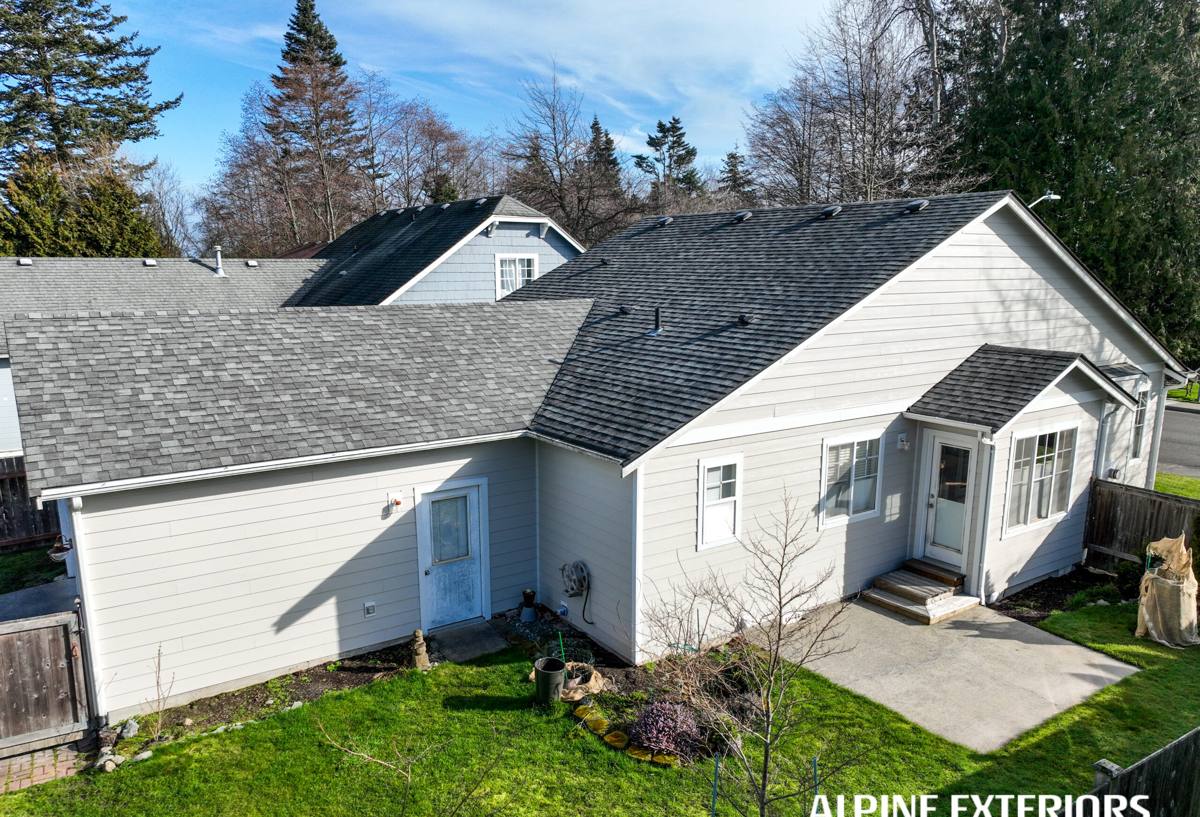
Why the Exterior Material Choice Matters Here
In a climate like this, the material itself is only part of the equation — but it's the part that determines your maintenance burden for the next 15-30 years. This is why we install only James Hardie fiber cement siding and don't offer vinyl, LP SmartSide (OSB-based composite), Cemplank, Allura, primed spruce, or raw cedar. We're not saying every other product is unusable everywhere; we're saying that for the moisture and moss conditions common in Snohomish and the broader Puget Sound region, we're not willing to put our name on the install if we don't have full confidence in the material long-term.
Where the Common Alternatives Fall Short Here
- Vinyl siding expands and contracts with temperature swings, which can loosen fastening over time, and it doesn't hold paint if a homeowner ever wants a different color — it's the color it is.
- LP SmartSide and other OSB-based composites are wood-strand products with a resin coating. They perform reasonably when installation is flawless, but any breach at a cut edge, nail hole, or seam that isn't fully sealed lets moisture into a wood-based core — a real risk in a climate where things stay damp for days.
- Cemplank and Allura are also fiber cement, and fiber cement as a category is the right call for this region. Our reason for standardizing on Hardie specifically comes down to the factory-applied ColorPlus finish, the HZ5 product engineering built for wet Pacific Northwest exposure, and a transferable warranty structure we've found to be the strongest in the category.
- Primed spruce and raw cedar are real wood, and real wood needs real maintenance — recoating, caulking, and vigilance — to keep moisture out. In a moss-prone, marine-air climate, that maintenance interval shrinks, and skipping it shows up fast as cupping, checking, or rot at the bottom courses.
Why James Hardie for This Climate Specifically
James Hardie fiber cement is non-combustible, dimensionally stable, and manufactured with regional HZ engineering — the HZ5 product line is formulated for the wetter climate zones that include western Washington. That matters in Snohomish because the siding isn't just dealing with occasional rain; it's dealing with sustained damp air, shaded moss-prone walls, and salt-tinged wind. The factory-applied ColorPlus finish is baked on under controlled conditions rather than field-painted, which gives it more consistent coverage and better fade and moisture resistance than a site-applied coat, and it comes with its own finish warranty on top of the product warranty. When it's installed to spec — correct clearances, proper flashing, correct fastener pattern — it's a system built to handle exactly the conditions this area produces year-round.
How a Snohomish Siding Project Typically Works
Assessment
We start by walking the exterior and identifying where moisture has already caused problems — soft trim, staining under windows, moss buildup on north walls, gaps at penetrations — and where the house's exposure (tree cover, wind direction, elevation) is going to demand extra attention during installation.
Installation Detail
The material choice matters, but so does the install. In a driving-rain climate, we pay particular attention to flashing at every window and door, correct lap and gap spacing so the panels can move without binding, and sealing at penetrations like vents and hose bibs — the spots where most moisture intrusion actually starts.
Finish and Color
Because ColorPlus is factory-applied, the finish is consistent panel to panel, which also means touch-up paint (for the rare nick or scratch) is formulated to match rather than guessed at on-site.
Roofing, Windows, and Decks in the Same Conditions
Siding doesn't work in isolation — it's one part of a building envelope that also includes the roof, windows, and any exterior decking, and in Snohomish's climate all of them face the same core stresses.
Roofing
Moss on a roof is more than a cosmetic issue — it holds moisture against shingles and can work its way under tabs and flashing over time, particularly on shaded north-facing slopes common on wooded Snohomish lots. Roof edges and valleys are also where wind-driven rain concentrates, so flashing condition there matters as much as the shingles themselves.
Windows
Window flashing and the seal between the window unit and the siding are one of the most common points of water intrusion in this climate. When we're doing siding work, we check window flashing as a matter of course, because a siding job that ignores a bad window seal just traps the problem behind new material.
Decks
Decks take the most direct hit from standing moisture and moss, since they're horizontal surfaces exposed to both rain and shade. Proper drainage, board spacing, and ledger flashing where the deck meets the house are the details that determine whether a deck lasts.
Cost Factors for Snohomish Homeowners
| Factor | Why It Affects Your Project |
|---|---|
| Home exposure (tree cover, elevation, wind direction) | Higher wind or rain exposure calls for more flashing and sealing detail, which affects labor time |
| Existing moisture damage | Soft trim, rot, or sheathing damage found during tear-off adds repair scope before new material goes on |
| Siding profile and trim complexity | Lap siding vs. panel systems, plus the amount of trim and corner detail, change material and labor needs |
| Number of stories and roofline complexity | Access, scaffolding, and cutting complexity scale with height and roof intersections |
| Scope (siding only vs. siding plus roofing/windows/decks) | Bundling envelope work can reduce redundant setup and access costs versus separate projects |
Why a Local Crew Matters
A crew that works Snohomish County regularly knows which exposures tend to trap moisture, which neighborhoods see heavier moss buildup, and how wind off the Sound behaves differently depending on a lot's elevation and tree cover. That local pattern recognition shapes real decisions on the job — where to add extra flashing, which walls need closer inspection before covering them up, and what maintenance schedule actually makes sense for a specific property rather than a generic recommendation.
What to Look For When Hiring
- Ask what siding material they install and why — a contractor who's thought it through should be able to explain the trade-offs, not just quote a price
- Confirm they carry current Washington state contractor licensing and insurance
- Ask how they handle flashing at windows, doors, and penetrations specifically — this is where most moisture problems start
- Ask about the manufacturer's warranty terms and whether it's transferable if you sell the home
- Get a written scope that separates material, labor, and any repair work found during tear-off
- Ask how they handle moss and existing moisture damage discovered mid-project
If you're weighing a siding, roofing, window, or deck project in Snohomish, we're happy to take a look and walk through what your specific home is facing — no pressure, no obligation. Reach out for a free estimate using the form below.