 Everett
 Why Snohomish Roofs Wear Differently
Snohomish sits close enough to Puget Sound and the Snohomish River basin that homes here deal with a combination most inland roofs never see: salt-laden air, wind-driven rain that gets pushed sideways under flashing and shingle tabs, and a moss season that can run eight months or longer in shaded, north-facing sections of a roof. None of these things alone is unusual for Western Washington. Together, over enough years, they change what "roof repair" actually needs to mean for a house in this part of Snohomish County.
Salt air accelerates corrosion on exposed metal — nail heads, flashing edges, gutter fasteners, and vent boots all corrode faster here than they would twenty or thirty miles inland. Driving rain doesn't just fall straight down; it gets forced up under shingle edges and around penetrations by wind coming off the Sound, which means water intrusion often starts in places a quick visual check from the ground will miss. And moss doesn't just look bad — its root structure lifts shingle edges, holds moisture against the roof deck, and quietly rots the wood underneath long before a homeowner sees a stain on the ceiling.
A repair that ignores any one of these three factors tends to fail again within a couple of years. That's the standard we hold ourselves to: a repair here has to account for all three, not just patch the spot where water showed up inside the house.
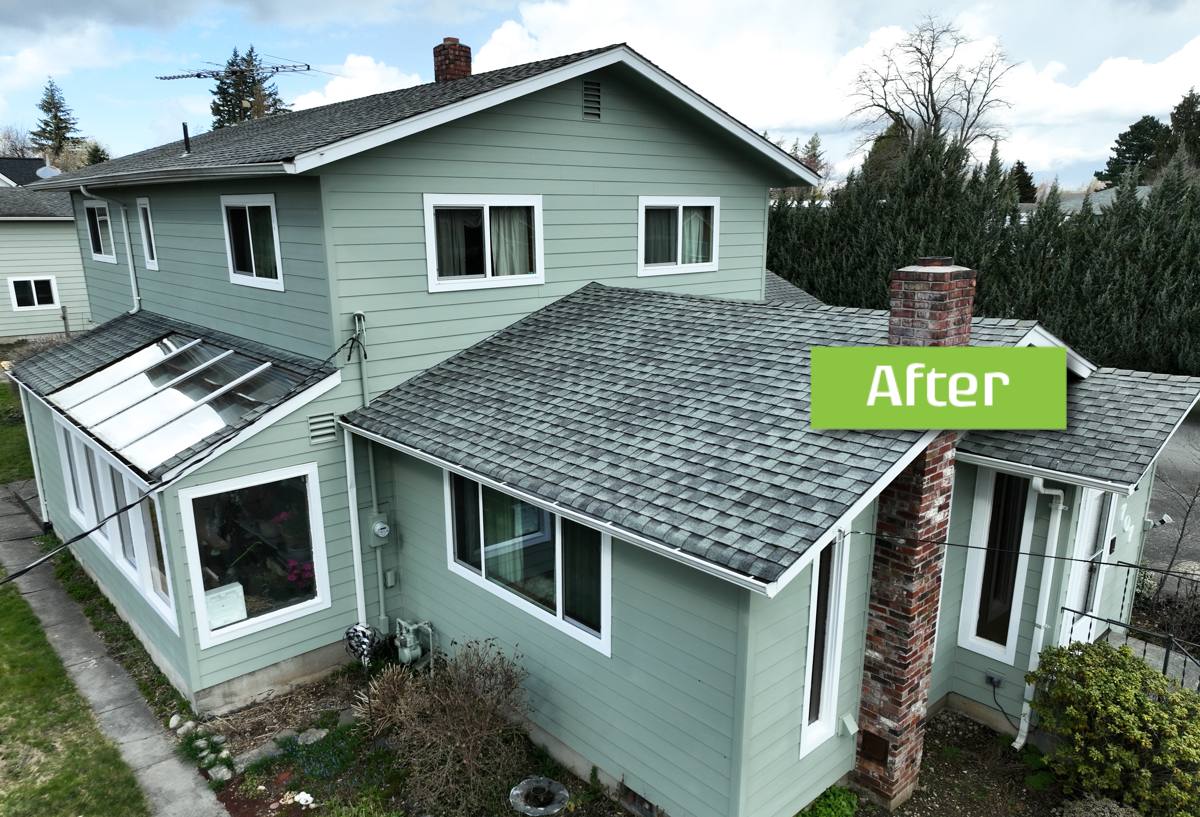
Signs a Snohomish Roof Needs Repair, Not Replacement
Most roofs don't need to be torn off — they need specific problem areas addressed correctly. Here's what typically brings us out to a Snohomish home:
- A ceiling stain that appears after a heavy wind-driven rain event but not after a calm, steady rain
- Visible moss buildup on the north or west-facing roof slopes, especially near trees or in shaded valleys
- Granules collecting in gutters or at downspout outlets, a sign of shingle wear
- Curling, cracking, or lifted shingle tabs, particularly on slopes that catch the prevailing wind
- Rust streaking below metal flashing, vent caps, or exposed fasteners
- Soft or spongy spots underfoot near chimneys, skylights, or where two roof planes meet
- Daylight visible through the attic sheathing at a joint or penetration
Any one of these on its own is usually a repair, not a replacement. What matters is diagnosing the actual cause rather than just resealing the spot where the leak became visible — water travels along the roof deck before it drips through drywall, so the entry point is almost always somewhere other than the stain.
What a Correct Roof Repair Actually Involves
Finding the real entry point
We start on the roof, not the ceiling. Interior stains tell you where water ended up, not where it got in — wind-driven rain in particular can travel several feet along the underlayment or decking before finding a gap to come through. A correct repair means tracing that path, checking flashing laps, fastener patterns, and underlayment condition around the suspect area, not just caulking the first thing that looks off.
Flashing and penetrations first
The overwhelming majority of roof leaks we find in Snohomish trace back to flashing — around chimneys, skylights, plumbing vents, dormers, and roof-to-wall transitions — rather than the field of the shingles themselves. Flashing is metal, and metal near the Sound corrodes and works loose faster than it would inland. Any repair that doesn't inspect and, where needed, replace flashing is treating a symptom.
Matching materials, not just covering the gap
Shingles fade and weather over time, so a patch using new material next to old will always look different, and that's fine — appearance isn't the priority, correct water-shedding is. What matters more is using compatible materials: the right nail gauge and coating for a coastal-influenced climate, underlayment that's rated for the exposure, and flashing metal that won't set up a corrosion reaction against whatever's already on the roof.
Addressing moss at the repair site
If moss caused or contributed to the damage, clearing it and treating the area is part of the repair, not an upsell. Leaving moss in place around a fresh patch just guarantees the same failure returns in a season or two.
Common Roof Repair Issues We See Around Snohomish
| Issue | Typical Cause | What a Proper Repair Includes |
|---|---|---|
| Leak near chimney or skylight | Corroded or improperly lapped flashing | Remove and replace flashing, correct the lap sequence, reseal with appropriate sealant |
| Soft roof deck under moss patches | Prolonged moisture retention from moss growth | Remove moss and debris, assess and replace damaged decking, treat surrounding area |
| Lifted or missing shingles after windstorms | Wind uplift on exposed slopes, aging adhesive strips | Replace damaged shingles, re-secure adjacent tabs, check fastener pattern |
| Rust staining below vents or flashing | Salt-air corrosion on exposed metal fasteners | Replace corroded fasteners and metal components with corrosion-resistant materials |
| Interior stain with no visible roof damage | Wind-driven rain intrusion at a distant entry point | Full slope inspection to trace water path, not just spot patching near the stain |
Our Roof Repair Process
1. Inspection and diagnosis
We walk the roof, not just the ground, and check the attic from inside where access allows. We're looking for the actual source of a leak, the condition of flashing and underlayment, and any moss or debris that's contributing to the problem.
2. A clear, honest scope
Before any work starts, we explain what we found, what caused it, and what fixing it correctly requires — including if the honest answer is that a section is beyond a spot repair and full replacement of that area makes more sense long-term.
3. The repair itself
Damaged materials come out, decking is assessed and replaced where soft or rotted, flashing is redone where it's failed, and new shingles or roofing material are installed to match the surrounding field as closely as practical.
4. Cleanup and moss treatment
Debris is cleared from the roof and gutters, and moss in the repair area is treated so the same conditions don't cause a repeat failure.
5. Follow-up
We check our own work after the next significant rain where practical, because a repair that only gets tested by a light drizzle hasn't really been tested at all in this climate.
Repair vs. Replacement: What Actually Drives the Decision
| Factor | Favors Repair | Favors Replacement |
|---|---|---|
| Age of roofing material | Well within expected service life | Near or past typical lifespan for the material |
| Extent of damage | Isolated to one area or penetration | Recurring leaks in multiple, unrelated spots |
| Decking condition | Solid, dry, no widespread soft spots | Soft or rotted decking across multiple sections |
| Moss and moisture history | Localized, treatable | Long-term, widespread moss damage to the deck |
| Overall cost outlook | Repair cost is a fraction of replacement cost | Repeated repairs are approaching replacement cost |
Broadly, straightforward flashing or localized shingle repairs on a Snohomish home tend to run in the low hundreds to low thousands of dollars depending on access, material, and extent of decking damage — a wide range because the real driver is what we find once we're on the roof, not a flat rate. We'll always give you the honest number before we start, not after.
Protecting the Repair Long-Term
A good repair addresses the current problem. Keeping it from recurring means managing the two things that cause most repeat failures around here: moisture retention and moss regrowth. A little routine attention goes a long way in this climate.
- Keep gutters and downspouts clear so water doesn't back up under the roof edge
- Trim back tree limbs that shade roof sections and keep them damp longer than the rest of the roof
- Have moss treated before it spreads, rather than after it's lifted shingle edges
- Check attic ventilation — poor airflow traps moisture against the underside of the deck
- Schedule a roof check after major windstorms, since lifted tabs aren't always visible from the ground
- Address small leaks early; a repair now is almost always cheaper than deck replacement later
Why a Crew That Already Works Snohomish Matters
Roof repair isn't generic work. A crew that's used to inland conditions can miss what's routine to us: which flashing details fail first when wind comes off the Sound, how far moss tends to spread in a shaded valley before it's visible from the street, and which fastener types hold up against salt air versus which corrode within a few seasons. Knowing Snohomish County's specific mix of rain patterns, tree cover, and coastal exposure means we're not guessing at causes — we've seen the same failure patterns on roofs like yours before.
It also means honest scoping. We're not incentivized to oversell a full replacement when a targeted repair will genuinely hold up, and we're not going to underscope a repair just to win the job cheap, only for it to fail again next winter. Our reputation in this area depends on repairs that actually last through a full Snohomish wet season, not just past the point where the check clears.
Get an Honest Look at Your Roof
If you're seeing signs of a leak, moss buildup, or storm damage on your Snohomish home, it's worth having someone take an honest look before small damage turns into a deck replacement. We offer free, no-pressure estimates — just fill out the form below and we'll get back to you with a clear assessment and straightforward next steps.