 Everett
 Edmonds Sits Right Where Siding Gets Tested Hardest
Edmonds homes face a combination most Snohomish County properties don't deal with in the same measure: direct exposure to Puget Sound salt air, driving rain that comes in sideways off the water during winter storms, and a moss and algae season that can run eight months out of the year on north- and west-facing walls. Add in the shade from mature evergreens on many of the wooded residential streets, and you've got siding that rarely gets a full day of sun to dry out between rain events. That combination is exactly what fiber cement siding was engineered to handle, and it's exactly where cheaper materials tend to show their weaknesses first.
We work Edmonds regularly out of our Everett base, and the pattern on service calls is consistent: siding failures cluster near the waterfront bluffs and on homes with heavy tree cover, not because the homes are poorly built, but because the siding material or the installation wasn't matched to what this specific stretch of Puget Sound throws at a house year after year.
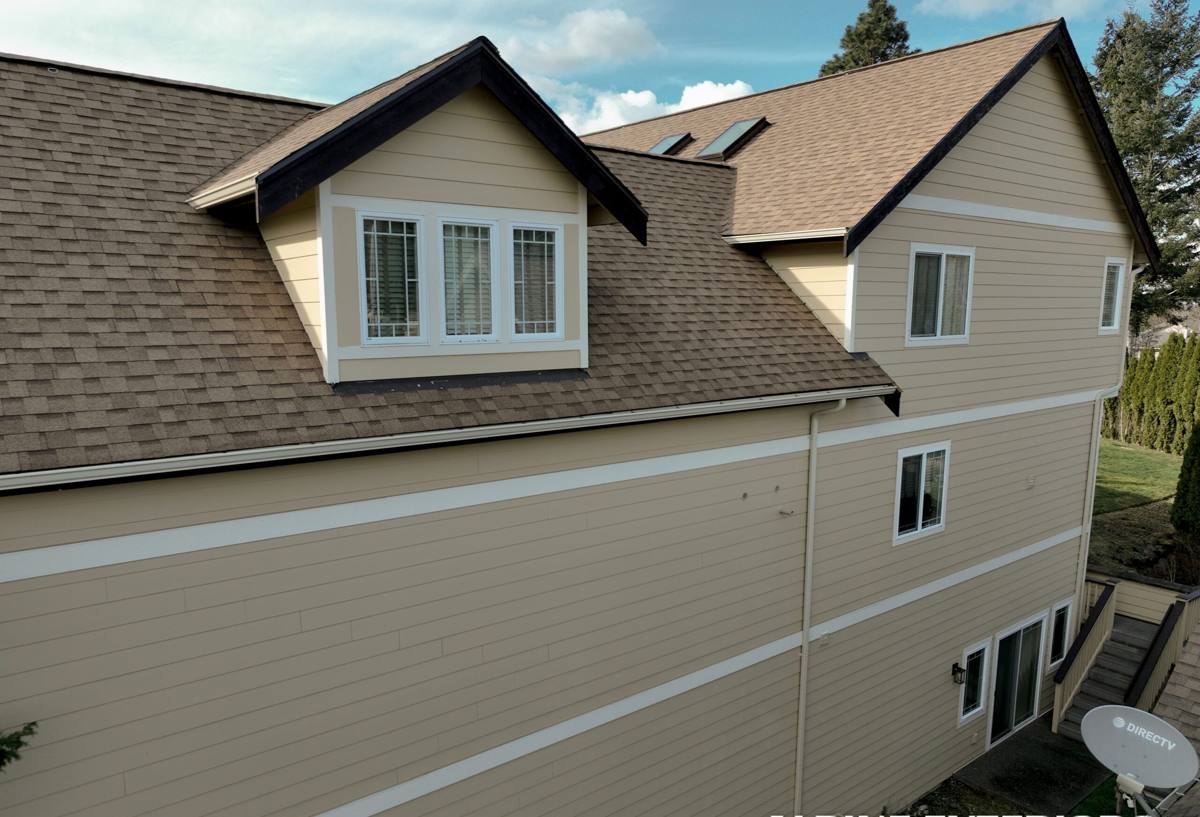
Why We Only Install James Hardie on Edmonds Homes
We don't install vinyl, LP SmartSide, Cemplank, Allura, primed spruce, or cedar. That's not a marketing position — it's a standard we've held to because of what we've seen happen to those materials in exactly this climate. Vinyl expands and contracts more than fiber cement in temperature swings, and it can warp or crack under sustained salt exposure. Wood-based and engineered wood products depend on an unbroken paint or coating layer to keep moisture out; once that layer is compromised by driving rain or trapped humidity under moss growth, the substrate underneath is vulnerable to rot in a way fiber cement simply isn't.
James Hardie fiber cement siding is non-combustible, dimensionally stable, and doesn't feed mold or moss the way wood fiber does. The factory-applied ColorPlus finish is baked on under controlled conditions, which gives it better adhesion and UV/salt resistance than field-applied paint. For a house three blocks from Puget Sound, that difference compounds year after year.
What This Means Specifically for a Marine Climate
Salt-laden air accelerates the breakdown of unprotected fasteners, degrades standard paint films faster than inland exposure, and keeps moisture in the air even on days it isn't actively raining. Hardie's HZ5 product line is engineered for exactly this kind of climate zone — it's formulated with a moisture-resistant composition suited to areas with sustained damp exposure, which describes most of western Snohomish County and especially anything within a mile or two of the water.
What Correct Installation Actually Involves Here
The siding product is only half the equation. We see plenty of James Hardie siding around Snohomish County that was installed incorrectly, and it fails early not because the product is bad but because the installer skipped steps that matter more in a wet marine climate than they would in a dry one. A correct install on an Edmonds home includes:
- A drainable weather-resistive barrier behind the siding, with a rainscreen gap where wall conditions call for it, so any moisture that does get past the cladding has somewhere to go
- Proper flashing at every window, door, and roofline intersection — this is where the majority of the water intrusion we find on service calls actually originates, not through the siding field itself
- Kick-out flashing at roof-to-wall junctions, which is frequently missing on older homes and is one of the most common causes of hidden rot behind siding near rooflines
- Correct fastener spacing and placement per Hardie's installation instructions, using corrosion-resistant fasteners appropriate for a coastal-influenced environment
- A consistent minimum clearance between the siding's bottom edge and grade, decks, patios, and roof surfaces, so splashback and standing water don't sit against the material
- Factory-cut edges sealed or field-painted per Hardie spec before installation, since an unsealed cut edge is one of the few places moisture can work into the board
- Caulking only at the specific joints Hardie's install guide calls for — over-caulking traps moisture just as effectively as under-caulking lets it in
None of this is exotic. It's the manufacturer's documented installation standard. The problem is that it takes more time and more attention to detail than a lot of crews are willing to give it, especially on a schedule where they're trying to move fast between jobs.
Mistakes We Find Most Often on Existing Edmonds Homes
When we're called out to look at a siding problem on a home that already has fiber cement installed, the issues are rarely about the material failing on its own. The recurring culprits are missing or undersized flashing above windows, siding installed tight to the ground or to a deck surface with no clearance, fasteners driven into a stud but positioned wrong on the board causing cracking at the corners, and caulk applied at butt joints that should have been left to drain or covered with proper trim instead.
How Moss and Algae Actually Affect Your Siding
Moss itself doesn't eat through fiber cement the way it can degrade wood fiber, but it does hold moisture against the wall surface for extended periods, and on north- and west-facing walls under tree cover it can build up enough to affect drainage paths and trap organic debris against trim and joints. Left unaddressed for years, that trapped moisture finds its way into any gap in the installation — which is exactly why the flashing and clearance details above matter more here than they would on a drier, sunnier site. Periodic gentle cleaning (never high-pressure washing directed at seams or under laps) keeps growth from building up to the point where it's holding water against the wall long-term.
Our Process for an Edmonds Siding Project
| Step | What Happens | Why It Matters Here |
|---|---|---|
| On-site assessment | We walk the exterior, check existing moisture damage, flashing conditions, and tree/shade exposure on each elevation | Edmonds homes often need different detailing on the water-facing side than the street side |
| Product and color selection | Choose HardiePlank, HardieShingle, or HardiePanel and ColorPlus finish based on home style and exposure | Some elevations benefit from different product lines depending on shade and moisture load |
| Weather barrier and flashing prep | Install or verify drainable house wrap, window/door flashing, and kick-out flashing before any siding goes up | This is the layer that actually stops water intrusion — the siding is the second line of defense |
| Installation to Hardie spec | Fastening, clearances, joint treatment, and trim work done to manufacturer instructions | Correct installation is what makes the warranty valid and the siding perform for decades |
| Final inspection and walkthrough | We review the finished work with you, including maintenance basics for this climate | You should know what normal weathering looks like versus something worth a call |
Why a Crew That Already Works Edmonds Matters
Working Edmonds regularly means we already know which elevations tend to hold moss longest, which streets sit in enough tree shade that drying time matters more, and which parts of the city get the most direct exposure to wind-driven rain off the Sound. That's not something you can fully account for from a generic install checklist — it shapes decisions like where to add extra flashing attention, whether a rainscreen gap is worth the added step on a particular wall, and how to sequence work around the wetter months so the substrate isn't exposed to a soaking rain mid-install.
It also means we're a known quantity if something needs a warranty-related look years down the road, rather than a contractor who did one job in the area and moved on.
Longevity and Maintenance: What to Actually Expect
| Material | Typical Maintenance in This Climate | Common Failure Point |
|---|---|---|
| James Hardie fiber cement | Occasional gentle wash, inspect caulk joints every few years | Rare when installed to spec; issues trace back to flashing or fastening, not the board itself |
| Vinyl | Low upkeep but limited repair options | Can warp, fade, or crack under sustained temperature and salt exposure |
| Cedar or primed wood | Repainting/staining on a recurring cycle, moisture monitoring | Rot at joints and cut ends once the coating layer is compromised |
| LP SmartSide / engineered wood | Regular coating maintenance, careful joint sealing | Edge and end-cut swelling if moisture gets past the coating |
A correctly installed James Hardie system on an Edmonds home should hold its appearance and performance for decades with minimal intervention. That's the whole reason we standardized on it — it's the product that best matches what this specific stretch of coastline demands from a building material.
What a Realistic Cost Range Depends On
Every Edmonds home is different, and we won't quote a number without seeing the house, but the factors that move the price on a James Hardie job are consistent:
- Whether existing siding needs to be removed and what condition the sheathing underneath is in once it's exposed
- How much trim, flashing, and detail work the home's architecture requires (multiple gables, dormers, or roof-to-wall intersections add labor)
- Product choice — lap siding, shingle-style panels, and board-and-batten all price differently
- Access — homes on steep bluff lots or with limited staging space near the water can add time
- Whether any rot repair or additional flashing work is needed before new siding goes on
We give a firm, written estimate after walking the property, not a phone-quoted range that changes once we're on site.
Questions to Ask Before You Hire Anyone for This Job
- Are you a certified James Hardie installer, and can you explain what that certification actually covers?
- What's your specific plan for flashing and drainage on this house, not just the siding brand you're using?
- Will you show me the manufacturer's fastening and clearance requirements you're following?
- How do you handle cut-edge sealing before boards go up?
- What does the warranty cover, and does incorrect installation void it?
If a contractor can't answer these clearly, that's worth noticing before you sign anything.
If your Edmonds home is due for new siding, or you're seeing early signs of moisture trouble on an existing installation, we're happy to take a look. The estimate is free, there's no pressure, and you'll get a straight answer about what your home actually needs — use the form below to get started.