 Everett
 What West Everett Siding Is Actually Up Against
West Everett homes sit in one of the more demanding exterior climates in Snohomish County, even if it doesn't always feel that way day to day. The combination is steady rather than dramatic: salt-tinged air moving off the water, rain that arrives sideways as often as it falls straight down, and a moss season that runs long enough to feel like a permanent condition rather than a seasonal one. None of that damages a house overnight. It works on siding, trim, and fasteners a little at a time, year after year, and the homes that hold up longest are the ones where the siding system was matched to that reality from the start rather than treated as an afterthought.
That's the whole reason this page exists as its own thing rather than a generic siding write-up. James Hardie siding on a West Everett home isn't the same project as James Hardie siding somewhere dry and inland — the material is the same, but what "installed correctly" means shifts once you account for wind-driven rain, sustained dampness on shaded walls, and salt exposure on anything metal.
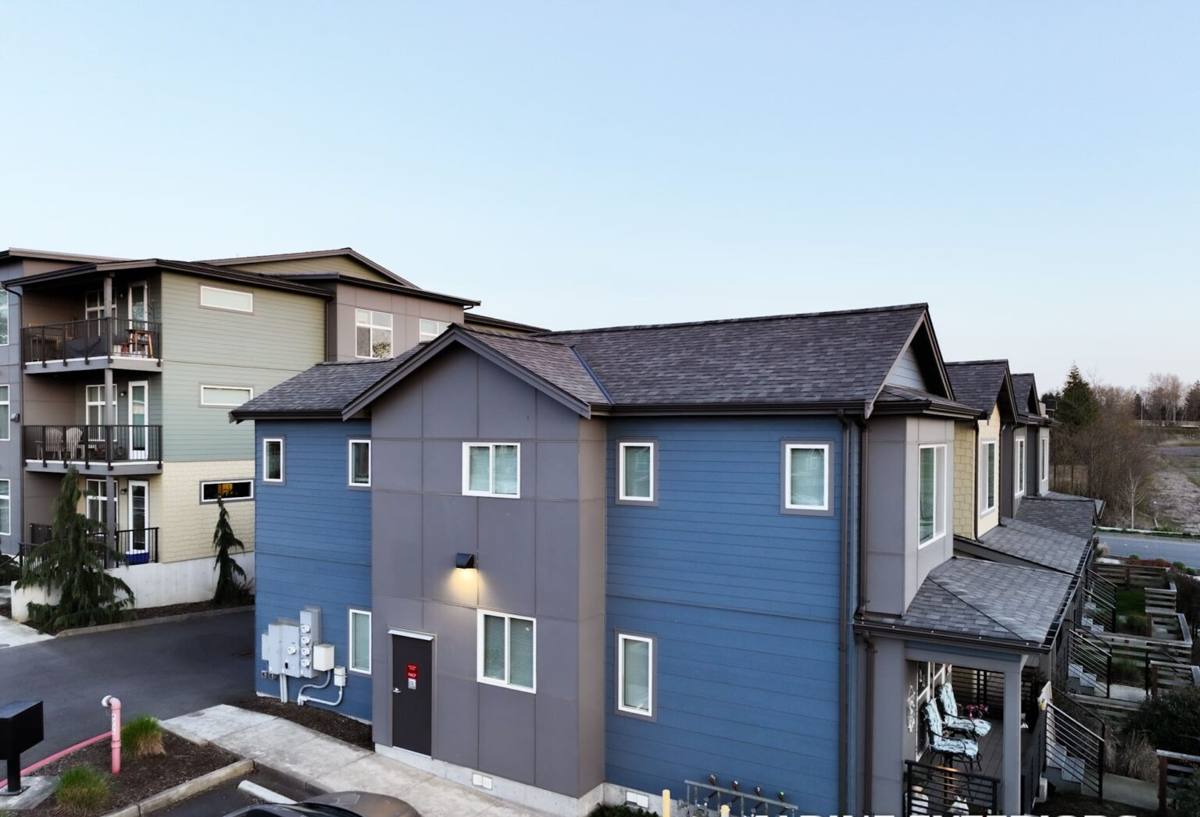
Why Fiber Cement Instead of Vinyl, LP SmartSide, or Wood
We install James Hardie fiber cement exclusively. We don't install vinyl siding, LP SmartSide, Cemplank, Allura, primed spruce, or cedar, and that's a standard we hold ourselves to rather than a limitation on what we're capable of putting up. Each of those alternatives has legitimate uses somewhere, but in a climate that stays wet for long stretches of the year, they share a common weak point: they either absorb moisture directly, rely on a coating or caulk joint to keep water out over time, or move enough with temperature and humidity swings that seams gradually work themselves loose.
James Hardie fiber cement doesn't share that weak point. It's non-combustible, it doesn't swell or feed moss the way wood-based siding can, and its ColorPlus factory finish is baked on under controlled conditions rather than applied on a jobsite at the mercy of the weather. Hardie also builds its HZ product line specifically for colder, wetter climate zones like ours, rather than shipping one board formulated for the whole country. Paired with a strong transferable warranty and installation done to the manufacturer's actual specifications, it's the system that holds up through a full West Everett year — not just the one it goes up in.
What We're Not Saying
Vinyl and engineered wood siding aren't dishonest products, and homeowners who've had them installed elsewhere aren't wrong to have chosen them. The trade-off is simple and worth stating plainly: in a high-moisture, salt-air environment, those materials tend to hand the maintenance burden back to the homeowner sooner — recaulking, repainting, or panel replacement within a decade or two — in a way a correctly installed fiber cement system generally doesn't.
What Correct Installation Actually Involves Here
James Hardie siding performs the way it's engineered to perform only when it goes up correctly, and in West Everett's climate, several details matter more than they would somewhere drier:
- Weather-resistive barrier: a properly lapped and sealed house wrap underneath the siding, so any water that does get past the cladding has a plane to drain down rather than a path into the sheathing
- Flashing at every penetration: windows, doors, hose bibs, vents, and anything else that punches through the wall need flashing detailed to direct water out and down, not sideways or behind the siding
- Correct fastener type and spacing: under-fastened or improperly spaced boards are one of the more common causes of early failure, and salt air adds corrosion pressure that a dry climate wouldn't
- Clearance above grade, decks, and roof lines: Hardie's minimum clearance specs exist to keep the bottom edge of the siding out of standing moisture, splash-back, and prolonged dampness
- Caulking only where Hardie's install guide actually calls for it: over-caulking traps moisture behind the board just as reliably as skipping it lets water in
Skipping or shortcutting any one of these doesn't necessarily show up on install day. It shows up three, five, or ten years later, usually on the wall that gets the least sun and the most wind-driven rain — which in a lot of West Everett homes is a north- or west-facing elevation.
Reading Your Walls: Sun, Shade, and Water Exposure
Not every wall on a West Everett home faces the same conditions, and that should inform how a job gets planned, not just executed. South- and west-facing walls generally take the brunt of direct wind-driven rain and more UV exposure, which affects everything from caulk life to how a ColorPlus finish weathers over time. North-facing walls and anything tucked under mature tree cover dry out more slowly after a storm, which is exactly the condition moss and algae need to take hold — regardless of how good the siding underneath is.
A contractor who's paying attention treats these as different micro-climates on the same house, not a single uniform wall. That can mean small adjustments in flashing detail, ventilation clearance, or even where extra fastening gets used, based on which elevation is actually taking the worst of the weather.
Signs Your Current Siding Is Already Losing the Fight
Homeowners often call us after noticing one or two of these, not realizing how far along the underlying problem already is:
- Persistent green or black staining that comes back within weeks of being washed off, especially on shaded or north-facing walls
- Soft spots, visible swelling, or a "spongy" feel when you press on wood-based or engineered wood siding
- Paint that's peeling, bubbling, or chalking heavily rather than just fading evenly
- Gaps opening up at seams, corners, or trim boards that weren't there when the siding was newer
- Visible cupping or warping on individual boards or panels
Any one of these on its own might just need attention. Several at once, especially paired with moisture showing up on an interior wall or ceiling near an exterior corner, usually means the siding system has already stopped doing its job and the damage is happening behind the surface, not just on it.
Choosing the Right Hardie Product Line for Your Home
Not every West Everett home needs the same Hardie configuration. The three most common choices break down like this:
| Product | Typical Use | What It's Good At |
|---|---|---|
| HardiePlank lap siding | Most common choice for full re-sides and new construction | Classic horizontal look, wide color and texture range, the most field-proven of Hardie's lines |
| HardiePanel vertical siding | Gables, accent walls, modern-style builds | Strong architectural statement, fewer horizontal seams for water to track along |
| HardieShingle | Accent gables, craftsman-style detailing | Shadow-line texture that reads like cedar shingle without the moisture absorption |
Texture (smooth vs. cedarmill) and finish (factory-applied ColorPlus vs. field-painted primed board) are separate decisions layered on top of the product line choice, and in this climate we generally steer homeowners toward ColorPlus wherever it's available — a factory-cured finish holds up against sustained dampness and salt air more consistently than a coat of paint applied on a jobsite with a limited dry-weather window.
Our Process for a West Everett Project
- Walkthrough and assessment: we look at every elevation individually, note existing moisture damage, and check flashing, trim, and window details before quoting anything
- Product and finish selection: we walk through HardiePlank, HardiePanel, and HardieShingle options along with color and texture, factoring in which walls take the most weather
- Tear-off and inspection: once old siding comes off, we inspect the sheathing and framing underneath for any moisture damage that needs to be addressed before new material goes up — this step catches problems a surface look never would
- Weather barrier and flashing: house wrap, window and door flashing, and penetration details go in before a single piece of siding is hung
- Installation to Hardie's specification: correct fastening, clearances, and caulking, elevation by elevation
- Final walkthrough: we go over the finished work with you directly rather than just handing over an invoice
We don't skip the tear-off inspection step even when it slows a project down, because siding installed over hidden rot or a compromised weather barrier fails regardless of how good the new material is.
What Drives the Cost on a West Everett Project
| Factor | Why It Moves the Price |
|---|---|
| House size and elevation count | More square footage and more corners, gables, and dormers mean more material and more labor-intensive detail work |
| Condition of the sheathing underneath | Rot or moisture damage found during tear-off adds repair work before new siding can go up — this is the biggest source of quote-to-final-cost variance |
| Product line and texture | HardieShingle and custom trim details generally run more than a straightforward HardiePlank lap job |
| Finish choice | Factory ColorPlus vs. field-painted primed board affects both material cost and long-term maintenance |
| Site access and prep | Tight lots, mature landscaping, and multi-story walls all add labor time |
We won't quote a firm number without seeing the house, but we'll always walk you through what's driving your specific price rather than handing over a number with no explanation behind it.
Why a Crew That Already Works West Everett Matters
Siding installed to the letter of the manufacturer's spec still needs to be adapted to the specific conditions of the site it's going on, and that's where local experience actually pays off. A crew that's worked a number of homes in this part of Snohomish County has already seen which elevations tend to take the worst of the wind-driven rain, which lots hold moisture longer under tree cover, and how the area's mix of older and newer construction affects what's usually found once old siding comes off. That's not something a crew unfamiliar with the area picks up on the first job — it's built from doing the work here repeatedly.
It also matters for permitting and code familiarity. Local building department requirements, inspection expectations, and typical construction details in Snohomish County are things a crew working this area regularly already has a handle on, which keeps a project moving instead of stalling on avoidable back-and-forth.
Keeping Hardie Siding Performing Long-Term
James Hardie siding is genuinely low-maintenance compared to the alternatives, but "low-maintenance" isn't "no-maintenance," especially in this climate. A short list of what actually matters:
- Rinse siding gently once or twice a year to keep salt residue, pollen, and organic buildup from accumulating, especially on shaded and north-facing walls
- Keep gutters clear so overflow doesn't run directly down a wall section and keep it perpetually damp
- Trim back vegetation and tree cover that's keeping any section of wall in constant shade — moss needs sustained dampness to establish, and airflow is the simplest way to deny it that
- Recaulk only where the manufacturer's install detail actually calls for a caulk joint, and only with a product rated for exterior fiber cement use
- Have any impact damage, cracked boards, or gaps at trim repaired promptly rather than left through another wet season
None of this is demanding work, but it's the difference between siding that quietly does its job for decades and siding that starts needing real repair a lot sooner than it should have.
If your West Everett home's siding is showing its age, or you're planning ahead of a full re-side, we're happy to walk the property with you and put together a free, no-pressure estimate.