 Everett
 Lynnwood's Climate Puts Real Demands on Siding
Lynnwood sits close enough to Puget Sound and the broader Snohomish County lowlands that homes here deal with a specific combination of weather stress: salt-tinged marine air moving in off the water, wind-driven rain that hits walls sideways rather than falling straight down, and long stretches of overcast, damp weather that keep moss and algae active for most of the year. None of these factors is dramatic on its own, but together they wear down siding faster than a drier, calmer climate would.
Salt-laden air is hard on metal fasteners and finishes, encouraging corrosion over time if the wrong hardware or coating is used. Driving rain doesn't just wet a wall — it pushes water up and under lap joints, around window trim, and into any gap that wasn't properly flashed or sealed. And moss, which thrives in shade and constant moisture, holds water against a wall surface long after the rain has stopped, which is exactly the condition that causes trouble for moisture-sensitive materials.
A siding product and installation method that ignores any one of these three factors will show it within a few years — usually as peeling paint, soft trim, staining at seams, or green growth that keeps coming back no matter how often it's cleaned.
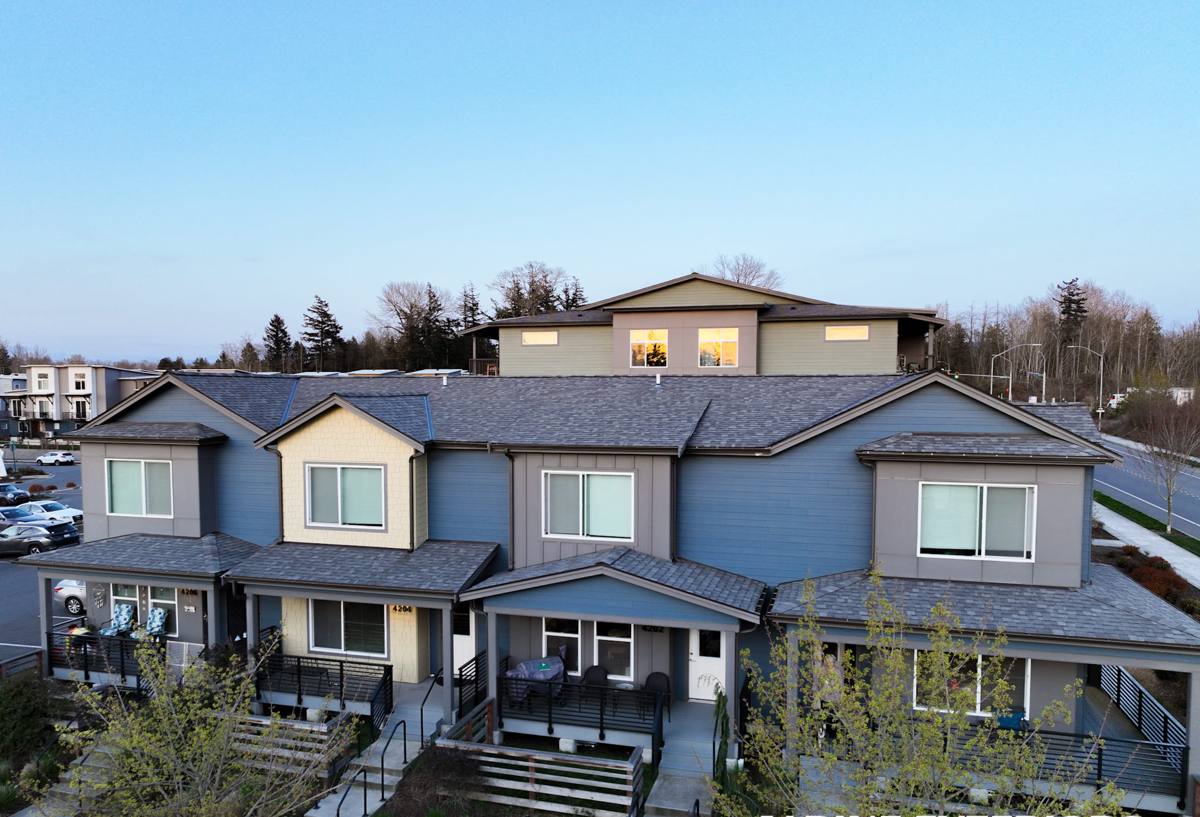
Why James Hardie Fits This Kind of Climate
James Hardie fiber cement is engineered in specific formulations for different climate zones, and the HZ5 line used in this region is built for wetter, cooler coastal conditions rather than a generic one-size-fits-all product. That distinction matters in Lynnwood, where the siding is rarely given a long stretch of dry weather to fully shed moisture between storms.
A few reasons fiber cement holds up well here:
- It's dimensionally stable — it doesn't swell, cup, or warp the way wood-based sidings can when humidity swings between a wet winter and a drier summer.
- It's non-combustible, which matters for insurance and code considerations independent of the moisture question.
- The factory-applied ColorPlus finish is baked on under controlled conditions and holds color and adhesion far longer than field-applied paint on porous wood siding, which reduces how often a homeowner has to repaint just to keep the wall protected.
- It doesn't rot. Moss and algae can still grow on its surface the same as they can on any exterior material, but they aren't feeding on the substrate the way they can with wood or wood-composite products.
None of this makes a house maintenance-free — nothing in this climate is — but it removes the moisture-driven failure modes that make other siding choices a bigger long-term liability along Puget Sound.
What a Correct James Hardie Installation Actually Involves
James Hardie siding performs the way it's designed to only when it's installed to the manufacturer's specifications. In a wet, salt-exposed climate, skipping or shortcutting these details is where most siding failures actually start — not in the product itself.
The details that matter most locally
- Corrosion-resistant fasteners. Given the salt exposure in this area, fastener choice isn't optional — the wrong nail or screw will streak and corrode well before the siding itself shows any wear.
- Proper flashing and a continuous weather-resistive barrier behind the siding at every window, door, and penetration, so any water that does get past the surface has somewhere to go besides the sheathing.
- Correct clearance from grade, decks, and roof lines, so splashback and roof runoff don't sit against the bottom edge of the siding.
- Proper lap spacing and fastening pattern so panels can drain and aren't over-fastened in a way that restricts normal movement.
- Sealed and painted cut edges on any field-cut ColorPlus siding, since a raw cut edge is the one part of the panel not protected by the factory finish.
- Correct caulking at trim and joints — enough to seal the gap without trapping water behind it.
Any one of these steps done poorly can undercut an otherwise good product. This is why the installation crew matters as much as the siding brand.
How Our Process Works on a Lynnwood Project
- On-site assessment. We look at the existing siding, trim, and sheathing condition, check for hidden moisture or rot, and identify anything the tear-off will need to address before new siding goes up.
- Removal and substrate check. Old siding comes off, and we inspect the sheathing underneath — any soft or water-damaged sections get repaired before anything new is installed over them.
- Weather barrier and flashing. A continuous weather-resistive barrier goes on, with flashing detailed at every window, door, and penetration before siding starts.
- Installation to spec. James Hardie panels or lap siding go up with the correct fasteners, spacing, and clearances for this climate zone.
- Finish work. Cut edges are sealed, joints are caulked correctly, and any touch-up painting is done to match the ColorPlus finish.
- Walk-through and cleanup. We review the completed work with the homeowner and clear the site of debris and old material.
Choosing a Product Line and Look for This Area
James Hardie makes several distinct product lines, and the right one depends on the home's style and how much of the existing look the homeowner wants to keep versus change.
| Product Line | Look | Best Fit |
|---|---|---|
| HardiePlank lap siding | Traditional horizontal lap | Most common choice for full re-sides; matches typical Pacific Northwest home styles |
| HardiePanel | Vertical or board-and-batten | Modern facades, accent walls, gable ends |
| HardieShingle | Staggered or straight-edge shingle profile | Craftsman or cottage-style homes wanting a shingled look without wood's maintenance |
| HardieTrim | Smooth or textured trim boards | Window, door, and corner trim to match the main siding |
ColorPlus finishes come in a range of factory colors that don't require field painting at install, while primed panels are available for homeowners who want a custom field-applied color. In a climate where repainting is a real maintenance event, most homeowners here find the factory finish worth the more limited color selection.
What Actually Drives Cost on a Lynnwood Job
We don't quote pricing sight-unseen because the factors below genuinely change the scope of a job, but here's what tends to move the number up or down on projects in this area.
| Factor | Why It Matters Here |
|---|---|
| Home size and story count | More surface area and higher walls mean more material and labor, plus added access equipment for two-story sections |
| Condition of existing sheathing | Homes with hidden moisture damage from prior siding failures need repair before new siding can go on correctly |
| Product line selected | Lap, panel, and shingle profiles differ in material and installation time |
| Trim complexity | Homes with lots of window and gable trim take longer to detail and flash correctly |
| Site access | Tight lots, slopes, or landscaping close to the house can add setup time |
| Tear-off vs. new construction | Removing and disposing of old siding adds labor that new construction doesn't require |
Maintaining James Hardie Siding in a Marine Climate
Fiber cement is low-maintenance compared to wood, but "low-maintenance" isn't "no-maintenance" in a climate like this one. A short annual routine keeps siding performing the way it should:
- Rinse the siding once a year to remove salt film, pollen, and general grime buildup.
- Soft-wash rather than pressure-wash moss or algae growth, especially on shaded or north-facing walls — high-pressure water can force moisture behind laps and trim.
- Check caulking at joints, trim, and penetrations annually, since caulk is the first thing to fail and the easiest to catch early.
- Make sure gutters and downspouts are directing water away from the wall, not dumping it onto a section of siding below.
- Watch for chalking or fading paint as an early signal that a touch-up is due, rather than waiting for visible peeling.
- Look for rust streaking near fastener heads, which can indicate hardware that wasn't rated for this environment.
Why It Matters That We Already Work in Lynnwood
A crew that installs siding across Snohomish County day in and day out learns the local patterns — which neighborhoods have older homes with sheathing issues hiding under the existing siding, how to sequence a tear-off around the wet season, and which flashing and fastener details actually hold up here versus what a generic install manual assumes for a drier climate. That local knowledge doesn't show up on a spec sheet, but it's the difference between a Hardie installation that looks right on day one and one that still looks right after a decade of Pacific Northwest winters.
If you're weighing a siding replacement in Lynnwood and want a straightforward look at your home's specific situation, we're happy to walk the exterior with you and give you a clear picture of what's involved — no pressure, no hard sell. Use the form below to request a free estimate.