 Everett
 Siding Installation for Pinehurst Homes
Pinehurst sits close enough to Puget Sound and the Snohomish County waterways that its homes take on a specific kind of weather stress: salt-laden air moving in off the water, long stretches of driving rain through fall and winter, and a moss season that can run most of the year in shaded yards. None of that is unusual for Everett as a whole, but it adds up differently depending on how a house is sited, how much tree cover surrounds it, and which direction its walls face. A siding installation done for Pinehurst needs to account for all three, not just meet a generic code minimum.
This page is about siding installation specifically — new siding on a home in Pinehurst, whether you're replacing failing material or re-cladding a house that's never had a proper water-management system behind its exterior. We'll cover what the climate demands, what a correct installation actually involves, how our process works, and why hiring a crew that already knows this area matters more than it might seem.
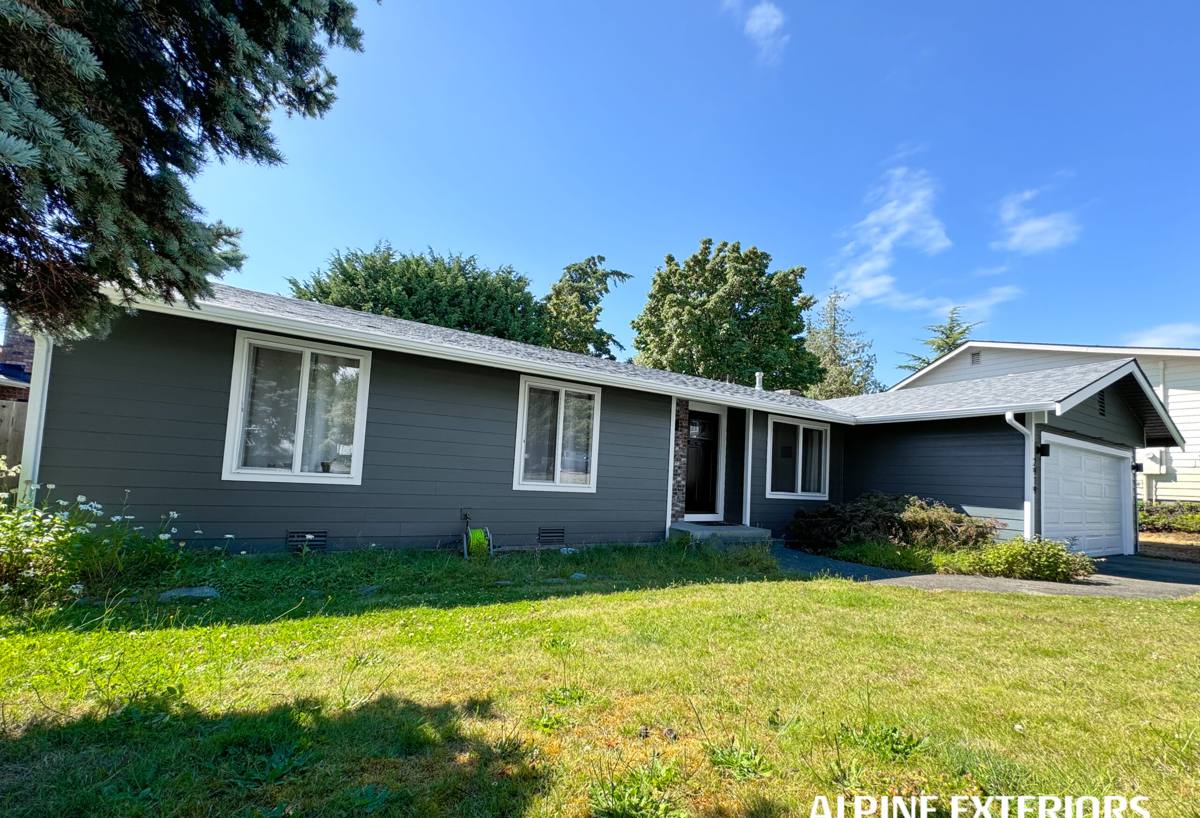
What Pinehurst's Climate Does to Siding Over Time
Salt Air
Homes closer to the water deal with airborne salt that settles on exterior surfaces and, over years, accelerates corrosion on fasteners, flashing, and any metal trim that isn't rated for it. Siding material that absorbs moisture readily gives that salt-laden moisture a place to sit against the wall assembly instead of shedding off.
Driving Rain
Everett's rain doesn't just fall — a good share of it comes in sideways during fall and winter storms, driven by wind off the Sound. That means siding isn't just shedding water off its face; wind pressure is actively pushing moisture toward every seam, joint, and penetration. A siding system with weak seams or poor water-shedding detailing will let that rain find its way behind the cladding.
Moss Season
Shaded lots, mature trees, and damp ground are common in Pinehurst, and together they create ideal conditions for moss and algae growth on north-facing walls and anywhere airflow is restricted. Siding that stays damp longer after a rain — because it absorbs water or sits too tight against landscaping — gives moss more time to take hold, which traps even more moisture against the wall.
Individually, each of these is manageable. Together, over 20 or 30 years, they're exactly the conditions that expose a poorly installed or poorly chosen siding system.
What a Correct Siding Installation Actually Involves
Homeowners often assume siding installation is mostly about the visible product — the boards or panels themselves. In a climate like this, the water-management system behind the siding matters just as much, if not more.
- A continuous, properly lapped weather-resistive barrier (house wrap) installed shingle-style so water drains down and out, never inward
- Correct flashing at every window, door, and penetration, integrated with the WRB rather than just caulked over it
- Proper fastening — the right nail or screw type, spacing, and depth for the specific siding product, since over- or under-driven fasteners are a leading cause of early failure
- Adequate clearance between siding and grade, decks, patios, and roof lines so water and moisture-holding debris can't wick or splash directly onto the material
- Rainscreen or drainage gap detailing where the wall assembly calls for it, so any moisture that does get behind the siding has somewhere to go
- Sealed and back-primed cut edges on any field-cut siding pieces, so factory protection isn't compromised at the cuts
Skip any one of these steps and the siding product itself almost stops mattering — even the best material fails early behind bad flashing or a missing rainscreen. This is the part of the job that doesn't show up in a driveway estimate but is exactly where quality separates over the following decade.
Why We Install Only James Hardie Fiber Cement
We install James Hardie fiber cement siding exclusively. We don't offer vinyl, LP SmartSide, Cemplank, Allura, primed spruce, or cedar as alternatives, and that's a deliberate standard, not a lack of options.
Vinyl is inexpensive and low-maintenance in mild conditions, but it's a petroleum-based product that expands and contracts significantly with temperature swings, can warp or crack under impact, and isn't rated for the kind of wind-driven rain exposure common on Pinehurst's more exposed lots. Engineered wood products like LP SmartSide use a resin-treated wood strand core, which performs reasonably well when installed and maintained precisely, but wood-based substrates are inherently more vulnerable to sustained moisture exposure than fiber cement — and moisture is exactly what this climate provides in volume. Cedar is a beautiful, traditional choice, but it requires ongoing refinishing, is a combustible material, and is one of the more attractive food sources for the moss and biological growth this area is prone to. Other fiber cement brands like Cemplank and Allura are direct competitors to Hardie and share the same basic material chemistry, but we've standardized on Hardie for its specific engineered product lines, factory finish system, and warranty structure — consistency in one system means our crews install it to the same exacting spec on every job.
James Hardie fiber cement is non-combustible, doesn't support moss and algae growth the way wood-based products can, and is engineered specifically for climate zones like this one through its HZ10 product line, which is formulated for wetter, more humid regions. It carries a factory-applied ColorPlus finish that resists fading and doesn't require repainting on the same cycle as field-painted wood or fiber cement, and it comes with a strong transferable limited warranty when installed to Hardie's specifications — which is exactly what our process is built around.
| Factor | Vinyl | Engineered Wood (LP SmartSide) | Cedar | James Hardie Fiber Cement |
|---|---|---|---|---|
| Moisture tolerance | Doesn't absorb, but seams can let water behind panels | Vulnerable if finish is compromised | Absorbs moisture, needs sealing | Engineered to resist moisture damage |
| Moss/algae resistance | Moderate | Lower — organic substrate | Lower — organic substrate | High |
| Combustibility | Melts/deforms under heat | Combustible | Combustible | Non-combustible |
| Finish longevity | Can fade, chalk over time | Field or factory finish, repaint cycle varies | Needs regular refinishing | Factory ColorPlus finish, long fade resistance |
| Typical warranty structure | Prorated, product-only | Limited, product-focused | Often none beyond material defects | Strong transferable limited warranty |
Our Installation Process for Pinehurst Homes
Assessment and Measurement
We start by walking the exterior and looking specifically at the conditions that matter most locally: which walls face prevailing wind and rain, where trees or fences limit sun and airflow, where existing moss or moisture staining already shows up, and where grade, decks, or hardscaping sit too close to the wall.
Tear-Off and Sheathing Check
Old siding comes off, and we inspect the sheathing underneath for rot or water damage before anything new goes on. Covering damaged sheathing with new siding just hides a problem that gets worse.
Water-Resistive Barrier and Flashing
We install a continuous WRB and flash every window, door, and penetration before the new siding goes up. This is the step that determines how the wall performs in driving rain, and it's not optional or skippable regardless of budget.
James Hardie Installation to Spec
Fastening, spacing, clearances, and joint treatment all follow Hardie's published installation specifications — this is what keeps the manufacturer's warranty intact and what determines how the siding actually performs over the following decades in this climate.
Final Detailing and Walkthrough
We check clearances at grade and decking, confirm caulking and trim detail, and walk the finished job with the homeowner before calling it complete.
Signs a Pinehurst Home May Need New Siding
Not every home needs full replacement, but certain signs point toward it rather than a patch repair:
- Persistent moss or dark staining that returns shortly after cleaning
- Soft or spongy spots when you press on the siding, especially near the bottom courses
- Visible gaps, warping, or buckling panels
- Peeling or bubbling paint that keeps recurring in the same spots
- Rising energy bills that suggest the wall assembly isn't performing the way it should
- Visible rot or staining on trim boards, corner boards, or around windows
If you're seeing more than one of these, it's worth having the wall assembly looked at — not just the surface material — before deciding between repair and replacement.
What to Ask Before Hiring a Siding Contractor in Pinehurst
- Do you carry current Washington contractor licensing and liability insurance, and can you provide proof?
- Are your installers factory-trained or certified on the specific siding product you're installing?
- Will you provide a written scope that includes the water-resistive barrier and flashing details, not just the finish material?
- What warranty applies to the material, and what warranty applies to your labor and workmanship?
- Can you explain how your installation accounts for wind-driven rain and moss-prone shaded areas specifically?
- Do you have experience working on homes in this area of Snohomish County, and can you speak to conditions specific to it?
A contractor who already works in and around Pinehurst should be able to answer the climate-specific questions without hesitation — that familiarity is exactly why local experience matters more here than a generic siding crew passing through.
Caring for Hardie Siding After Installation
James Hardie siding is low-maintenance compared to wood, but "low-maintenance" isn't "no-maintenance" in this climate. A periodic rinse to clear pollen, dust, and any early moss growth keeps the ColorPlus finish looking its best, and it's worth checking caulking at trim joints every year or two, since caulk wears out well before the siding does. Keep an eye on any spots where sprinklers hit the wall directly or where landscaping has grown up against the siding — those are the conditions that shorten the life of any exterior product, Hardie included.
Get a Straightforward Estimate
If your Pinehurst home needs new siding — or you're just not sure whether what you have will hold up through another wet season — we're happy to take a look and give you an honest, no-pressure assessment. Use the form below to request a free estimate.