 Everett
 Why Riverside Siding Takes More Punishment Than It Looks Like
Riverside sits close to the water, and that changes what a siding job has to survive. Air moving up from Puget Sound and the surrounding waterways carries fine salts that settle on exterior surfaces day after day. Those salts don't damage siding all at once — they work slowly, at fastener heads, at cut edges, at any seam where a finish has started to fail. On top of that, Snohomish County gets driving rain, the kind that comes in sideways during fall and winter systems rather than falling straight down, which means water gets pushed into laps and seams that would stay dry in a gentler climate. Then there's moss. Around here it isn't really a season so much as most of the year, and Riverside's mix of mature trees and shaded lots gives moss and algae exactly the damp, low-sun conditions they need to take hold, especially on north-facing walls and anywhere an eave blocks direct sun.
The Combination Homeowners Underestimate
Any one of these on its own is manageable. Together, on an aging installation, they compound each other. Moss holds moisture against the wall longer than bare siding would. That moisture accelerates corrosion at fastener heads already weakened by salt exposure. And once corrosion opens a gap at a nail or a seam, driving rain finds it fast. By the time a homeowner notices a soft spot or a stain, the underlying problem has usually been building for a couple of seasons, not a couple of weeks.
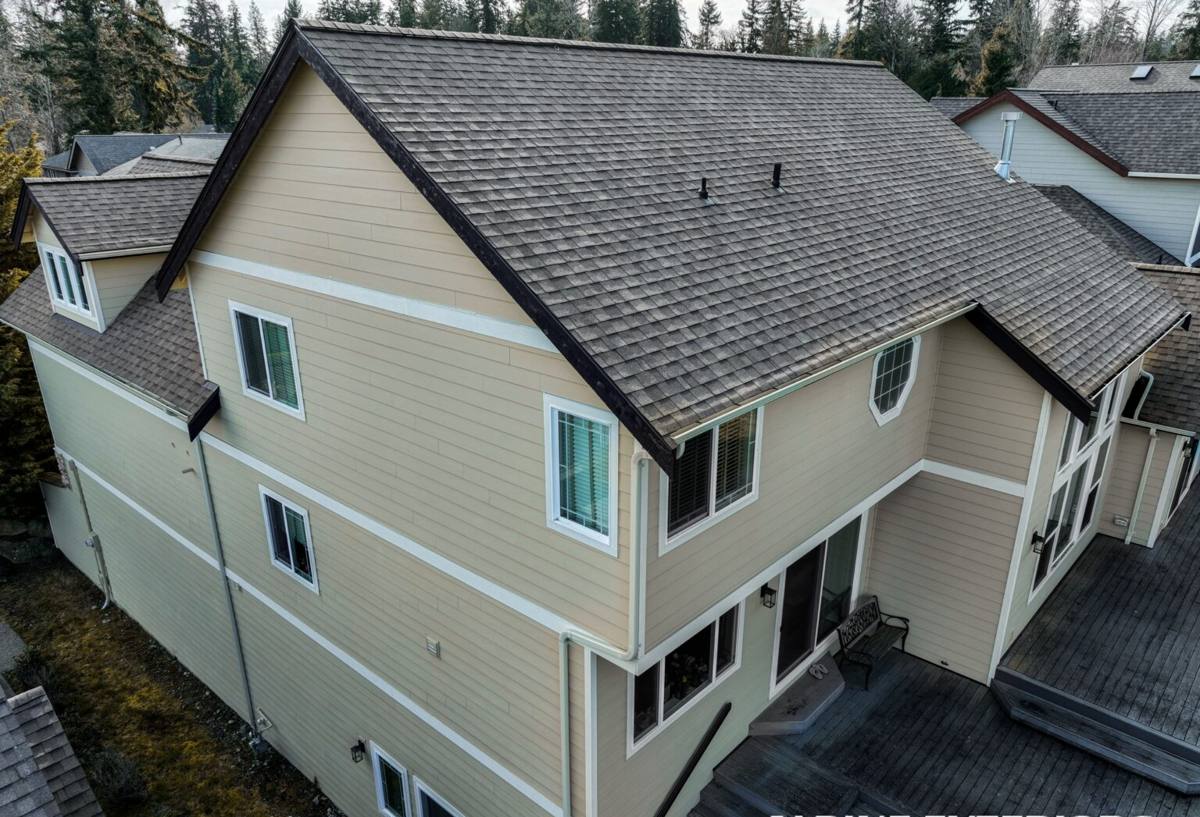
What a Correct Siding Replacement Actually Involves
Siding replacement done right is not just swapping old panels for new ones. It's a chance to fix everything behind the siding that you can't see once it's back on the wall — and in a climate like this, that hidden layer matters as much as the visible finish.
Under the Old Siding
Once the old siding comes off, the sheathing underneath gets inspected for soft spots, delamination, or rot, particularly around windows, doors, and anywhere the old siding showed staining or gaps. Any damaged sheathing gets replaced before anything new goes up — installing new siding over compromised sheathing just buries the problem for the next owner to find.
The Water-Resistive Barrier and Flashing
A weather-resistive barrier goes over the sheathing to create a drainage plane, and flashing gets installed at every window, door, and horizontal trim transition so that any water that gets behind the siding has a clear path down and out rather than a place to collect. This detail matters more in Snohomish County than in drier climates, because driving rain will eventually test every flashing detail on the house, not just the obvious ones.
Fastening and Clearances
Fiber cement siding has a manufacturer-specified fastening schedule — nail type, spacing, and placement relative to panel edges — and it has minimum clearances from grade, roof lines, and decks so that water and moisture-laden debris don't sit against the bottom edge of the siding. Skipping or guessing at these specs is one of the most common reasons a siding job fails early, regardless of what material was used.
Signs a Riverside Home Needs Replacement, Not Just Repair
Not every siding problem calls for a full replacement. But there's a point where patching individual boards stops making sense and a full replacement becomes the more honest recommendation. Watch for:
- Soft or spongy spots when you press on the siding, especially near the bottom courses or under windows
- Persistent moss or algae staining that comes back within a season or two of cleaning
- Paint or finish that's failing across multiple walls rather than one isolated area
- Visible gaps, warping, or buckling at seams and butt joints
- Rust streaking around fasteners, a sign the fastener itself is corroding
- Rot or discoloration on the sheathing or trim visible at any exposed edge
- Musty smells or interior moisture issues on walls that back up to the exterior siding
If you're only seeing one or two of these on a limited section of the house, targeted repair may still make sense. Once several of these show up across different walls, that usually means the underlying water management has failed broadly, and repair becomes a short-term patch on a bigger problem.
Why We Install Only James Hardie Fiber Cement
We don't install vinyl, LP SmartSide, Cemplank, Allura, or bare cedar and primed spruce siding. That's a deliberate standard, not a lack of familiarity with those products. Vinyl moves with temperature swings and can warp or crack at fastener points over time; wood-based and OSB-core products like LP SmartSide depend heavily on caulking and finish maintenance to keep moisture out, which is a hard promise to keep in a climate with this much sustained rain and moss growth. Cedar and primed spruce look great on day one but require an ongoing maintenance commitment — refinishing, caulking, moisture checks — that most homeowners don't sign up for once the newness wears off.
James Hardie fiber cement is non-combustible, holds its shape and dimensions through wet-dry cycles far better than wood-based products, and comes with a factory-applied ColorPlus finish that's baked on rather than field-painted, which matters a lot when the siding is going to spend years in salt air and driving rain. Hardie also engineers specific product lines for different climate zones — the HZ5 and HZ10 designations reflect real differences in moisture and freeze-thaw performance, not just marketing labels — so the product installed on a Riverside home can be matched to what this specific climate actually demands. Backed by a strong transferable warranty and a installation record we can stand behind, it's the one product we're willing to put our name on.
Our Process for a Riverside Siding Replacement
- On-site assessment. We walk the home, check current siding condition wall by wall, and look for the specific stress points — shaded north walls, low-clearance areas near grade, spots where moss keeps returning.
- Sheathing and structure check. Once we know what's under the existing siding (often confirmed during tear-off), we scope any repair work needed before new siding can go on.
- Product and color selection. We walk through Hardie panel and plank profiles and ColorPlus color options suited to the home and the neighborhood's look.
- Tear-off and inspection. Old siding comes off, sheathing gets inspected and repaired as needed, and any hidden moisture damage gets addressed before anything new is installed.
- Water-resistive barrier and flashing. A continuous drainage plane and correct flashing at every penetration and horizontal transition go in before siding starts.
- Siding installation to spec. Fastening schedule, clearances, and seam treatment follow Hardie's published specifications, not shortcuts.
- Final walk-through. We review the finished work with the homeowner and flag any maintenance items specific to the home's exposure.
Cost Factors for a Riverside Siding Replacement
Every home is different, but most full tear-off and replacement projects in this area land somewhere in a broad mid-five-figure range, with a handful of factors doing most of the work in moving a project up or down within that range.
| Factor | Why It Moves the Price |
|---|---|
| Home size and wall complexity | More square footage and more corners, gables, and trim details mean more material and labor |
| Condition of sheathing underneath | Hidden rot or moisture damage found during tear-off adds repair scope that can't be quoted sight-unseen |
| Existing siding type | Some materials are more labor-intensive to remove and dispose of than others |
| Hardie product line and profile | HZ5 versus HZ10, and plank versus panel versus shingle-style profiles, carry different material costs |
| Trim and accessory work | Window and door trim, fascia, and soffit work bundled into the same project changes total scope |
| Access and site conditions | Mature trees, narrow side yards, and limited equipment access near the water can add labor time |
Why a Local Everett Crew Matters for This Job
Siding installation specs are the same on paper everywhere, but knowing how a specific neighborhood's exposure plays out over time is something you only get from working there repeatedly. A crew that's done siding replacements around Riverside knows which walls tend to hold moss longest, which lot layouts create shaded, slow-drying conditions, and how the local permitting and inspection process works with the City of Everett and Snohomish County. That local pattern recognition doesn't replace following manufacturer specs — it adds to it, by pointing attention at the details that matter most on this specific type of property before a problem shows up.
It also means being reachable after the job is done. If a question comes up two years in about a moss patch or a seam, a local crew that's still working in the same neighborhood is a lot easier to get back out to the house than a company that only passed through once.
Keeping New Siding Looking Right Through Moss Season
Correctly installed Hardie siding with a factory ColorPlus finish needs far less maintenance than wood-based alternatives, but "less" isn't "none." A periodic gentle rinse — not a high-pressure blast that can drive water behind laps — keeps organic growth from establishing on shaded walls. Keeping nearby vegetation trimmed back so more sun and airflow reach the siding surface goes a long way toward slowing moss regrowth on the walls that are prone to it. And a quick visual check after major storms, looking at trim, flashing, and the bottom courses near grade, catches small issues while they're still small.
If you're seeing early wear on your current siding or you're just ready to stop maintaining a material that keeps demanding attention, we're glad to take a look and talk through what a correct replacement would involve for your specific home. Fill out the form below for a free, no-pressure estimate.