 Everett
 New Roof Installation Built for South Everett's Weather
South Everett sees the same weather pattern as the rest of Snohomish County, but the neighborhood's mix of mature tree cover, established ranch-style homes, and newer construction near the busier corridors means roofs here take on that weather in slightly different ways from house to house. A roof shaded by tall evergreens holds moisture longer than one that gets full sun most of the day. A roof on a home built in the 1970s or 80s often has less attic ventilation than current code calls for. None of that is a problem you can diagnose from a truck driving by — it's why a new roof installation in this area should start with someone actually looking at your specific roof, not a generic quote.
This page is about one job: full roof replacement for homes in South Everett. Not repairs, not a patch on a leak — a complete new roof, done to handle salt-tinged air off Puget Sound, driving rain that comes in sideways during winter storms, and a moss season that runs longer here than it does in drier parts of the state.
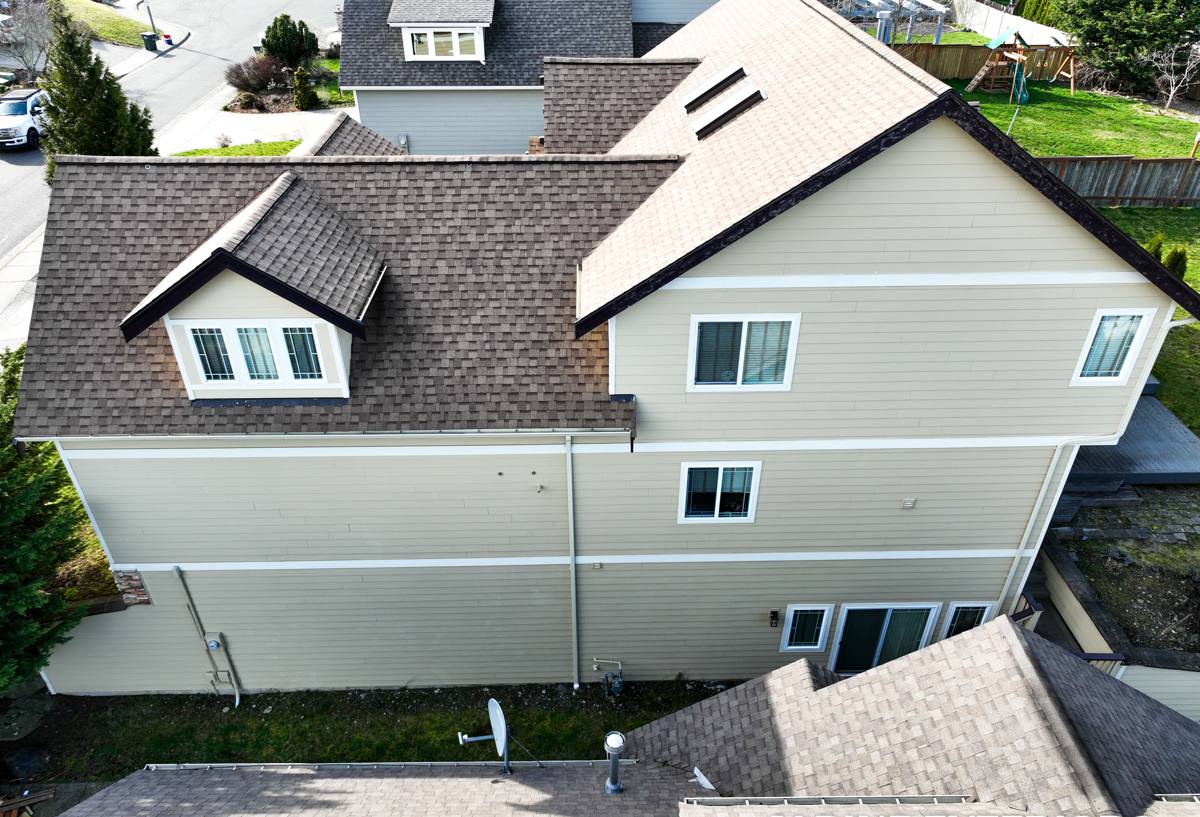
What Local Climate Does to a Roof Over Time
Everett's proximity to the Sound means the air carries a faint but constant load of salt and moisture, which accelerates corrosion on exposed metal fasteners, flashing, and vents that aren't rated for it. Combine that with our rainfall totals — heavy, sustained, and spread across most of the year — and you get a few predictable failure patterns:
Moss and Organic Growth
Moss doesn't just sit on top of shingles looking bad. Its roots work into the granule surface, and as it grows it holds water against the roofing material far longer than open air would allow. On north-facing slopes and anywhere shaded by trees, that moisture cycle — wet, never fully dry, wet again — is what shortens shingle life long before the material would otherwise wear out.
Driving Rain and Wind-Driven Water
Storms coming off the Sound often push rain at an angle instead of straight down. That matters at every horizontal joint on a roof — valleys, step flashing against walls, and the transitions around chimneys and skylights. A roof that would be fine in calm rain can leak in a wind-driven storm if those details weren't built with enough lap and the right underlayment.
Long Wet Stretches, Short Drying Windows
Underlayment and decking that stay damp for extended periods are more prone to rot, especially where ventilation is marginal. This is less about any single storm and more about the cumulative effect of a roofing system that never gets a real chance to dry out between fall and spring.
Signs You Need Full Replacement, Not Another Repair
Not every roof problem calls for tearing the whole thing off. But there's a point where repeated patching stops making financial sense. We look for:
- Granule loss heavy enough that you can see bare fiberglass mat on multiple shingles, not just one weathered spot
- Soft or spongy decking felt underfoot in the attic, especially near eaves or valleys
- Moss or moisture staining that returns within a season or two of cleaning
- Shingles cupping, curling, or losing their seal across large sections rather than isolated spots
- A roof already past or close to the end of its rated lifespan with more than one active leak point
- Daylight visible through the roof deck from inside the attic
If your roof shows one or two of these in isolation, a repair may still make sense. When several show up together, replacement is usually the more honest recommendation — and we'll tell you that directly rather than stringing out repairs on a roof that's already at the end of its service life.
What a Correct New Roof Installation Actually Includes
"New roof" can mean very different things depending on what corners get cut. A correct installation for this climate includes each of the following — not as upsells, but as baseline requirements:
- Full tear-off to the decking — never a layover on top of existing shingles
- Decking inspection, with any soft, delaminated, or rotted sheathing replaced before anything new goes down
- Ice-and-water shield membrane at eaves, valleys, and any low-slope transitions, not just where code requires the minimum
- A synthetic underlayment across the full roof, rated for extended exposure to wind-driven moisture
- Properly lapped metal drip edge at eaves and rakes
- New step and counter-flashing at every wall, chimney, and skylight intersection — reused old flashing is a common source of future leaks
- Balanced intake and exhaust ventilation sized to the actual attic, not a default vent count
- Fastening pattern and nail placement matched to the manufacturer's specification for our wind exposure
- Full site cleanup, including a magnetic sweep for stray nails
- A final walkthrough inspection before we consider the job done
Material Options for South Everett Homes
There's no single "best" roofing material — the right choice depends on your roof's exposure, your home's style, and how long you plan to own it. Here's how the common options hold up against our specific conditions:
| Material | Typical Lifespan Here | Moss & Rain Performance | Trade-offs |
|---|---|---|---|
| Architectural (dimensional) asphalt shingle | 25–30 years | Good — thicker profile sheds water well and holds up to algae-resistant granule treatments | Mid-range cost; most common choice for the area |
| 3-tab asphalt shingle | 15–20 years | Fair — thinner mat means faster granule loss under sustained wet conditions | Lowest upfront cost, shortest lifespan locally |
| Standing seam metal | 40–50+ years | Excellent — sheds moss buildup and handles driving rain with minimal seams | Higher upfront cost; requires correct fastener spec to resist salt-air corrosion |
| Synthetic/composite shake | 30–40 years | Good — mimics cedar shake appearance without the moisture absorption issues real wood shake has here | Higher cost than asphalt; good option where a wood-shake look is wanted |
Whatever material you choose, we install to manufacturer spec and won't push a product just because it carries a better margin. If a client wants a lower-cost option, we'll explain the maintenance trade-offs honestly rather than talk them out of their own budget decision.
Our Installation Process
- On-site evaluation. We inspect the current roof, attic ventilation, and decking condition, and give you a written estimate — no guessing from photos or satellite views.
- Material selection and permit. We help you weigh the options above against your budget and timeline, then pull the required permit through the City of Everett or Snohomish County, depending on your property.
- Scheduling around weather. Roofing here means working around rain windows. We plan tear-off in sections when needed and use temporary dry-in protection so your home is never left exposed overnight.
- Tear-off and decking repair. Old material comes off down to the deck, and any compromised sheathing is replaced before anything new is installed.
- Underlayment and flashing. Ice-and-water membrane, synthetic underlayment, drip edge, and new flashing go in first — this layer does most of the actual work keeping water out.
- Roofing material installation. Shingles, metal panels, or synthetic material are installed to manufacturer spec, with attention to nailing pattern and exposure for our wind conditions.
- Ventilation finishing. Ridge and soffit vents are balanced so the attic can actually dry between wet stretches instead of trapping moisture.
- Cleanup and walkthrough. Full site cleanup, magnetic nail sweep, and a walkthrough so you know exactly what was done and what to expect going forward.
Ventilation and Long-Term Moss Prevention
A new roof's biggest long-term enemy in this climate isn't the rain hitting it directly — it's trapped moisture underneath. Attics that can't exchange air properly stay damp longer after storms, which speeds up moss growth on the surface and can lead to sheathing rot from underneath, out of sight. Balanced intake (at the soffits) and exhaust (at the ridge) is not optional in our climate; it's one of the most important parts of the job and one of the easiest to get wrong if it's treated as an afterthought.
We also talk with homeowners about tree cover. If large evergreens keep sections of your roof shaded most of the day, that's useful information for material choice and for setting expectations about periodic moss treatment down the road — a new roof reduces the problem significantly but doesn't eliminate the need for occasional maintenance on shaded slopes.
Permits, Timeline, and Weather Scheduling
Roof replacement in Everett and unincorporated Snohomish County requires a building permit, which we handle as part of the job. A typical single-family roof replacement takes one to three days of active work once we're on-site, though the exact timeline depends on roof size, complexity, and how many layers of decking repair are needed. The bigger variable locally is weather — we build scheduling flexibility into every project so a rain system moving through doesn't leave your home exposed mid-tear-off.
Why a Crew That Already Works South Everett Matters
A roof crew that works this specific area regularly has already seen how moss behaves on the shaded lots common here, how wind-driven rain tends to find weak spots in flashing during winter storms, and what ventilation setups tend to be underbuilt in homes of a certain age. That's not something you can substitute with general roofing experience from a drier region or a crew that mostly works new construction in a different climate. Knowing the local permitting process for Everett and Snohomish County also keeps the project moving instead of stalling on paperwork.
If your roof is showing its age or you've had recurring leaks despite repairs, we're happy to take a look and give you a straight answer — replacement if it's warranted, repair if it isn't. Reach out for a free, no-pressure estimate using the form below.