 Everett
 Why Delta Decks Wear Differently
Delta sits close enough to the water and the marine weather patterns that move through Everett and greater Snohomish County that its decks take on a specific combination of stresses: salt-tinged air that speeds up corrosion on fasteners and hardware, driving rain that gets pushed sideways under railings and against ledger boards, and a moss season that can run from fall through spring on any deck that doesn't get regular sun. None of these things individually destroys a deck overnight. Together, over several winters, they find every weak point — a missed coat of sealant, a fastener that wasn't rated for exterior use, a ledger flashing detail that was never quite right.
We've repaired enough decks in this part of Everett to recognize the pattern early. A deck here doesn't fail because someone built it badly on purpose — it fails because the original build didn't account for how much moisture this specific area sees, or because normal wear-and-tear maintenance got skipped for a year or two and the damage compounded.
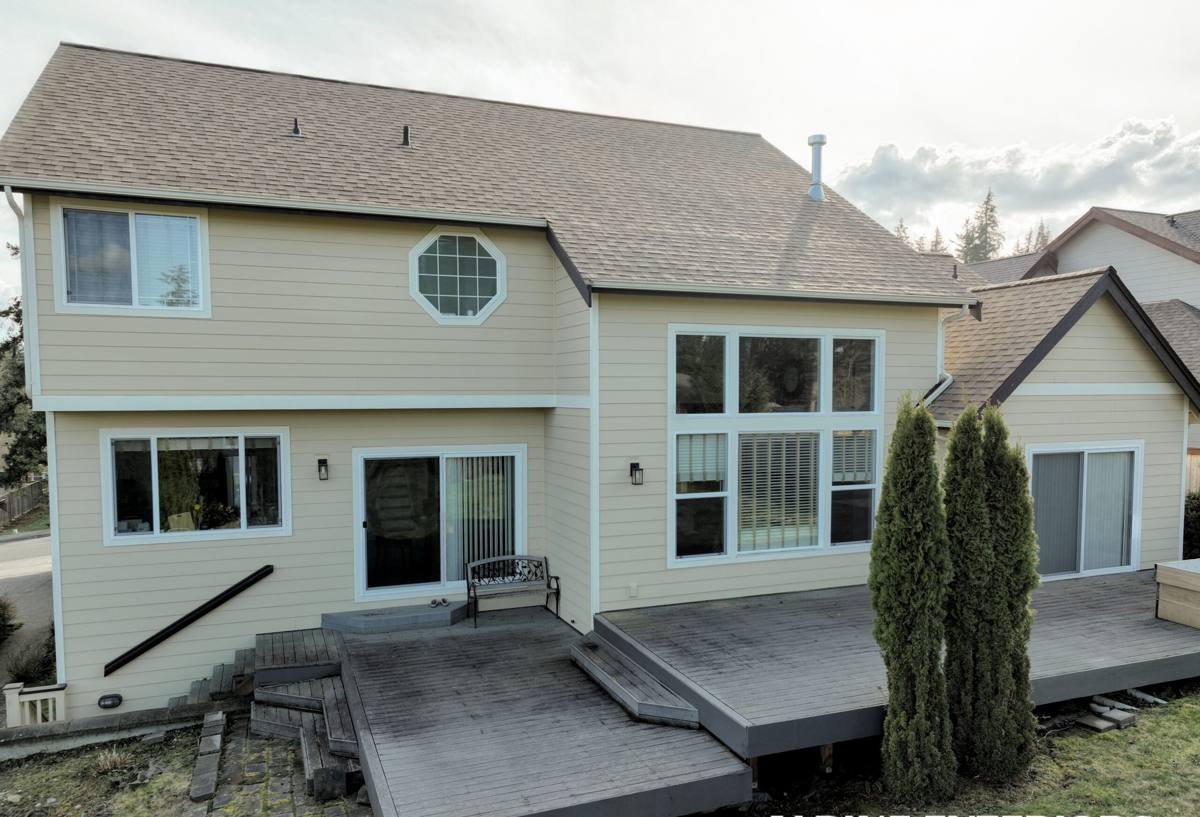
Signs a Delta Deck Needs Repair
Most homeowners call us after noticing one obvious problem — a soft spot underfoot, a wobbly railing — but a real inspection usually turns up two or three additional issues that haven't announced themselves yet. Here's what we look for, and what you can check yourself before calling anyone:
- Soft, spongy, or springy decking boards, especially near the house or in shaded corners
- Green or black staining that doesn't wash off with a deck cleaner — often moss or algae that's gotten a foothold in the wood grain
- Rust streaking around fasteners or post bases, a sign the hardware is corroding faster than it should
- Gaps or separation where the deck meets the house (the ledger board connection)
- Railings or posts that shift or flex when you lean on them
- Standing water that doesn't drain within a few hours after rain
- Visible cracking or splitting along board edges, particularly on south- or west-facing sections that see more sun-to-rain cycling
Any one of these on its own might be a minor fix. Several together usually mean the deck's underlying structure — the joists, the ledger connection, or the post footings — needs a closer look, not just a surface patch.
What's Actually Failing: Common Problems We Find
Ledger Board and Rim Joist Rot
The ledger board — where the deck attaches to the house — is the single most common failure point we see. Water works its way behind the flashing (or through a flashing detail that was never installed correctly to begin with) and sits against the house rim joist. Because this area stays damp and shaded, it's also where moss and fungal growth tend to start. By the time staining shows up on the siding above the deck, the wood behind it has often been wet for a season or more.
Fastener and Hardware Corrosion
Salt-influenced air moving in off the water accelerates corrosion on any fastener, joist hanger, or post base that isn't rated for it. We regularly find galvanized hardware that's rusted through in areas that see more airborne moisture, while the same hardware on a more sheltered deck a few blocks away is still holding up fine. This is a case where the fix isn't "better wood," it's the right-grade metal.
Moss and Algae Damage on Decking Surfaces
A long moss season means any deck surface that doesn't dry out regularly — under trees, on the north side of the house, behind a solid rail — stays damp longer than the wood or composite material is designed to tolerate. On wood decking this leads to soft, punky boards. On composite decking it's usually cosmetic staining, but it can hide slip hazards and, if ignored for years, contribute to moisture intrusion at fastener points.
Post and Footing Movement
Freeze-thaw cycles and saturated soil around footings can cause posts to shift slightly over time. It's rarely dramatic, but a post that's moved even half an inch changes how load is distributed across the frame, and it's often the real reason a railing "just feels loose" even after you tighten every visible bolt.
Repair vs. Replace: How We Make the Call
Not every deck problem means a full rebuild, and we don't push for one when a targeted repair will hold up. The honest answer usually comes down to how much of the structural frame — as opposed to just the surface decking — is affected.
| Factor | Usually a Repair | Usually a Replacement |
|---|---|---|
| Decking boards | A few soft or cracked boards, rest of deck sound | Widespread softness across most of the surface |
| Ledger board | Flashing failure caught early, wood still solid | Rot has spread into the rim joist or house framing |
| Framing/joists | Isolated joist damage near a leak point | Multiple joists compromised or undersized for current code |
| Railings/posts | Loose connections, minor hardware corrosion | Posts rotted at the base or footings failing |
| Age of deck | Under 15 years, built to a reasonable standard | Original build has multiple outdated or unsafe details |
When we're on-site, we're checking underneath the deck as much as on top of it. A deck can look fine from the yard and still have a ledger connection that's been quietly failing for two winters.
Our Repair Process
1. Inspection From the Ground Up
We start underneath — checking joists, the ledger connection, post bases, and footings — before we look at the surface. This is where the real problems usually are.
2. A Straight Answer on Scope
You get a clear explanation of what's failing, why, and what it'll take to fix it right, including whether a repair makes sense or whether you're better served putting that money toward a partial or full rebuild. We're not going to talk you into more work than the deck needs.
3. Correcting the Cause, Not Just the Symptom
If we're replacing rotted decking near the house, we're also checking and correcting the flashing detail underneath it — otherwise the same spot fails again in a few years. If hardware is corroding, we upgrade to fasteners and connectors rated for the exposure this location actually sees.
4. Matching Materials Properly
Repairs get tied into the existing structure with framing lumber and connectors rated for exterior, moisture-exposed use — not general-purpose hardware that happens to be cheaper. Where decking boards are replaced, we match species and finish as closely as the existing deck allows, or talk through composite options where it makes sense for a section that struggles with moss regardless of material.
5. Cleanup and a Final Walkthrough
We walk the finished repair with you, point out what was fixed and why, and flag anything else worth keeping an eye on going forward.
Materials: What Holds Up Here vs. What Doesn't
For framing and structural repairs, we use lumber and hardware rated for the actual moisture and air exposure of the site — not just whatever meets a minimum code standard. In areas with more salt-air influence, that often means stepping up to stainless or heavy hot-dip galvanized fasteners and connectors rather than standard galvanized, since the cost difference is small relative to the labor of redoing a repair in a few years.
For decking surfaces, both quality pressure-treated wood and composite decking have a place, and the right call depends on the specific deck — how much shade it gets, how exposed it is to wind-driven rain, and what the homeowner wants for long-term upkeep. Wood costs less upfront and can be repaired board-by-board, but needs periodic cleaning and sealing to resist moss and moisture in a climate like this one. Composite costs more upfront and doesn't need sealing, but still needs regular cleaning to prevent surface algae buildup in shaded, damp spots, and isn't always a simple board-by-board repair if it's damaged.
Keeping a Repaired Deck in Good Shape
A repair holds up a lot longer with basic seasonal attention. This is the same checklist we walk homeowners through after finishing a job:
- Sweep leaves and debris off the deck regularly through fall — trapped organic material holds moisture and feeds moss growth
- Clean visible moss or algae as soon as it appears rather than waiting for it to spread
- Check that gaps between boards stay clear so water can drain instead of pooling
- Inspect the ledger board area (where the deck meets the house) once a year for staining or soft spots
- Look at railing connections and post bases for movement or rust each spring
- Reseal or refinish wood decking on the manufacturer's recommended cycle, not just when it starts looking gray
- Keep gutters and downspouts near the deck clear so runoff isn't draining directly onto or under it
Why a Crew That Already Works in Delta Makes a Difference
Deck repair isn't a one-size-fits-all trade. A crew that mostly works drier inland areas can do a technically fine repair and still miss the details that matter here — the flashing tolerance that a marine climate demands, the hardware grade that actually holds up to salt-influenced air, the framing choices that account for a moss season lasting several months rather than a few weeks. We work on decks throughout Everett and Snohomish County regularly enough to know which failure points show up again and again in this specific area, and we build repairs to address those, not just the generic version of the problem.
That local familiarity also means a more accurate estimate the first time — we're not guessing at what a Delta deck typically needs, we're applying what we've already seen on similar homes nearby.
Get a Straight Assessment of Your Deck
If your deck has soft spots, moss you can't keep ahead of, or just doesn't feel as solid as it used to, it's worth getting a professional look before those issues spread further into the frame. We offer free, no-pressure estimates — come find out what's actually going on underneath, and what it'll take to fix it right.