 Everett
 Edmonds Roofs Answer to a Different Climate Than the National Averages
Asphalt shingle manufacturers publish lifespan ratings based on a moderate, average climate — the kind of weather that doesn't really exist along this stretch of Puget Sound. Edmonds sits on the water in Snohomish County, and a roof here spends its life fighting three things at once: salt-tinged air moving off the Sound, rain that comes in sideways during winter storms instead of falling straight down, and a moss season that can run most of the year on shaded or north-facing slopes. None of that means asphalt shingles are the wrong choice — they're still the most common roofing material on Edmonds homes for good reason — but it does mean the material, the details underneath it, and the maintenance plan all need to be chosen with this specific climate in mind, not a national brochure.
This page is about one thing: asphalt shingle roofing for homes in Edmonds specifically. What the shingles are made of, which grade makes sense here, what a correct installation involves under the surface, and why hiring a crew that already works this area — rather than one passing through from somewhere drier — actually changes the outcome.
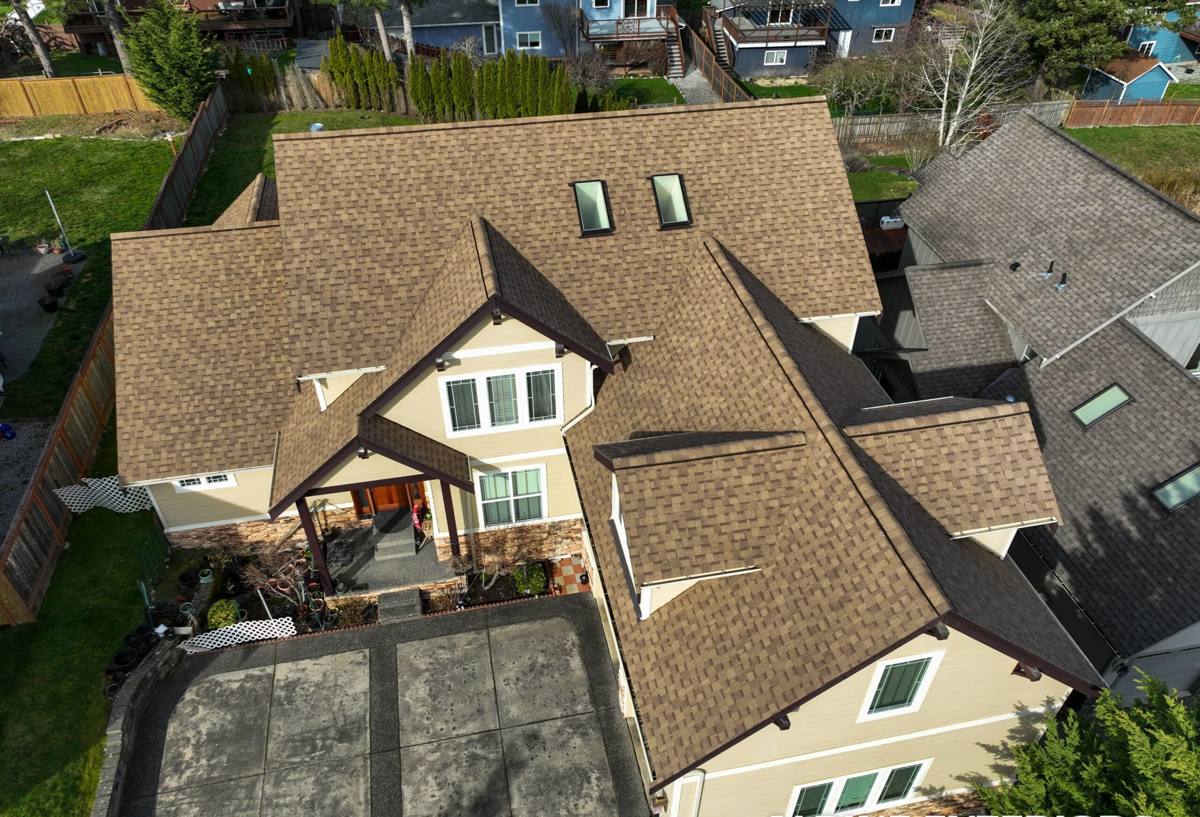
What's Actually in an Asphalt Shingle, and Why the Granules Matter Here
A modern asphalt shingle is built from a fiberglass mat coated in asphalt and topped with mineral granules. The granules do more than give the shingle its color — they're the shingle's actual weather shield, blocking UV light from breaking down the asphalt underneath and giving the surface its fire and impact resistance. When you see bald patches on an old roof or granules collecting in the gutters, that's the shingle's protective layer wearing away, not just cosmetic aging.
In a climate that grows moss as readily as this one does, one detail is worth knowing about before you pick a shingle: algae-resistant (AR) granules, usually copper- or zinc-infused, that resist the dark streaking and biological growth that shows up on standard shingles within a few years on a shaded Edmonds roof. Almost every reputable manufacturer offers an AR line now at a modest price difference over standard granules, and on a roof here — especially anything with tree cover or a north-facing slope — it's one of the easiest upgrades to justify.
Fiberglass Mat vs. Older Organic Mat Shingles
Older organic-mat shingles (paper-based, saturated in asphalt) have largely been phased out in favor of fiberglass-mat shingles, which hold up better against moisture absorption and are lighter and more dimensionally stable. If you're re-roofing a home that still has an old organic-mat roof, you're almost certainly moving to a better-performing product by default.
Architectural vs. 3-Tab: Which Makes Sense for a Home in Edmonds
Homeowners usually land on one of two tiers of asphalt shingle, and the decision matters more here than in a drier climate because of how each handles wind and water.
| Factor | 3-Tab Shingles | Architectural (Laminate) Shingles |
|---|---|---|
| Construction | Single layer, flat profile | Two layers laminated together for thickness and dimension |
| Wind resistance | Lower rated, typically 60-70 mph | Higher rated, commonly 110-130 mph depending on line |
| Realistic lifespan in this climate | On the shorter end of the national range | Holds up meaningfully longer under sustained wet, windy conditions |
| Appearance | Flat, uniform look | Shadow lines and texture, reads closer to slate or shake |
| Upfront cost | Lower | Moderately higher, but usually the better value over the life of the roof |
Given the wind-driven rain events that come through this part of Snohomish County most winters, we lean toward architectural shingles on the large majority of Edmonds re-roofs. The thicker laminate construction handles sustained wind better, sheds water more effectively at the tab edges, and simply lasts longer under conditions that are harder on a roof than a national average climate assumes. Where a 3-tab shingle still makes sense is usually a budget-driven decision on a shorter-hold property — a legitimate choice, just one worth making with eyes open about the tradeoff.
What a Correct Installation Actually Involves
The shingle brand printed on the wrapper matters less than most homeowners assume. What actually determines whether a roof performs for its full expected lifespan is what happens underneath it, and that's where a rushed or corner-cutting install shows up years later as a leak.
Tear-Off and Deck Inspection
A full tear-off to bare decking lets the crew actually see the plywood or OSB underneath — soft spots, delamination, or old water staining that a layover install would simply bury under new shingles. Any damaged decking gets replaced before anything else goes down; skipping this step is one of the most common ways a "cheap" roof job turns into a problem two winters later.
Underlayment
A synthetic or self-adhered underlayment goes down over the deck as the roof's actual second line of defense. In a climate where wind can drive rain up under a shingle tab during a real storm, this layer is what keeps that moisture off the deck rather than letting it soak in.
Flashing
New flashing at every chimney, skylight, sidewall, and valley — not caulk smeared over whatever corroded flashing was already there. Flashing is where the vast majority of roof leaks actually originate, not out in the open field of shingles, and it's also where salt-air corrosion does its slow damage over the years on a roof this close to the water.
Starter Strip, Drip Edge, and Nailing Pattern
A proper starter course at the eaves and rakes, correctly installed drip edge, and shingles nailed to the manufacturer's specified pattern and placement are what the wind rating on the shingle wrapper actually depends on. Under-nailing or nailing too high on the shingle is a common shortcut that voids the manufacturer warranty and shows up as lifted or blown-off shingles in the first real windstorm.
Ventilation
Balanced intake and exhaust ventilation keeps the attic deck dry from the inside, which matters as much as keeping rain out from the outside. Poor ventilation traps moisture against the underside of the deck, which can lead to premature sheathing rot and, in cold snaps, contributes to ice damming at the eaves.
The Three Things Every Edmonds Roof Is Fighting
Salt Air Off the Water
Homes closer to the Edmonds waterfront see more salt-laden air moving across the roof than homes further inland in Snohomish County. Salt exposure doesn't damage the shingles themselves as much as it accelerates corrosion on exposed metal — flashing, nail heads, vent caps, gutter hardware. A fastener or flashing detail that would hold up for decades further inland can start showing rust and losing integrity years sooner this close to the Sound, which is exactly why flashing quality and fastener selection deserve real attention on a waterfront-adjacent install.
Wind-Driven, Sideways Rain
Winter storms here don't just drop rain straight down — wind pushes it sideways and up under roof edges, valleys, and flashing details that would stay dry in a calmer climate. This is the practical reason underlayment quality, valley detailing, and proper shingle overlap matter more here than they would in a region with gentler weather.
Moss Season
Moss doesn't just sit on the surface looking bad — its rhizoids work down into the granule layer, hold moisture against the shingle for months at a stretch, and lift shingle edges as they grow. North-facing slopes and roofs shaded by mature trees, common throughout Edmonds and the surrounding Snohomish County neighborhoods, can develop visible moss within a year or two of a roof going on if it's never treated. Regular light moss removal — never pressure washing, which strips protective granules right along with the moss — is one of the cheapest things a homeowner can do to add real years to a roof's life here.
What Drives the Cost of a Shingle Roof Here
There's no single per-square number that applies honestly to every home, because too many variables change the real cost. The table below is meant to help you understand what you're actually paying for, not to substitute for an in-person quote.
| Cost Factor | Why It Moves the Price |
|---|---|
| Roof pitch and complexity | Steep or cut-up roofs with multiple valleys and dormers take longer and need more safety setup than a simple gable |
| Number of existing layers | A roof with an old layover often needs a full tear-off of two layers, not one, before new shingles go down |
| Decking condition | Soft or rotted sheathing found during tear-off has to be replaced before installation continues |
| Penetrations | Chimneys, skylights, and multiple vent stacks each need individual flashing work |
| Shingle tier | 3-tab, standard architectural, and premium/designer lines carry different material costs |
| Access and site conditions | Tight lots, steep driveways, or limited staging space near the water can affect labor and disposal logistics |
The only way to get a number you can actually plan around is a walk of the roof and an honest look at the deck, not a phone estimate based on square footage alone.
How the Job Actually Runs, Start to Finish
- On-site inspection of the existing roof, attic, and ventilation, with a written scope before any work begins
- Material delivery and site protection — landscaping, siding, and gutters covered before tear-off starts
- Full tear-off to bare decking, with any damaged sheathing identified and replaced
- Underlayment, ice and water shield at eaves and valleys, and new flashing installed at every penetration
- Shingle installation to manufacturer nailing specifications, working field, valleys, and ridge in sequence
- Ridge and soffit ventilation checked and corrected if the existing setup is inadequate
- Full site cleanup, including a magnetic nail sweep of the yard and driveway
- Final walk-through so you can see the finished work and ask questions before we consider the job done
Maintenance That Actually Extends a Shingle Roof's Life Here
- Have moss gently removed (not pressure washed) at the first sign of growth, rather than letting it establish across a full slope
- Keep gutters and valleys clear of needles and leaf debris year-round, not just once in the fall
- Trim back tree limbs that overhang the roof to cut down on shade, debris, and physical abrasion during windstorms
- Walk the property after major windstorms and look for lifted, cracked, or missing shingles from the ground
- Check attic ventilation isn't blocked by insulation, stored items, or debris
- Have flashing around chimneys and skylights inspected periodically, since that's where slow salt-air corrosion shows up first
- Address small leaks immediately — water that reaches the deck rarely stays contained to one spot for long
Why a Crew That Already Works Edmonds Makes a Real Difference
Roofing draws its share of crews that show up after a windstorm, write a fast contract, and are gone by the next season — a pattern homeowners along the Puget Sound corridor have seen before. A crew that works Edmonds regularly knows what this specific stretch of Snohomish County coastline actually does to a roof over time: which slopes hold moss the longest, how much flashing corrosion to expect on a waterfront-adjacent property, and how local permitting works for a straightforward re-roof versus one that needs additional structural attention. That familiarity shows up in fewer surprises during the job and a roof that's built for the weather it will actually face, not a generic install.
A few basic checks are worth running on any roofing contractor before signing anything:
- Confirm current Washington contractor licensing and insurance — ask to see it, not just hear a claim
- Ask how they handle flashing and deck repair, not just which shingle brand they carry
- Get manufacturer warranty terms in writing, including what voids them
- Confirm whether decking replacement is included in the base bid or billed as a surprise add-on
- Check that they're an established local business, not just a phone number that showed up after the last storm
- Get a written, itemized scope of work rather than a one-line price
Getting a Straight Answer About Your Edmonds Roof
A shingle roof is one of the largest investments in a home and one of the least visible once it's finished, which is exactly why the details underneath the surface matter more than the sales pitch on top of it. If you're weighing a repair against a full replacement, or just want an honest read on how much life is left in your current roof, we offer free, no-pressure estimates for homes in Edmonds and throughout Snohomish County. Use the form below to get started.