 Everett
 Glenhaven's Climate Is Harder on Siding Than It Looks
Glenhaven sits inside Everett's Snohomish County weather pattern, which means homes here deal with a specific combination of stresses most of the country never sees: salt-laden air rolling in off Puget Sound, long stretches of driving rain pushed sideways by wind, and a moss and algae season that can stretch from fall through spring. None of these alone is unusual for the Pacific Northwest. Together, over years, they're exactly the conditions that expose weak siding materials and sloppy installation work.
Salt air carries moisture and minerals that accelerate corrosion on fasteners and speed up the breakdown of coatings that aren't built to resist it. Driving rain doesn't just wet a wall's surface — it gets pushed up and under laps, seams, and trim if the assembly behind the siding isn't detailed correctly. And moss doesn't just look bad; where it holds onto a damp siding surface, it keeps that surface wet far longer than it would otherwise dry, which is exactly the kind of prolonged moisture exposure that rots wood-based products and stains poorly-sealed cement board.
None of this means Glenhaven is an unusually hostile place to own a home. It means the siding system and the installation crew both have to be chosen with this specific climate in mind, not a generic one.
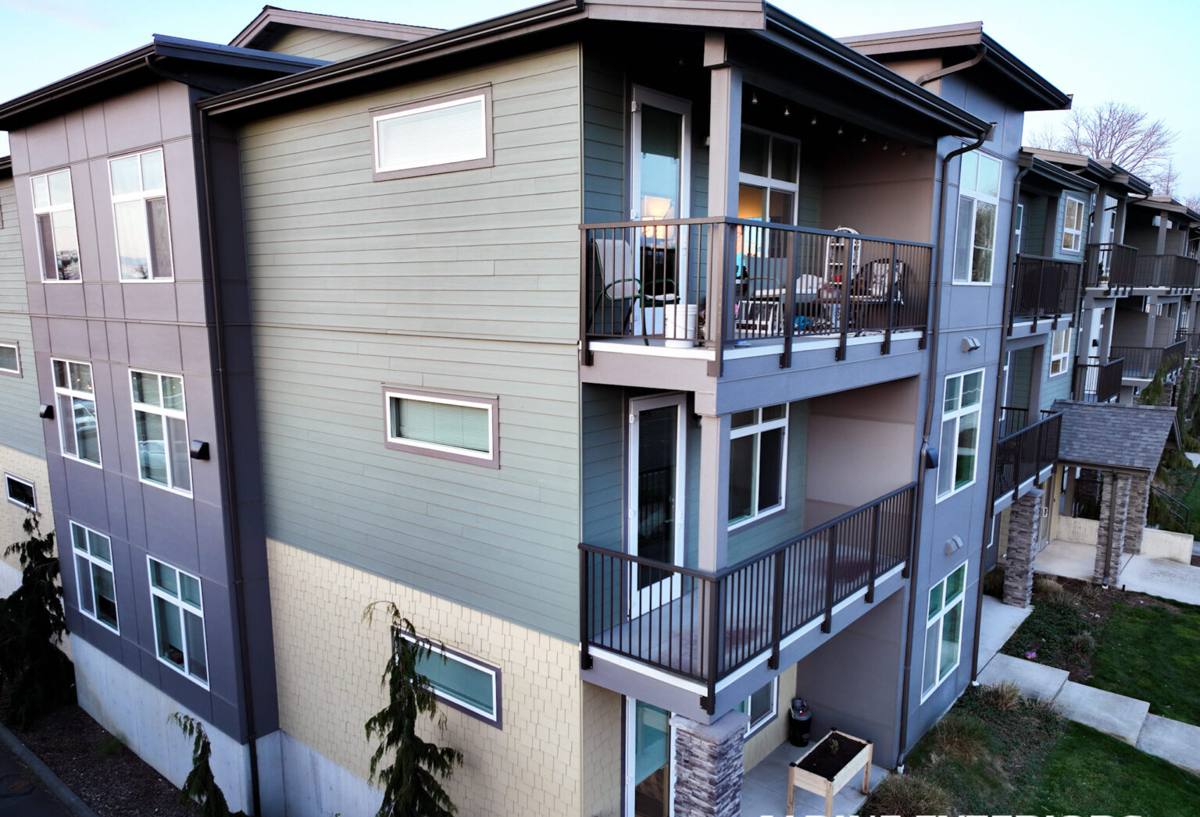
Why We Install Only James Hardie Fiber Cement
We standardized on James Hardie siding for every home we work on, including in Glenhaven, and we don't install vinyl, LP SmartSide, or other fiber cement brands. That's a deliberate decision, not a sales preference. Hardie's fiber cement is non-combustible, dimensionally stable in wet-dry cycling, and manufactured with a factory-applied ColorPlus finish that's formulated to hold color and resist fading in exactly the kind of damp, low-sun climate Everett gets much of the year.
Vinyl siding can warp and gap under sustained wind-driven rain, and its color is baked into a thinner, more UV-sensitive material than Hardie's factory finish. Wood-based composite sidings depend heavily on unbroken paint or coating integrity to keep moisture out of their wood fiber core — and in a climate with this much sustained dampness and moss growth, any coating failure becomes a wood-rot problem much faster than it would in a drier region. Hardie's cement-based composition doesn't have that same wood-fiber vulnerability, which is a major reason it holds up better here over the long run.
We're not going to tell you those other products are worthless — they have real uses and reasonable price points. We just won't put our name on an installation using a product we don't think earns its keep in this specific climate, over the 30-plus year timeframe a homeowner actually cares about.
James Hardie's Climate Engineering
James Hardie manufactures regional product formulations — commonly referred to as HZ5 and HZ10 — engineered for different climate zones across the country. Western Washington, including Everett and Glenhaven, falls into the HZ5 zone, which is formulated for high-moisture, moderate-freeze conditions rather than the harsher freeze-thaw cycling seen in colder inland climates. Using the correct zone-matched product isn't a marketing detail — it affects how the board handles moisture absorption and expansion over time.
What a Correct Installation Actually Involves
The siding material is only half the equation. Fiber cement siding installed with the wrong details behind it can still leak, trap moisture, and fail early — and because problems often stay hidden behind the cladding, a bad install can look fine for a year or two before it causes real damage. In a climate that pushes rain sideways and keeps surfaces damp for extended periods, these details matter more than they would somewhere drier:
- Weather-resistive barrier: A continuous, properly lapped house wrap or building paper behind the siding, with all penetrations sealed, so any water that gets past the cladding has a drainage path instead of a path into the wall cavity.
- Rainscreen or drainage gap: A small air gap between the siding and the wall assembly lets bulk water drain and lets the wall dry out between rain events — important in a climate where "between rain events" can be a short window.
- Flashing at every transition: Windows, doors, roof lines, decks, and any wall penetration need correctly lapped flashing so water is directed out and down, never behind the barrier.
- Proper clearance: Hardie specifies minimum clearances from grade, roofing, and decking so splash-back and standing moisture don't sit against the bottom edge of the siding.
- Correct fastening: Corrosion-resistant fasteners, set to Hardie's specified pattern and depth — not overdriven, not underdriven — so the board isn't cracked or left able to move and work a gap open over time.
- Factory-cut and sealed edges: Field cuts need to be sealed per Hardie's specifications, since a raw cut edge left exposed is a common point where moisture gets into the board over years.
Every one of these is invisible once the job is finished and looks fine. That's exactly why the installer's discipline matters as much as the product itself.
Our Process for Glenhaven Projects
We run the same disciplined process on every Glenhaven home, adjusted for what we find once we're actually on the wall:
- On-site assessment: We look at the existing siding, sheathing, and moisture barrier condition, note any soft spots, trim rot, or past water intrusion, and check drainage around the foundation and roof lines.
- Tear-off and substrate check: Once the old siding is off, we inspect the sheathing underneath. Any water-damaged sheathing gets replaced before anything new goes back on — covering a compromised substrate with new siding just hides the problem.
- Weather barrier and drainage plane: We install a continuous weather-resistive barrier and drainage gap system suited to the wall assembly, prioritizing the west- and south-facing walls that typically take the brunt of wind-driven rain here.
- Flashing and trim details: Every window, door, and penetration gets properly integrated flashing before siding goes up around it.
- Hardie installation to spec: Boards, panels, or shingles installed per James Hardie's published fastening, clearance, and joint-treatment requirements — not generic "close enough" carpentry.
- Final inspection and walkthrough: We walk the finished job with the homeowner, point out what was done and why, and cover basic care going forward.
Choosing the Right Hardie Product Line
James Hardie makes several product profiles, and the right mix for a Glenhaven home usually comes down to the home's existing architecture and how much of the wall is exposed to weather versus sheltered by eaves, porches, or landscaping.
| Product | Best Use | Why It Fits This Climate |
|---|---|---|
| HardiePlank lap siding | Primary wall cladding on most home styles | Traditional lapped profile sheds driving rain well when installed with correct overlap and clearance |
| HardieShingle siding | Accent gables, dormers, or full shingle-style homes | Gives a textured, coastal-appropriate look while keeping fiber cement's moisture resistance |
| HardiePanel vertical siding | Modern facades, accent walls, gable ends | Fewer horizontal laps means fewer potential water-entry seams on exposed elevations |
| HardieTrim boards | Corners, window and door trim, fascia | Matches the siding's moisture resistance at the most vulnerable transition points |
ColorPlus factory finish is worth calling out on its own: it's baked on and cured under controlled conditions rather than field-painted, which gives it better UV and fade resistance than a job-site paint job — a real advantage in a climate where color fade from damp, low-angle light exposure is common with field-finished products.
Living With Salt Air and Moss: What Ongoing Care Looks Like
Hardie siding is low-maintenance, not zero-maintenance, and homes near Puget Sound's salt air benefit from a modest, regular care routine rather than waiting until something looks wrong:
- Rinse siding periodically with a garden hose to clear accumulated salt residue and airborne grime, especially on walls facing prevailing wind and weather.
- Keep gutters clear so overflow doesn't run down the face of the siding and create a constant damp strip where moss and algae take hold.
- Trim back landscaping so foliage isn't holding moisture against the wall or blocking airflow and sun that would otherwise help the siding dry.
- Check and refresh caulking at trim joints and penetrations every few years — caulk is a wear item even on a wall system this durable.
- Address any moss or algae growth with a gentle, siding-safe cleaning approach rather than high-pressure washing, which can force water behind laps and joints.
None of this is heavy work, but skipping it is how a well-installed siding job ages faster than it should in this specific climate.
Cost Factors for Glenhaven Homes
Every home is different, but the same variables tend to drive cost up or down on Hardie siding projects in this area:
| Factor | How It Affects Cost |
|---|---|
| Tear-off and disposal | Removing existing siding and hauling it off adds labor and disposal cost versus a bare-wall install |
| Sheathing repair | Water-damaged sheathing found during tear-off needs replacement before new siding goes up |
| Home size and wall complexity | More corners, dormers, and trim details mean more cutting, fitting, and flashing work |
| Product mix | Combining lap siding with shingle accents or vertical panel sections adds material and labor variety |
| Trim and finish level | Full HardieTrim packages cost more than minimal trim but hold up better long-term |
As a broad range, full siding replacement on homes in this area commonly runs from the low five figures for smaller homes with straightforward walls up into the $30,000–$40,000-plus range for larger homes with more complex architecture and full trim packages. A firm number only comes from an on-site look at your specific home.
Why Hiring a Crew That Already Works This Area Matters
A contractor who installs siding across a range of climates has to relearn the local weather every time they take on a job outside their usual territory. A crew that works Everett and Snohomish County regularly already knows which elevations on a typical Glenhaven-area home take the worst of the wind-driven rain, how much clearance to leave given local drainage conditions, and what moss and algae growth patterns to expect based on a home's sun exposure and tree cover. That familiarity shows up in the small decisions made on-site — where to add extra flashing attention, which details not to shortcut — that don't show up on a proposal but do show up in how the siding performs ten and twenty years out.
It also means a real, findable local presence if a warranty question or a minor issue comes up down the road, rather than chasing down a crew that moved on to the next region.
Warranty Protection Worth Having
James Hardie backs its fiber cement siding with a strong, transferable limited warranty, and ColorPlus finishes carry their own finish warranty covering fading and chipping under normal conditions. Warranty coverage is only as good as the installation behind it, though — most manufacturer warranties require installation to be done per the manufacturer's published specifications, which is one more reason correct fastening, clearance, and flashing details aren't optional extras. We install to those specifications as standard practice, not as an upsell.
If you're weighing a siding replacement or repair for a Glenhaven home, we're happy to take a look, walk the property with you, and talk through what your home actually needs given its exposure and condition. There's no pressure and no cost to get a straight answer — just fill out the form below to schedule a free estimate.