 Everett
 Siding Built for the Way Pinehurst Actually Weathers
Pinehurst sits in the kind of Everett neighborhood where the weather doesn't announce itself with dramatic storms so much as it wears a house down slowly, over years, through moisture that never fully leaves. Mature tree cover keeps yards shaded and cool in summer, but it also keeps north- and west-facing walls damp longer after every rain. Proximity to Puget Sound means the air carries salt, even blocks inland, and that salt settles on exterior surfaces day after day. Add a Pacific Northwest rain season that runs long and a moss season that runs even longer, and you have a climate that is genuinely tough on siding — not through extreme events, but through relentless, low-grade exposure that exploits every weak point in a material or an installation.
This page is about one thing specifically: what it takes to install James Hardie fiber cement siding correctly on a Pinehurst home, why that product and that installation standard matter here, and what our process looks like when we're doing this work in this neighborhood.
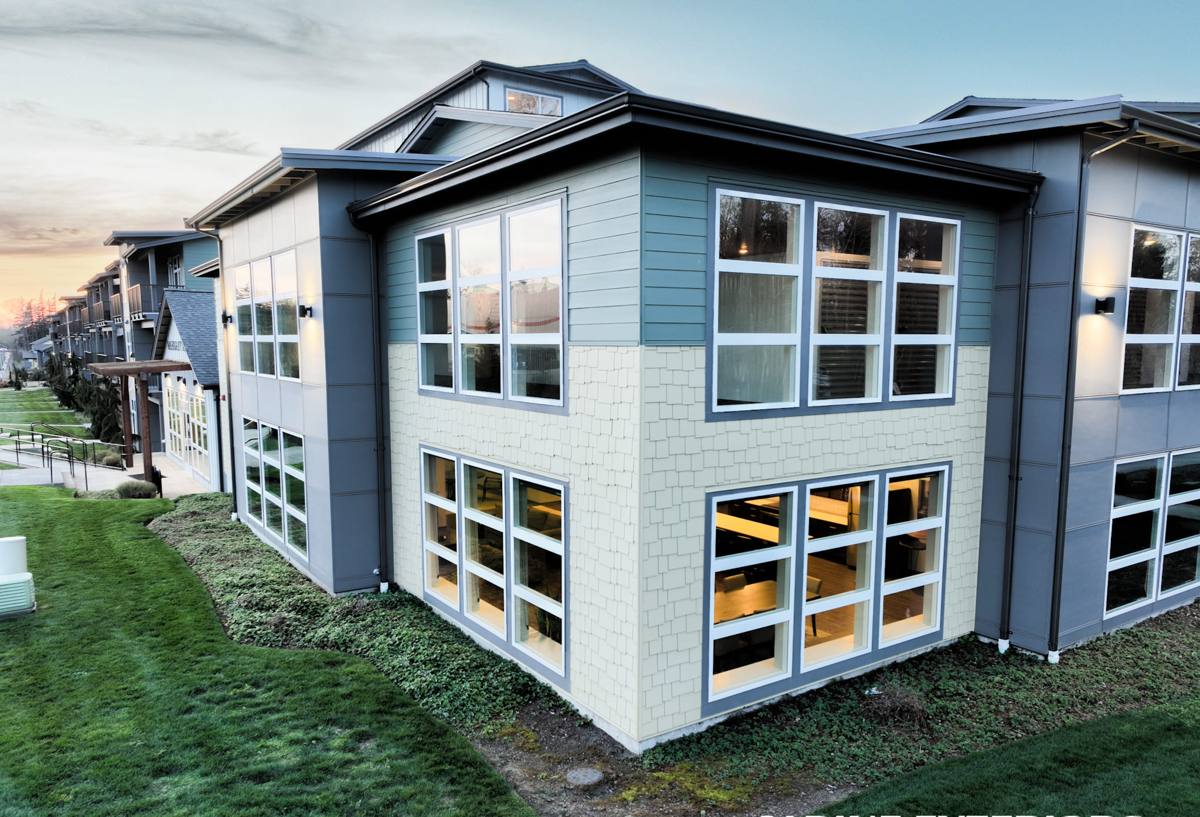
What Salt Air, Rain, and Moss Actually Do to Siding
Salt Air and Corrosion
Homes within a few miles of Puget Sound deal with airborne salt that accelerates corrosion on fasteners, flashing, and any metal trim components. Over time, salt exposure can also degrade lesser paint finishes faster than manufacturers' published fade timelines would suggest, especially on south- and west-facing elevations that catch both sun and salt-laden wind together.
Driving Rain and Wall Moisture
Everett's rain rarely falls straight down. Wind off the Sound pushes it sideways into walls, which means siding has to shed water at laps, corners, and penetrations — not just on flat faces. A wall assembly that traps that moisture behind the cladding, rather than draining and drying it, is where rot starts, usually invisibly, behind the siding itself rather than on its surface.
Moss Season and Shade
Pinehurst's tree canopy is part of what makes the neighborhood pleasant to live in, but shaded, damp walls are exactly where moss and algae take hold. On a material that absorbs moisture into its surface, that growth can work its way in over time. On a material that stays dimensionally stable and doesn't wick water, moss stays a surface issue that washes off rather than a structural one.
Why We Install Only James Hardie Fiber Cement
We don't install vinyl siding, LP SmartSide, Cemplank, Allura, or primed wood products like spruce or cedar. That's not a marketing position — it's a standard we settled on after weighing how each material actually performs against a climate like Everett's, decade over decade, not just in the first few years.
Fiber Cement's Advantage in This Climate
James Hardie's fiber cement is engineered from cement, sand, and cellulose fibers, which makes it dimensionally stable in a way wood-based products aren't — it doesn't swell, warp, or absorb water the way engineered wood siding can when a caulk joint fails or a seam opens up. It's also non-combustible, which matters increasingly to insurers and to homeowners thinking about wildfire smoke and ember exposure even on the wet side of the state.
ColorPlus Technology
Hardie's ColorPlus factory finish is baked on under controlled conditions, which gives it more consistent fade and chip resistance than field-applied paint — a real advantage where salt air and UV both work against a finish year-round. It also means touch-up, when it's ever needed, uses a color-matched formula rather than a guess at a paint counter.
HZ5 Engineering for This Region
Hardie manufactures its products in climate-specific formulations. The HZ5 line is engineered for regions with the freeze-thaw and moisture exposure profile that Western Washington sees, which is part of why we spec it here rather than treating siding as a one-size-fits-all product.
How Hardie Compares to the Alternatives We Don't Install
| Material | How It Handles Rain & Salt Air | Long-Term Trade-Off |
|---|---|---|
| James Hardie fiber cement | Dimensionally stable, non-combustible, factory finish resists fade | Heavier, requires correct fastening and clearances to perform as designed |
| Vinyl siding | Won't rot, but can warp or become brittle with temperature swings and UV | Color is molded-in only; fades and can't be refinished; seams can loosen |
| LP SmartSide (engineered wood) | Treated to resist moisture, but still wood-based at the core | Depends heavily on caulking and paint maintenance holding up over time |
| Cedar / primed spruce | Natural material, absorbs moisture readily in a wet climate | Needs the most frequent repainting and sealing to avoid rot |
None of these alternatives are junk products — vinyl and engineered wood both have legitimate uses. But for a coastal, rain-heavy, moss-prone neighborhood like Pinehurst, we've found the maintenance burden and moisture risk of the alternatives outweighs their lower upfront cost, which is why we standardized on Hardie and stopped installing the others.
What a Correct James Hardie Installation Actually Involves
Hardie siding's real-world performance depends almost entirely on installation quality — the product itself is only half the equation. A correct install in a climate like Everett's includes:
- A proper water-resistive barrier installed behind the siding, lapped correctly to drain water down and out rather than trapping it against the sheathing
- Correct fastener type, spacing, and depth — Hardie is unforgiving of overdriven or underdriven nails, which can crack panels or leave them loose
- Minimum clearance gaps at the foundation, roofline, and any hard surfaces like decks or patios, so the siding never sits in standing water or gets constant splash-back
- Flashing at every window, door, and penetration, integrated with the water-resistive barrier rather than just caulked over
- Factory-cut or properly sealed field cuts, since an exposed cut edge is the one place fiber cement can take on water if left untreated
- Caulking used only where Hardie's install specs call for it — over-caulking can trap moisture just as easily as under-caulking lets it in
Skipping any one of these doesn't usually show up as a problem in year one. It shows up in year eight or ten, as a soft spot at a corner or a stain below a window — exactly the kind of slow failure that a rainy, shaded climate like Pinehurst's is good at finding.
Our Process on a Pinehurst Job
- Site walk and assessment. We look at sun exposure, tree cover, drainage patterns around the foundation, and the condition of the existing wall assembly before we ever talk product.
- Tear-off and sheathing check. Old siding comes off and we inspect the sheathing underneath for any moisture damage that needs to be addressed before new siding goes on — covering up a problem is worse than finding it.
- Water-resistive barrier and flashing. This layer gets installed and integrated at every window, door, and penetration before a single piece of Hardie goes up.
- Hardie installation to spec. Panels, fasteners, and clearances follow Hardie's published installation guidelines, not shortcuts that speed up the job.
- Trim, caulk, and final inspection. We walk the finished job checking clearances, fastening, and finish quality before calling it done.
Why Local Experience in Pinehurst Matters
A crew that already works in this part of Snohomish County knows what to check for before problems show up — where tree cover keeps a wall wet longer, where salt air has already started working on old flashing, where a roofline funnels more water onto one section of siding than the rest of the house. That's not something you can fully account for from a spec sheet; it comes from having done this work, on this kind of house, in this kind of weather, repeatedly. A crew unfamiliar with the neighborhood is more likely to install to a generic standard rather than to what Pinehurst's specific mix of shade, rain, and salt exposure actually demands.
Maintenance Once It's Installed
Correctly installed Hardie siding is low-maintenance, not no-maintenance. A rinse-down once or twice a year to keep moss and grime from building up on shaded walls, a periodic look at caulking around windows and trim, and prompt attention to anything that looks like a new crack or gap will keep a Hardie exterior performing the way it's designed to for decades. None of that requires the repainting cycle that wood-based sidings demand in this climate.
Get a Free, No-Pressure Estimate
If you're weighing a siding project on a Pinehurst home, we're happy to take a look, walk you through what your specific walls and exposure need, and give you a straightforward estimate — no pressure, no upsell into products we don't stand behind. Use the form below to get started.