 Everett
 Building Decks That Actually Hold Up in Mukilteo
Mukilteo sits right on Possession Sound, and that waterfront location is exactly why decks here take a different kind of beating than decks fifteen miles inland. Salt-laden air drifts off the water and settles on every exposed surface. Wind-driven rain comes in sideways during fall and winter storms, working its way into joints and fastener holes that would stay dry in a more sheltered yard. And for months at a time, shaded and north-facing decks barely see direct sun, which means moss and algae get a long, uninterrupted head start. A deck built without those specifics in mind will look fine for a year or two and then start showing problems — cupped boards, rusted hardware, slick green film on the walking surface, soft spots where fasteners have been sitting in trapped moisture.
We build custom decks for homeowners throughout Everett and Snohomish County, and Mukilteo jobs get their own set of decisions from day one: fastener grade, ledger flashing detail, decking material, and railing hardware all get chosen with the marine environment in mind, not a generic Western Washington spec.
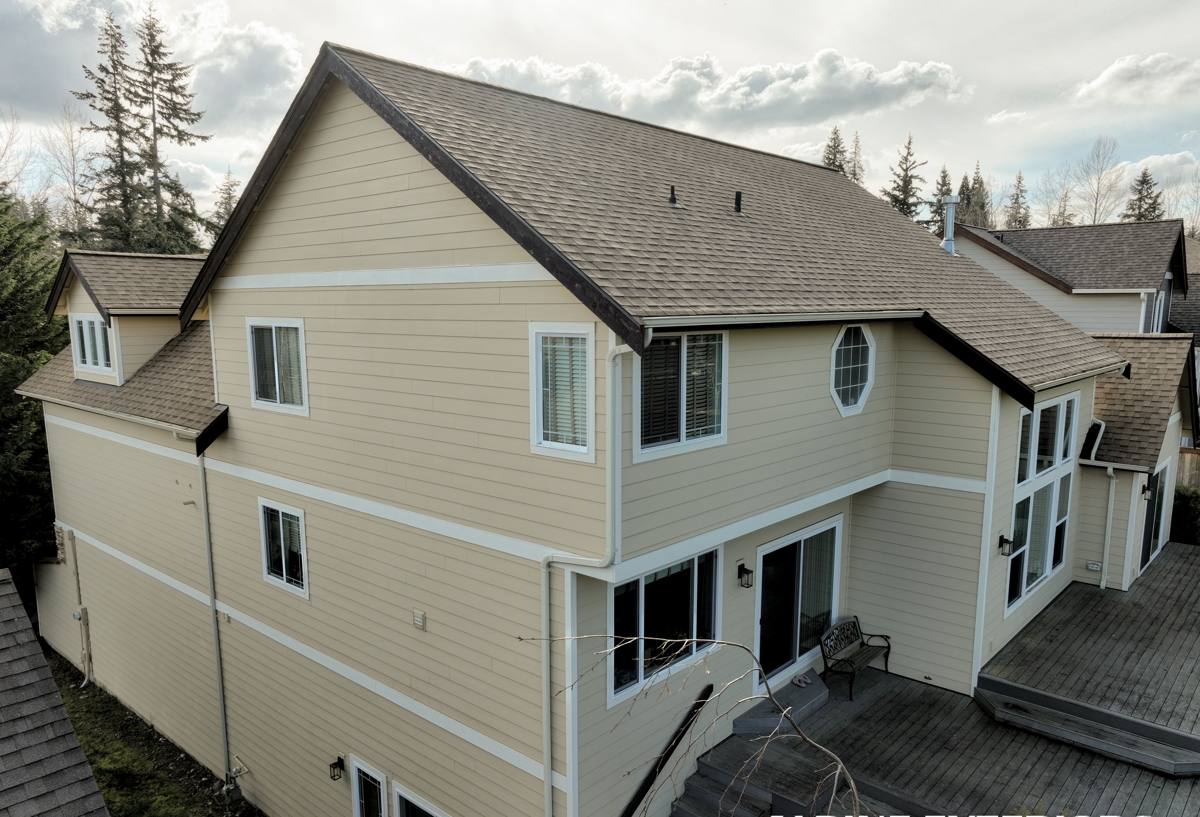
What Mukilteo's Climate Actually Does to a Deck
Salt Air and Corrosion
Homes closer to the water deal with airborne salt that accelerates corrosion on anything less than fully rated stainless or heavy-duty coated hardware. Standard exterior screws and joist hangers can start rusting and staining decking within a couple of seasons on a waterview lot. It's not dramatic — it's a slow bleed of orange streaks around every fastener head, and eventually a weakened connection you can't see until it fails.
Driving Rain and Water Intrusion
Storms off the Sound don't fall straight down — they come in at an angle, which pushes water into places a vertical rain never would: under railing base plates, behind ledger boards, into the end grain of stair stringers. The ledger connection where the deck meets the house is the single most common failure point we find on older Mukilteo decks, almost always because flashing was skipped or installed wrong.
Moss, Algae, and Shade
Long moss season here means any deck with partial shade — under eaves, near mature trees, on the north side of the house — builds up a biofilm that's more than cosmetic. Moss holds moisture against the decking surface and becomes a slip hazard on stairs and low-traffic corners. The right board profile and finish schedule make a real difference in how fast that buildup returns after cleaning.
What a Correctly Built Deck Requires Here
A deck that's actually built for this location isn't more expensive because we're upselling — it's built differently in specific, verifiable ways:
- Stainless or marine-grade coated fasteners and structural hardware, not standard galvanized, on any deck within reach of salt air
- Self-adhering flashing membrane at every ledger board and post base, installed before any decking goes down
- Proper drainage gap and slope away from the house so water doesn't pool against the structure
- Joist tape or cap flashing on framing lumber to stop end-grain water absorption
- Decking material and fastening pattern chosen for the amount of shade the deck actually gets
- Railing posts through-bolted to framing, not just lag-screwed into rim joists
Decking Material Options for Mukilteo Homes
There's no single "best" decking material — the right call depends on budget, how much sun the deck gets, and how much upkeep you want to do. Here's how the common choices actually perform in this specific climate:
| Material | Moss/Algae Resistance | Salt Air Behavior | Maintenance |
|---|---|---|---|
| Pressure-treated wood | Needs regular cleaning and sealing to resist buildup | Fine with correct fasteners; wood itself isn't affected by salt | Annual cleaning, re-sealing every 2-3 years |
| Cedar | Naturally more rot-resistant but still needs cleaning in shaded areas | Handles salt air well; UV and moisture are the bigger factors | Periodic oiling to maintain color and resistance |
| Composite decking | Capped composites resist moss better than wood but shaded spots still need washing | Excellent — no corrosion concern, some boards discolor over decades | Occasional washing, no sealing or staining |
| PVC decking | Very resistant, non-porous surface | Excellent, fully inert to salt exposure | Lowest — soap and water cleaning only |
We're honest about trade-offs on all of these. Composite and PVC cost more up front but cut down dramatically on the cleaning and refinishing cycle that a shaded, salt-exposed wood deck otherwise demands. Wood costs less initially and can look great, but it requires an owner who's actually going to keep up with sealing on schedule — skip a cycle or two in this climate and the maintenance gap shows fast.
A Note on Fastening Systems
Hidden fastener clip systems are popular for the clean look, and they work well on composite and PVC boards. On a Mukilteo project we still verify the clip material is rated for coastal exposure — some budget clip hardware isn't, and that's a corrosion point hiding under boards where you won't see it until a plank works loose.
Design Considerations Beyond the Structure
Orientation and Sun Exposure
Where we can, we talk through deck placement and layout relative to the house's shade pattern before finalizing material choice. A deck that catches afternoon sun dries out and self-cleans far better than one tucked under an overhang facing north — that alone can shift which decking material makes the most sense.
Railings and Hardware
Cable rail and metal baluster systems look great on a view lot but are some of the least forgiving products in salt air if the wrong grade is used. We spec marine-rated stainless for cable and hardware on any deck with meaningful water exposure, and we say so plainly if a lower-grade option is being considered — it's a maintenance and longevity trade-off, not a right-or-wrong material.
Stairs and Multi-Level Decks
Stairs take the brunt of moss buildup because they see less foot traffic than the main deck surface and often sit in partial shade at the base. We pay extra attention to stair tread drainage and can incorporate grooved or textured board faces on stairs specifically to cut down on slip risk during wet months.
Our Process for a Mukilteo Deck Project
- On-site assessment — we look at sun exposure, existing drainage, ledger condition if this is a replacement, and proximity to the water to gauge salt exposure level
- Design and material selection — we walk through decking and railing options against your budget and maintenance preference, with the trade-offs above laid out honestly
- Permitting — most deck projects in Everett and unincorporated Snohomish County require a permit; we handle that process rather than leaving it on you
- Structural build — framing, ledger flashing, and fastener selection are done to coastal-exposure standards regardless of decking material chosen
- Decking and railing installation — installed with drainage gaps and fastening patterns matched to the material and the site's shade level
- Final walkthrough — we go over basic maintenance expectations specific to the material you chose, so there are no surprises in year two
Repair, Replace, or Rebuild?
Not every aging deck needs a full teardown. If the framing is sound and the problems are limited to surface boards, railings, or fastener corrosion, a partial rebuild can extend the deck's life at a fraction of full replacement cost. The deciding factor is almost always the ledger connection and the joists — if those show rot or corrosion damage, a full rebuild is the honest recommendation, because building new decking on top of a compromised structure just delays a bigger problem.
Signs It's Time for a Rebuild, Not a Repair
- Soft or spongy spots anywhere in the decking, especially near the house
- Visible gaps or water staining where the deck meets the ledger board
- Rust bleeding from multiple fastener locations across the deck
- Persistent moss regrowth within weeks of cleaning, suggesting a drainage or slope problem underneath
- Railing posts that flex or move when pushed
Why Local Experience Matters for This Job
Deck construction standards from a builder's manual are the same everywhere. What isn't the same is knowing, before the first board is cut, which Mukilteo lots sit close enough to the water to justify full marine-grade hardware versus which inland-facing lots can reasonably use a lighter spec — and knowing which parts of a yard hold shade long enough into the afternoon that moss control has to be designed in rather than left as a maintenance afterthought. That judgment comes from having built and repaired decks across Everett and Snohomish County long enough to see which shortcuts show up as callbacks two winters later.
If you're planning a new deck or dealing with an aging one that's starting to show its age, we're happy to come take a look and talk through honest options for your specific lot. Reach out for a free, no-pressure estimate using the form below.