 Everett
 Mukilteo's Siding Problem Isn't Like Everett's Inland Neighborhoods
Mukilteo sits right on Puget Sound, and that changes what siding has to survive. A house a few miles inland in Everett deals mostly with rain volume and shade-driven moss. A house closer to the water in Mukilteo deals with that plus salt-laden air off the Sound, more direct wind exposure on view lots, and driving rain that hits siding at an angle instead of falling straight down. None of that is exotic — it's just Snohomish County's marine climate doing what it does — but it means the siding choice and the install details matter more here than they do a few miles east.
This page is specifically about fiber cement siding for Mukilteo properties: what the local climate actually does to a wall assembly, what a correctly installed job looks like, and why we only install James Hardie fiber cement rather than the wider menu of siding products on the market.
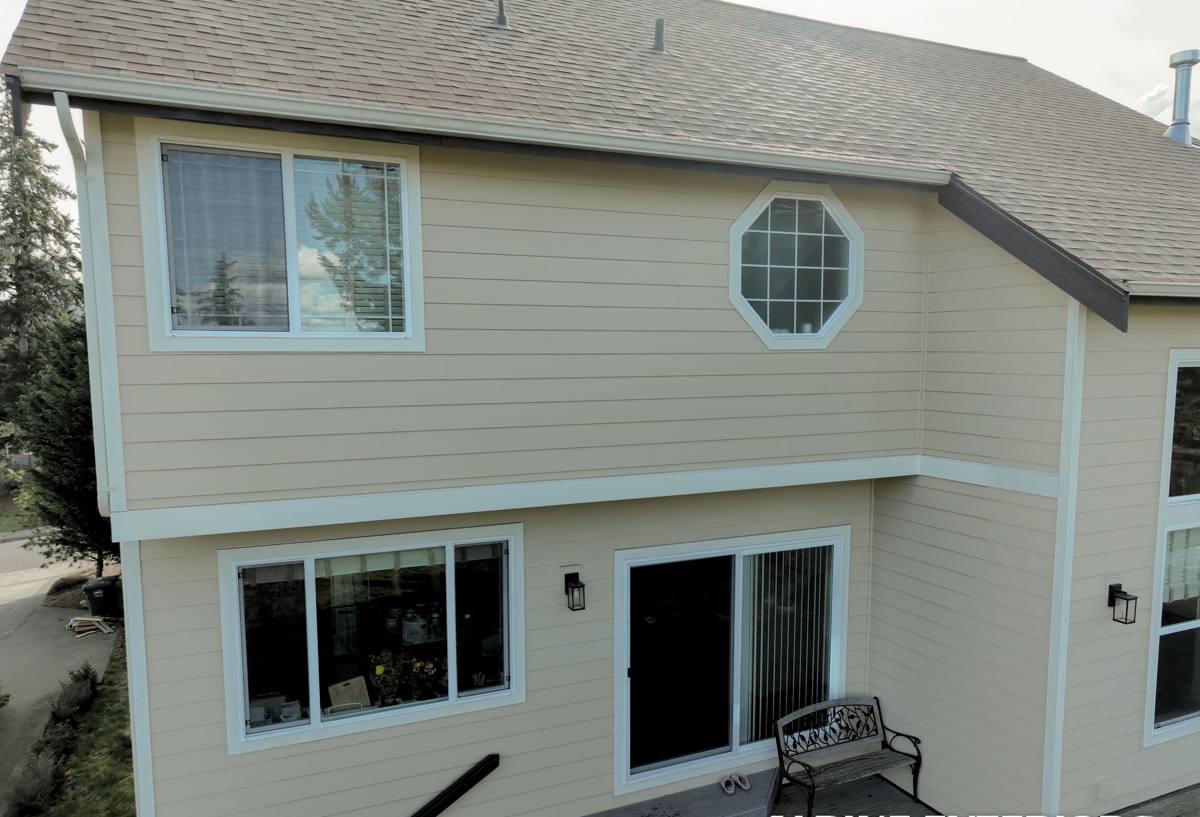
What Salt Air, Driving Rain, and Moss Season Actually Do to a Wall
Salt Air and Marine Exposure
Airborne salt from Puget Sound settles on exterior surfaces and accelerates corrosion of exposed metal — fasteners, flashing edges, trim screws — faster than the same materials would corrode a few miles inland. It also breaks down cheap paint films and coatings over time, which is part of why factory-applied, baked-on finishes hold up better here than field-applied paint.
Wind-Driven Rain
Mukilteo's waterfront and near-waterfront lots catch more direct wind than sheltered inland streets. Wind-driven rain doesn't just wet a wall surface — it pushes water sideways and upward at laps, seams, and penetrations (windows, hose bibs, light fixtures). A siding system with weak water management at those details will let moisture behind the cladding, and that's where rot and mold problems actually start, not on the face of the siding itself.
The Long Moss Season
Western Washington's wet season runs roughly October through May, and shaded or north-facing walls stay damp for long stretches during that window. Moss and algae need sustained moisture to establish, and once they get a foothold on a porous or poorly finished surface, they hold even more moisture against the wall — a cycle that speeds up decay underneath. Siding that resists moisture absorption at the surface, and finishes that resist organic growth, matter more here than in drier parts of the state.
Why We Install Fiber Cement Here — And Only One Brand of It
Fiber cement is a mix of cement, sand, and cellulose fibers, engineered to be dimensionally stable and resistant to moisture-driven swelling, cracking, and rot in a way that wood-based and foam-core products aren't. That stability matters directly in a climate like Mukilteo's, where siding is wet more months than it's dry.
We install James Hardie fiber cement exclusively — not LP SmartSide, not vinyl, not Cemplank or Allura, not primed spruce or cedar. That's a deliberate standard, not a sourcing preference. Wood-based products can perform fine in dry climates but carry more risk of moisture-related swelling and edge deterioration in a marine environment. Vinyl is inexpensive and low-maintenance but it's a thin, flexible material that can warp under sustained heat/cold cycling and telegraph the wall's imperfections rather than bridge them. Other fiber cement brands exist and some are reasonable products, but James Hardie's ColorPlus factory finish, its climate-specific HZ engineering, and its long, transferable warranty are the combination we've found most consistent for Puget Sound conditions. We'd rather install one product correctly, every time, than juggle several and hope each one is right for the job.
ColorPlus Factory Finish
Instead of field-applied paint, ColorPlus siding is finished at the factory with a baked-on, multi-coat process designed to resist fading, chipping, and moisture intrusion at the surface. In a salt-air, high-rain environment, that finish resisting water penetration at the panel face — not just at the seams — is a real advantage over field paint, which weathers unevenly and needs earlier recoating near the water.
HZ Product Engineering
James Hardie engineers its siding in HZ5 and HZ10 formulations tuned to regional moisture and freeze-thaw exposure. For a Puget Sound climate like Mukilteo's, that means a product formulated for a wet, moderate-temperature environment rather than a generic one-size-fits-all mix.
What a Correct Install Actually Requires Here
Fiber cement is only as good as its installation. In a low-wind, low-rain climate, sloppy flashing or tight clearances might go unnoticed for years. In Mukilteo, water finds those mistakes fast.
Clearance and Starter Details
Siding needs proper clearance from grade, roof lines, decks, and hardscape — typically several inches minimum — so splash-back and standing water don't sit against the bottom edge of the panel. This is one of the most common shortcuts on rushed jobs, and it's one of the first places moisture damage shows up.
Flashing and Water Management
Every window, door, and penetration needs flashing that directs water out and away from the wall assembly, layered correctly with the water-resistive barrier so water always drains down and out, never behind the barrier. On a wind-exposed Mukilteo lot, a missed or backwards-lapped flashing detail is exactly the kind of defect that turns into hidden rot two or three winters later.
Fastening and Panel Gaps
James Hardie specifies fastener type, placement, and panel gap tolerances for a reason — correct fastening keeps panels seated properly through wind loading and temperature movement, and correct gapping (plus sealant where specified) keeps water from wicking into butt joints. We follow Hardie's published installation instructions to the letter, because deviating from them is also what can void the manufacturer's warranty.
How We Approach a Mukilteo Project
- Site walk and exposure assessment — we look at wind exposure, existing moisture damage, shade patterns, and drainage around the house before quoting anything.
- Tear-off and sheathing check — old siding comes off and we inspect the sheathing and water-resistive barrier underneath for existing rot or moisture damage before covering anything back up.
- Water-resistive barrier and flashing — house wrap, flashing, and penetration details go in first and get inspected before a single piece of siding goes up.
- James Hardie installation to spec — correct clearances, fastening, and panel gaps, following Hardie's published instructions for our climate zone.
- Final walkthrough — we review the finished job with the homeowner, including basic care and what to watch for seasonally.
Matching the Product Line to the Exposure
Not every Mukilteo lot has the same exposure. A sheltered inland street a mile from the water is a different install consideration than a bluff-top or waterfront lot catching wind straight off the Sound. Here's generally how the common Hardie profiles line up with exposure differences we see around the area:
| Hardie Product | Best Suited For | Climate Consideration |
|---|---|---|
| HardiePlank lap siding | Most Mukilteo homes, standard exposure | Broad wind/rain resistance with proven long-term performance |
| HardieShingle | Homes wanting a shingle-style look, accent areas | More surface detail and laps — needs careful flashing at transitions |
| HardiePanel (vertical) | Modern designs, gable accents | Fewer horizontal laps, which can reduce certain water-entry points |
| HardieTrim | Corners, window/door surrounds, fascia | Matched finish system, avoids mixing incompatible trim materials |
What Drives the Cost of a Mukilteo Siding Job
We don't quote sight-unseen, but these are the factors that consistently move the price up or down on real projects in this area:
| Factor | Why It Matters |
|---|---|
| Home size and wall complexity | More corners, dormers, and cutouts mean more labor and trim work |
| Existing siding removal | Tear-off and disposal of old wood, vinyl, or damaged siding adds time |
| Sheathing/rot repair | Water damage found once old siding is off has to be repaired before new siding goes on |
| Number of stories and access | Two- and three-story walls and steep or waterfront lots need more staging and safety setup |
| Trim and profile choice | HardieShingle detail work and custom trim run more labor hours than straight lap siding |
Keeping Fiber Cement Siding Performing in This Climate
James Hardie siding is low-maintenance compared to wood, but "low-maintenance" doesn't mean "no attention needed" — especially through a Puget Sound moss season. A short seasonal checklist goes a long way:
- Rinse siding with a garden hose (not a pressure washer aimed directly at seams) once or twice a year to clear salt residue and organic buildup
- Check and clear gutters before the fall rains so water isn't overflowing down the wall face
- Look at shaded, north-facing walls each spring for early moss or algae growth and address it before it spreads
- Keep vegetation and mulch beds pulled back from the bottom edge of the siding
- Recaulk around windows, doors, and trim joints if you notice cracking or gaps forming
- Have flashing and caulking at penetrations inspected every few years, especially on wind-exposed sides of the house
Why Hiring a Crew That Already Works Mukilteo Matters
A crew that only occasionally works this close to the water can miss things that are second nature to a crew that does it regularly — how much more clearance a waterfront-adjacent wall needs, which sides of a house take the worst wind-driven rain, where moss shows up first on a shaded gable. Snohomish County permitting and local building department expectations are also more predictable to navigate when you've pulled permits for this specific jurisdiction before rather than learning it on your job.
None of that replaces good installation fundamentals — flashing, fastening, and clearances matter everywhere James Hardie siding goes up. But local familiarity means fewer surprises, fewer change orders, and a crew that already knows what this climate does to a wall over ten winters, not just what a spec sheet says it should do.
If you're weighing a siding replacement or new siding project in Mukilteo, we're glad to walk the property, take a real look at your exposure and existing siding condition, and put together a straightforward, no-pressure estimate using the form below.