 Everett
 Why Eastmont Siding Damage Isn't Always What It Looks Like
A cracked board, a soft spot near a downspout, a streak of green creeping up from the foundation line — on the surface these look like small, isolated problems. On a lot of Eastmont homes, they aren't. Everett's climate doesn't damage siding evenly or politely; it works on the vulnerable points first — corners, butt joints, anything near grade, anything under a drip line — and by the time damage is visible from the sidewalk, there's often more going on behind the board than the crack itself suggests.
Eastmont sits inland from the water compared to some of Everett's waterfront neighborhoods, but it still gets the full package: salt-tinged air moving in off Port Gardner Bay and Puget Sound, long stretches of driving rain that hits siding at an angle instead of falling straight down, and a moss and algae season that, in this part of Snohomish County, runs most of the year rather than just a few wet months. That combination is exactly what wears down siding that was installed a little short of spec, or that's simply reached the end of what its material can handle. This page covers what a correct siding repair looks like for Eastmont homes specifically, and why hiring a crew that already knows this neighborhood's housing stock and exposure patterns matters more than it might seem.
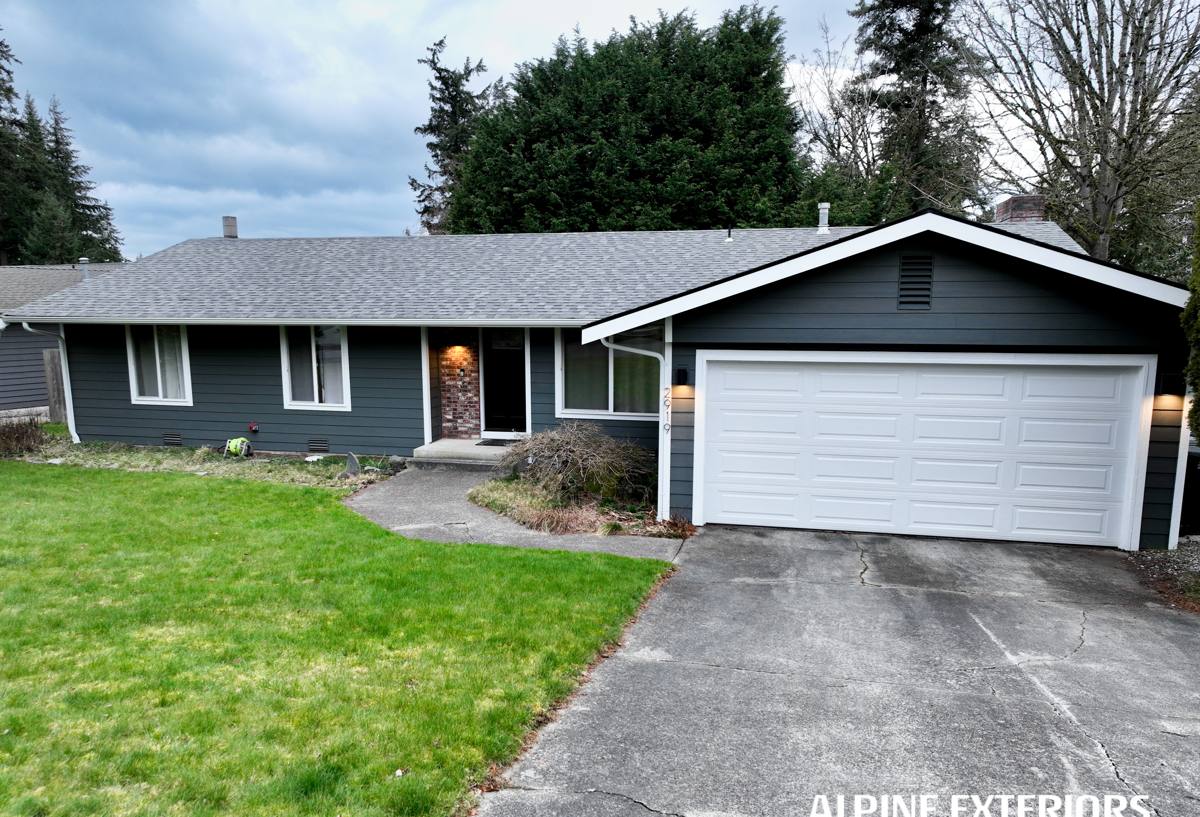
What Everett's Climate Actually Does to Siding
Driving Rain and Wind-Driven Moisture
Straight-down rain is easy for siding to shed. Wind-driven rain — the kind that comes in at an angle during a Puget Sound storm — is a different problem, because it pushes moisture up under laps, into butt joints, and behind trim that wasn't sealed or flashed correctly the first time. Repeated over years, that's how water gets behind siding without ever leaving an obvious puddle or stain on the surface.
Salt Air and Slow Material Breakdown
Homes throughout Everett, including neighborhoods set back from the immediate waterfront like Eastmont, still see salt-laden air move through on a regular basis. Salt exposure accelerates the breakdown of lower-grade siding materials and finishes, showing up as chalking, premature fading, or fastener corrosion well before a homeowner would expect it based on the age of the siding alone.
Moss, Algae, and Prolonged Dampness
Shaded walls, north-facing exposures, and lots with mature tree cover — common throughout Eastmont — stay damp longer after rain than open, sun-exposed walls. That prolonged dampness is what moss and algae need to establish, and once organic growth takes hold on or under siding, it holds moisture against the material rather than letting it dry, which speeds up whatever damage is already underway.
Common Siding Repair Issues We See in This Area
- Soft or delaminating boards near grade: siding installed too close to the ground or a hardscape surface wicks up moisture over time, especially on older homes built before current clearance standards were common practice
- Cracked or split boards at fastener points: often from boards installed too tight with no room to expand and contract, or from fasteners driven at the wrong angle
- Failed caulking and sealant at trim and penetrations: caulk has a service life, and once it fails around windows, vents, or utility penetrations, water finds a direct path behind the siding
- Moss and algae staining, especially on north-facing and shaded walls: largely cosmetic at first, but a sign the wall isn't drying out between rain events
- Damage at inside and outside corners: corner boards take more direct weather exposure and impact than field siding and tend to fail first
- Warping or buckling from moisture cycling: repeated wet-dry cycles over years can distort certain siding materials even without a single obvious point of water entry
What a Correct Siding Repair Actually Involves
A repair that just patches the visible damage without checking what's happening underneath is a repair that comes back. We treat every siding repair call in Eastmont as a two-part job: fix what's visible, and find out why it happened in the first place.
1. Diagnose Before Touching Anything
Before pulling a single board, we look at the pattern of damage across the wall — is it isolated to one board, or does it track a flashing line, a downspout, or a shaded corner? That pattern tells us whether we're dealing with a one-off material failure or a systemic moisture issue that will keep resurfacing in new spots if we only address the one board someone noticed.
2. Check What's Behind the Siding
Once boards are pulled, we inspect the water-resistive barrier, flashing, and sheathing underneath. Siding is the visible layer, but it's the drainage plane behind it that actually keeps a house dry — if that layer is compromised, replacing the siding alone doesn't solve the underlying problem.
3. Match or Upgrade the Material
On homes where the surrounding siding is sound, we match the repair to the existing material and profile as closely as possible. On sections where the damage points to a broader material or installation problem, we talk honestly with the homeowner about whether a targeted repair or a larger re-side of that elevation is the better long-term move, rather than patching something that's going to keep failing.
4. Reseal and Flash Properly
Any repair that touches trim, corners, or penetrations gets proper flashing and sealant work, not just caulk smeared over the gap. This is the step that's easy to shortcut and is usually the actual reason a "repaired" section fails again within a year or two.
Repair vs. Replacement: How We Help Eastmont Homeowners Decide
| Factor | Leans Toward Repair | Leans Toward Replacement |
|---|---|---|
| Extent of damage | Isolated to one wall or a handful of boards | Recurring across multiple elevations |
| Underlying moisture barrier | Intact and functioning | Compromised or original barrier at end of life |
| Age and material of existing siding | Newer, still within expected service life | Original material is dated, discontinued, or chronically underperforming |
| Cause of damage | A single identifiable event or defect | A systemic issue tied to the material or original installation |
| Homeowner's timeline | Wants a fast, targeted fix now | Open to addressing the whole elevation properly |
Neither answer is automatically right or wrong — it depends on what we find once the damaged section is opened up. What we won't do is recommend a full replacement when a proper, well-diagnosed repair will genuinely hold, or patch over a problem we know is going to resurface in six months just to close out a smaller job.
Why the Material Underneath the Repair Matters
We install James Hardie fiber cement siding exclusively, and it's worth explaining why that shows up in how we approach repair work too. Fiber cement doesn't absorb and swell with moisture the way some siding materials do, and it doesn't feed mold or rot the way wood-based products can once water gets behind them. When we're repairing a section of Hardie siding, we're usually dealing with an installation or flashing issue rather than the board itself breaking down — which is a meaningfully different (and generally more straightforward) repair than what we see on homes sided in materials that are more sensitive to this region's wet, mossy conditions.
On Eastmont homes we're repairing that were originally sided in something other than fiber cement, we'll always give an honest read on whether a like-for-like patch is the right call or whether it's worth discussing a transition to Hardie on that section, particularly if the existing material is showing the kind of moisture-related breakdown that tends to repeat.
Why Local Experience with Eastmont Homes Matters
Eastmont has a mix of housing ages and styles typical of established Everett neighborhoods, which means the siding problems we find here aren't uniform — an older home might have original wood siding reaching the end of its life, while a newer one might have a specific installation defect from its original build. A crew that's already worked on homes in this part of Everett has a working sense of how local lot conditions — tree cover, shaded exposures, proximity to the water — tend to show up as specific wear patterns, which speeds up accurate diagnosis instead of guessing.
There's also a practical, unglamorous reason local experience matters: knowing the Snohomish County and City of Everett permitting requirements for exterior repair work, and pulling the right permit for the scope of the job, so the work is documented correctly if it ever comes up during a future sale or insurance claim.
A Homeowner's Checklist Before Calling for a Repair
- Note where the damage is on the house — which elevation, how high, and whether it's near a downspout, corner, or shaded area
- Check whether the damage is limited to the siding surface or if you can see or feel softness when pressing gently near the affected area
- Look for a pattern — is this the only spot, or have you noticed similar issues elsewhere on the house over time
- Avoid painting or caulking over damage yourself before a professional look — it can mask what's actually happening underneath
- Ask any contractor you're considering whether they'll inspect behind the damaged boards, not just replace what's visible
- Confirm the contractor is licensed and bonded in Washington and will pull a permit if the scope requires one
What to Expect When You Call Us
We walk the affected area with you, explain what we're seeing and why, and give a straightforward assessment of whether it's a targeted repair, a larger section replacement, or something in between. We don't pad a small repair into a bigger job, and we don't quietly patch a symptom when the underlying cause is going to keep causing problems. If you're seeing damage, staining, or soft spots on your Eastmont home's siding and want an honest look at what's actually going on, we're glad to come take a look and put together a free, no-pressure estimate.