 Everett
 Siding Replacement Built for Edmonds' Puget Sound Climate
Edmonds sits right on Puget Sound, and that waterfront position shapes everything about how siding ages here. Homes closer to the water take on salt-laden air that accelerates corrosion on fasteners, trim, and lower-grade siding materials. Homes tucked under Edmonds' mature tree canopy deal with the opposite problem — shade, moisture, and a long moss and algae season that never really lets a wall dry out between storms. Add in the driving, wind-pushed rain that comes off the Sound during fall and winter systems, and you have a climate that punishes siding installed without real attention to water management. Siding replacement in Edmonds isn't just a cosmetic upgrade — it's a chance to correct whatever weak point let moisture in the first time.
Salt Air and Corrosion
Even a few miles from the water, airborne salt accelerates rust on exposed steel fasteners, cheap flashing, and staples used in older siding installs. Once a fastener starts rusting, it weeps stains down the face of the siding and eventually loses its grip, which is how you end up with panels or shingles that flutter or pull away in a windstorm. Any siding replacement in a Sound-adjacent city like Edmonds should spec corrosion-resistant fasteners and flashing as a baseline, not an upgrade.
Driving Rain and Wall Assembly
Puget Sound storms don't just fall straight down — wind pushes rain sideways into wall assemblies, especially on west- and south-facing elevations that catch weather coming off the water. Siding that relies on face-sealed caulk joints instead of a proper drainage plane behind it will eventually let water track in around windows, at butt joints, and along the bottom edge of the wall. That trapped moisture is what rots sheathing and framing long before the siding itself looks obviously bad from the street.
The Long Moss and Algae Season
Snohomish County's wet season runs long, and shaded, north-facing walls in tree-heavy Edmonds neighborhoods can stay damp for weeks at a stretch. Porous or textured siding surfaces give moss and algae something to grab onto, and once organic growth establishes itself, it holds even more moisture against the wall. A siding replacement is the right time to address both the material's surface (does it shed moisture or hold it?) and any grading, gutter, or vegetation issues that keep a wall from ever fully drying.
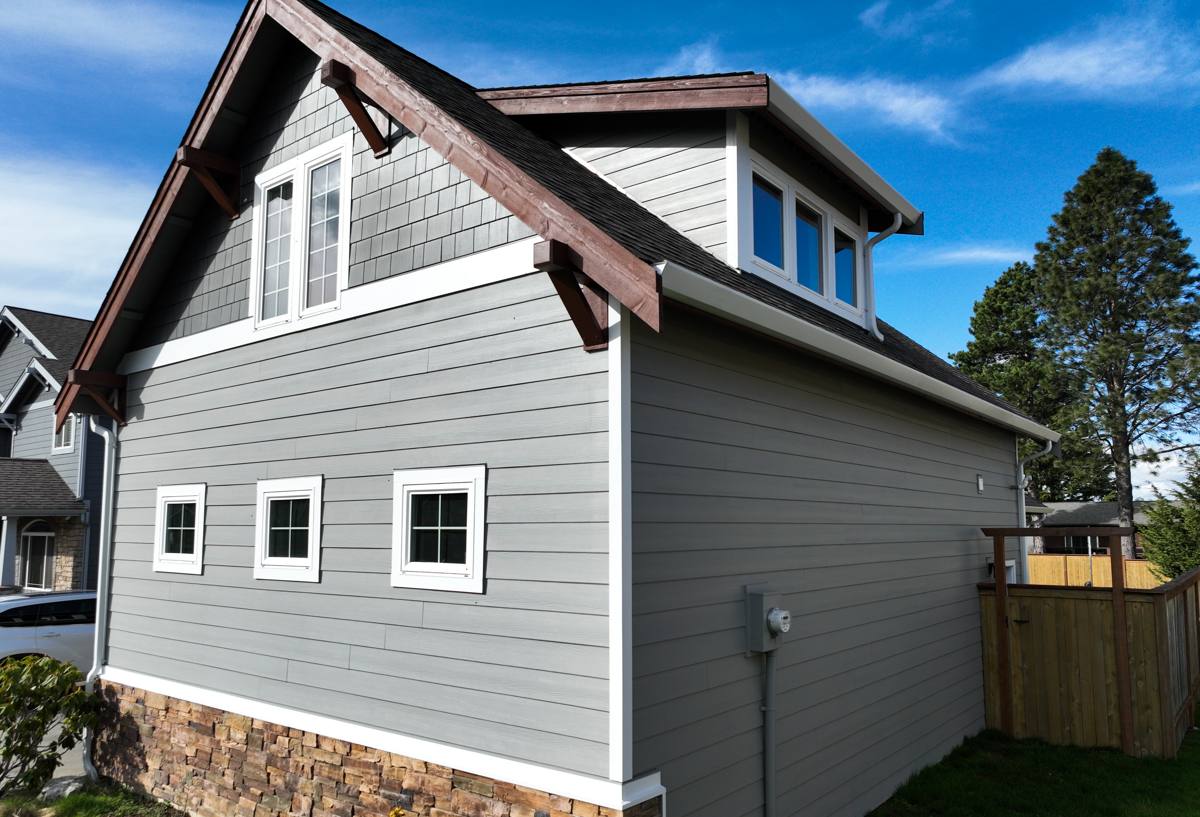
Signs Your Edmonds Home Needs Siding Replacement
Not every siding problem requires a full replacement, but in this climate, small issues tend to compound quickly once moisture gets behind the cladding. Here's what we look for during an inspection:
- Soft or spongy spots when you press on the siding, especially near the bottom courses or below windows
- Persistent moss, algae, or black streaking that comes back within a season of cleaning
- Visible cracking, warping, or delamination on older lap siding
- Rust streaks running down from nail heads or trim fasteners
- Paint that won't hold — repeated peeling or blistering within just a few years of repainting
- Gaps opening up at seams, corners, or where siding meets trim and window casings
- A musty smell in interior rooms along an exterior wall
- Visible rot at the wall base, corner boards, or anywhere siding sits close to grade
If you're seeing more than one or two of these, especially combined, it's worth getting a real inspection rather than another round of caulk and paint.
What a Correct Siding Replacement Job Actually Involves
Siding replacement done right is mostly about what happens before the new siding ever goes up. In a climate like Edmonds', the assembly behind the siding matters as much as the siding itself.
Tear-Off and Sheathing Inspection
Old siding comes off down to the sheathing, and that sheathing gets inspected for rot, soft spots, and hidden water damage — particularly around windows, doors, and any spot where past flashing failed. This is often the first time a homeowner learns how much moisture has actually been getting behind their old siding. Any damaged sheathing or framing gets replaced before anything new goes on; covering rot with new siding just hides the problem for a few more years.
Weather-Resistive Barrier
A continuous weather-resistive barrier goes over the sheathing, lapped correctly from the bottom up so water sheds outward instead of working its way behind the barrier. This layer is what actually stops bulk water that gets past the siding's face — it's arguably more important to long-term performance than the siding material itself.
Flashing at Every Penetration
Windows, doors, hose bibs, light fixtures, vents — every penetration through the wall is a place water can get in if it isn't flashed correctly. Proper flashing directs water back out and down, always integrated with the weather-resistive barrier rather than just caulked over the top. This is one of the most common places we find shortcuts on older installs.
Fastening and Clearances
Fastener type, spacing, and depth all affect how siding performs over decades, not just years — and in a salt-air environment, fastener material matters more than usual. Siding also needs proper clearance from grade, roof lines, decks, and hardscape so it isn't sitting in a wet zone; a lot of rot we find starts at these clearance points rather than on open wall faces.
Why We Install Only James Hardie Fiber Cement
We don't install vinyl siding, LP SmartSide, cedar, or other fiber cement brands. That's a deliberate standard, not a sales pitch, and it comes down to how each material actually performs over time in a marine climate like this one.
| Material | Where it struggles locally | Trade-off we weigh |
|---|---|---|
| Vinyl siding | Can warp or distort under heat/cold cycling; seams and J-channels give wind-driven rain a path behind the panel | Lower material cost, but shorter realistic lifespan and limited repair options when panels crack |
| LP SmartSide (engineered wood) | Wood-based substrate is vulnerable if any moisture gets past the finish, which is a real risk in a long wet season | Good appearance and workability, but moisture sensitivity raises the stakes on installation quality |
| Cedar / primed spruce | Natural wood needs ongoing refinishing and is a food source for the moss and algae already common here | Classic look, but highest long-term maintenance burden in this climate |
| James Hardie fiber cement | Non-combustible, dimensionally stable, resists moisture-driven warping and cracking | Higher install-day cost, offset by lower maintenance and a strong transferable warranty |
James Hardie's fiber cement is engineered specifically for climates like ours — the HZ5 product line is formulated for cold, wet, freeze-thaw-prone regions, which fits western Washington far better than a one-size-fits-all national product. The factory-applied ColorPlus finish is baked on and warrantied against peeling and fading, which matters in a place where repainting siding on a two- or three-story house isn't cheap or easy. It's also non-combustible, which is a genuine safety upgrade over wood-based sidings. None of this means other products are junk — vinyl and engineered wood both have a place. It means that after years of installing and repairing siding on homes in this exact climate, Hardie is the one we're willing to put our name behind.
Our Process, Start to Finish
- On-site inspection: We walk the exterior, check problem areas you've noticed, and look for signs of hidden moisture damage before quoting anything.
- Honest scope and estimate: You get a clear breakdown of what needs replacing, what's driving the cost, and what your material and color options are — no pressure, no upsell games.
- Tear-off and sheathing repair: Old siding comes off, sheathing gets inspected, and any rot or damage is repaired before moving forward.
- Weather barrier and flashing: A continuous weather-resistive barrier goes on, and every window, door, and penetration is properly flashed.
- Hardie installation to spec: Panels or planks go up following manufacturer fastening, spacing, and clearance requirements — not shortcuts that void the warranty.
- Trim, caulk, and final detail: Trim work and sealant get finished to a clean, weather-tight standard, including the small transition points that are easy to rush.
- Walkthrough: We go over the finished job with you before calling it done.
Cost Factors for Siding Replacement in Edmonds
Every home is different, and we don't publish blanket per-square-foot pricing because it misleads more than it helps. What we can tell you is what actually moves the number up or down on a real Edmonds project:
| Factor | Why it matters |
|---|---|
| Home size and wall complexity | More corners, gables, and dormers mean more cutting, flashing, and labor time |
| Condition of sheathing underneath | Hidden rot found during tear-off adds repair scope that can't be fully known until the old siding is off |
| Siding profile chosen | Lap siding, shingle-style panels, and board-and-batten all have different material and labor costs |
| Trim and accessory scope | Corner boards, window trim, and fascia work add up separately from the field siding itself |
| Access and site conditions | Steep lots, tight side yards, and multi-story walls common on Edmonds' hillside properties affect equipment and labor time |
| Color and finish selection | Factory-finished ColorPlus options vary in cost slightly by color depth and line |
The only way to get a real number is a site visit — anything quoted without seeing the actual walls and their condition is a guess.
Maintenance After Installation
Correctly installed James Hardie siding is genuinely low-maintenance, but "low" doesn't mean "none," especially in this climate. A simple annual routine keeps it performing the way it's designed to:
- Rinse the exterior with a garden hose (not a pressure washer aimed directly at seams) once or twice a year to clear salt residue and organic buildup
- Keep gutters clean and downspouts directed away from the foundation so walls aren't getting extra splash-back moisture
- Trim back vegetation and tree limbs that keep a wall shaded and damp longer than it needs to be
- Re-caulk at trim joints if you ever see a gap open up, rather than waiting
- Have your siding looked at after any major windstorm, since that's when flashing or trim damage is most likely
Why Hiring a Crew That Already Works in Edmonds Matters
Siding installation instructions read the same everywhere on paper, but the judgment calls — how much clearance to leave near a foundation that sits close to grade, how to flash a wall that takes direct hits from Sound-driven storms, which walls in a shaded Edmonds lot need extra attention to moss and moisture — come from having actually done the work here. A crew that installs siding in Arizona or even drier parts of Washington doesn't have the same instincts for what fails first in a marine climate. Local experience also means knowing what Snohomish County permitting and inspection expects, and being available quickly if a storm causes damage that needs attention before it becomes a bigger problem. Siding replacement is a once-a-decade-or-more decision for most homeowners — it's worth having someone who already understands the specific climate your walls have to survive.
If you're seeing early signs of trouble or just planning ahead, we're happy to take a look and give you a straight answer — no pressure, no hard sell. Use the form below to request a free estimate for your Edmonds home.