 Everett
 Port Gardner's Climate Is Harder on Siding Than Most Homeowners Realize
Port Gardner sits close enough to the water that homes here deal with a combination most inland Snohomish County neighborhoods don't: salt-laden air off the bay, driving wind-driven rain that hits siding at an angle instead of straight down, and a moss season that can stretch for most of the year in shaded, north-facing spots. None of these things destroy siding overnight. They work slowly, which is exactly why so many homes in this area end up with siding problems that were preventable — the damage builds for years before it becomes visible as staining, soft trim, or a paint job that won't hold.
Salt air is corrosive to fasteners and metal flashing, and it accelerates the breakdown of caulking and paint film. Driving rain finds every gap in a siding system that wasn't sealed and flashed correctly, and it doesn't take much of a gap for water to get behind the cladding. Moss and algae hold moisture against the surface of the siding for extended periods, which is a problem for any material that isn't dimensionally stable when wet. Any siding installed in Port Gardner has to be chosen and installed with all three of these conditions in mind, not just the one that's most visible.
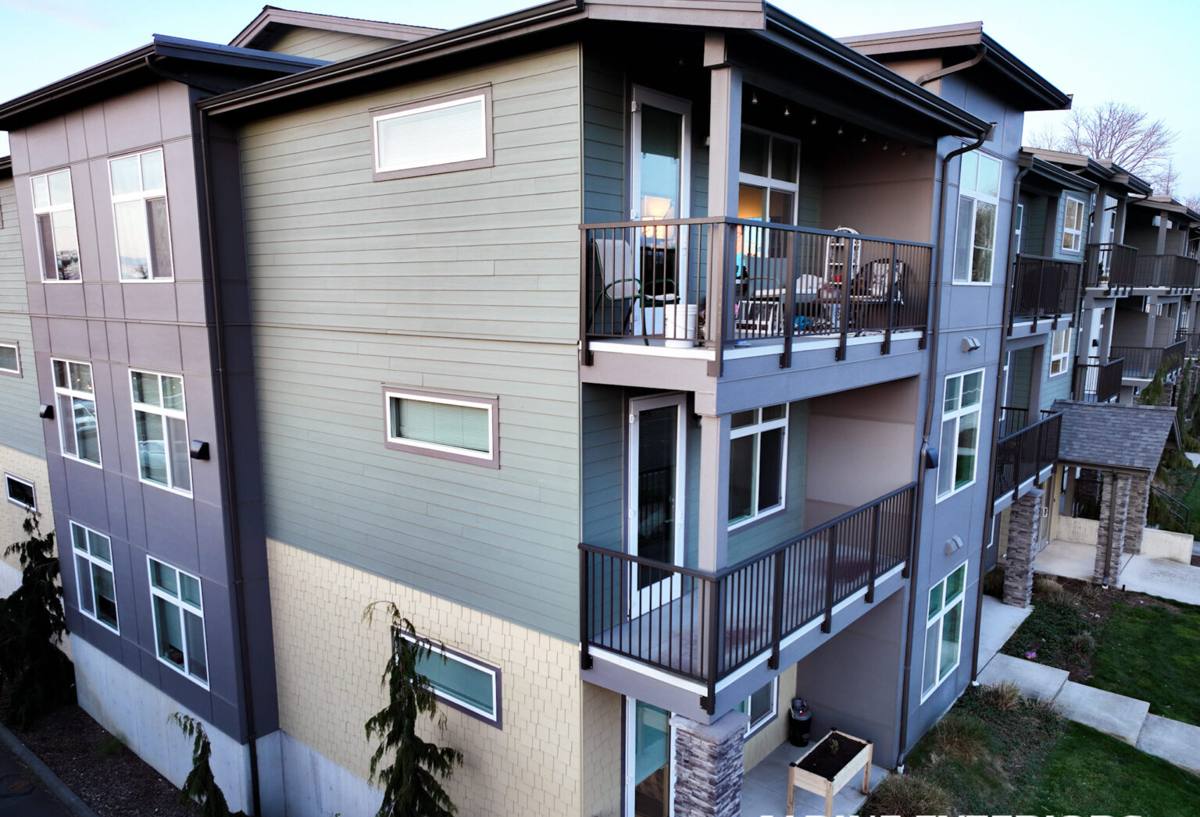
Why James Hardie Fiber Cement Is the Right Fit Here
James Hardie siding is fiber cement — a mix of cement, sand, and cellulose fiber that's engineered to be dimensionally stable in wet climates. Unlike wood-based products, it doesn't swell, warp, or rot when it takes on moisture, which matters directly for a location with this much rain exposure and moss growth. It's also non-combustible, which is a genuine safety advantage regardless of climate, and its ColorPlus factory-applied finish is baked on under controlled conditions rather than field-painted, so it holds color and resists the fading and chalking that salt air speeds up on site-painted surfaces.
Climate-Engineered Product Lines
James Hardie makes its products in different formulations depending on the climate zone they're sold into. Washington State falls into the "HZ5" zone, which is engineered for regions that see significant moisture and freeze-thaw cycling. HZ5 products use a different moisture-management formulation than the HZ10 products sold in hot, humid southern climates. That distinction isn't marketing — it's the manufacturer building the product to match what the weather in a place like Port Gardner will actually do to it over a 30- or 40-year lifespan.
What a Correct Installation Actually Involves
Fiber cement siding is only as good as the installation behind it. Most of the failures we get called out to look at on older homes near the water aren't a problem with the siding material itself — they're a problem with how it was put on. A correct James Hardie installation in a location like this includes several things that are easy to skip and expensive to fix later:
- A weather-resistant barrier installed correctly behind the siding, lapped shingle-style so water sheds outward instead of into the wall
- Proper flashing at every window, door, and roofline intersection — the single most common failure point we see on wind-driven-rain exposures
- A drainage gap (rain screen) that lets any moisture that does get behind the siding drain and dry out instead of sitting against the sheathing
- Correct fastener type and spacing, since the wrong fasteners corrode faster in salt air and can cause staining or loosening over time
- Factory-cut and factory-primed edges wherever possible, since field-cut edges need to be sealed to maintain the product's moisture resistance
- Caulking and sealant only where the manufacturer specifies it — over-caulking joints that should be able to move or drain is its own cause of trapped moisture
Skipping any one of these doesn't usually show up as a problem in year one. It shows up in year eight or ten, as a stain pattern, a soft spot at a window corner, or paint that's failing in one specific area while holding fine everywhere else.
How Our Process Works
We keep the process straightforward because the value is in the details, not in a sales pitch.
1. On-Site Assessment
We walk the exterior with you, look at the current siding condition, check trim and flashing details, and identify any moisture or rot issues that need to be addressed before new siding goes on. Covering up an existing problem with new siding just hides it.
2. Scope and Product Selection
We go over which James Hardie profile and finish fits the home — lap siding, panel systems, or shingle-style products — along with color options through the ColorPlus line, and we explain the reasoning so the decision is yours, made with full information.
3. Prep and Removal
Old siding comes off, the sheathing underneath gets inspected and repaired as needed, and the weather-resistant barrier and drainage gap go in before any new siding is installed.
4. Installation to Manufacturer Spec
Installation follows James Hardie's published installation requirements — fastener type and spacing, flashing details, clearances at grade and roof lines — because those specifications are what keeps the manufacturer's warranty valid and what actually keeps water out.
5. Final Walkthrough
We walk the finished job with you, cover care and maintenance specifics for the products installed, and make sure every question is answered before we consider the job done.
Signs Your Current Siding May Already Be Struggling
A lot of Port Gardner homeowners live with early-stage siding problems for a while before calling anyone, mostly because the signs are subtle at first. Worth checking for:
- Persistent moss or algae growth that comes back within weeks of cleaning, especially on north- or shade-facing walls
- Dark staining streaks running down from seams, trim, or fastener heads
- Paint that's peeling, bubbling, or chalking heavily in one area while the rest of the wall looks fine
- Soft or spongy spots when you press on siding or trim near the bottom of walls or around windows
- Visible gaps, warping, or cupping in existing boards
- A musty smell near exterior walls on the inside of the home
Any one of these on its own isn't necessarily an emergency, but they're worth a professional look before the next wet season rather than after.
Comparing Siding Options for a Location Like This
We only install James Hardie fiber cement, and part of the reason is how it holds up specifically in a salt-air, high-rain, moss-prone environment compared to the alternatives homeowners often consider.
| Factor | James Hardie Fiber Cement | Vinyl Siding | Wood-Based Siding (LP, cedar, primed spruce) |
|---|---|---|---|
| Moisture/rot resistance | Dimensionally stable, engineered for wet climates (HZ5) | Doesn't rot, but can warp or crack in temperature swings | Vulnerable to moisture absorption and rot if any gap in the finish develops |
| Finish durability in salt air | Factory-baked ColorPlus finish resists fading and chalking | Color molded through material but can fade and become brittle | Field-applied paint/primer wears faster near salt air, needs more frequent recoating |
| Fire resistance | Non-combustible | Combustible, can melt/deform near heat | Combustible |
| Maintenance burden | Occasional wash, repaint on a long cycle if ever needed | Low maintenance but limited repair options if damaged | Regular recoating and moisture monitoring required |
| Long-term cost pattern | Higher upfront, lower lifetime maintenance cost | Lower upfront, moderate lifetime cost | Lower upfront, higher lifetime maintenance cost |
Every product on that list has legitimate uses. We simply made a professional decision, based on years of seeing how siding actually performs in this climate over time, to standardize on one product we can stand behind fully rather than offer several and let installation quality be the only variable that matters.
Maintenance in a Salt Air and Moss Environment
Even a well-installed Hardie siding job benefits from basic upkeep in a location like Port Gardner:
- Rinse siding periodically to remove salt residue and organic buildup before it establishes itself as moss or algae
- Keep gutters clear so overflow doesn't run down the face of the siding repeatedly in the same spot
- Trim back vegetation and tree cover that keeps specific wall sections shaded and damp longer than the rest of the house
- Check caulking at trim and penetrations every year or two, since sealants are the first thing to wear out, not the siding itself
- Address any soft trim, staining, or paint failure promptly rather than waiting — small repairs stay small when caught early
Why It Matters That We Already Work in Port Gardner
Installation details that work fine in a dry inland climate aren't always the details that hold up a few blocks from the water. A crew that already works Port Gardner and the surrounding Everett waterfront knows which wall orientations take the worst of the wind-driven rain, where moss establishes itself fastest, and which flashing and drainage details actually matter here versus elsewhere in Snohomish County. That's not something you get from a general contractor pulled in from outside the area for one job — it comes from doing this work repeatedly in this specific environment and paying attention to what holds up and what doesn't.
If you're thinking about new siding, or you've noticed any of the warning signs above, we're happy to take a look and give you a straightforward, no-pressure estimate. There's no obligation — just an honest assessment of what your home needs.